If you run PTC Windchill or FlexPLM and any part of it faces the public internet, your weekend just got shorter. Ransomware actors tied to the Cl0p operation are actively exploiting unauthenticated remote code execution flaws in those deployments, chaining a pre-auth information disclosure bug in the FlexPLM WSDL endpoint with a server-side flaw in the Windchill login servlet to break in without credentials. The attack chain is unauthenticated, meaning the attackers need no valid username or password to execute code on the target server. Cl0p, also tracked as FIN11, Lace Tempest, and Chubby Scorpius, is using this access for data theft and extortion, not immediate file encryption, which is their established playbook.
Cl0p affiliates are targeting internet-exposed PTC Windchill and FlexPLM deployments with an unauthenticated RCE chain for data extortion.
What is the Cl0p PTC Windchill attack chain and how does it work?
The Hacker News first reported on July 25, 2026 that threat actors linked to the Cl0p ransomware campaign are exploiting vulnerabilities in internet-exposed PTC deployments. The attackers chain two distinct flaws to gain code execution. First, they abuse a pre-authentication information disclosure weakness in the FlexPLM WSDL endpoint to extract internal details about the application configuration. Second, they leverage that information to exploit a server-side flaw in the Windchill login servlet, enabling them to execute arbitrary commands.
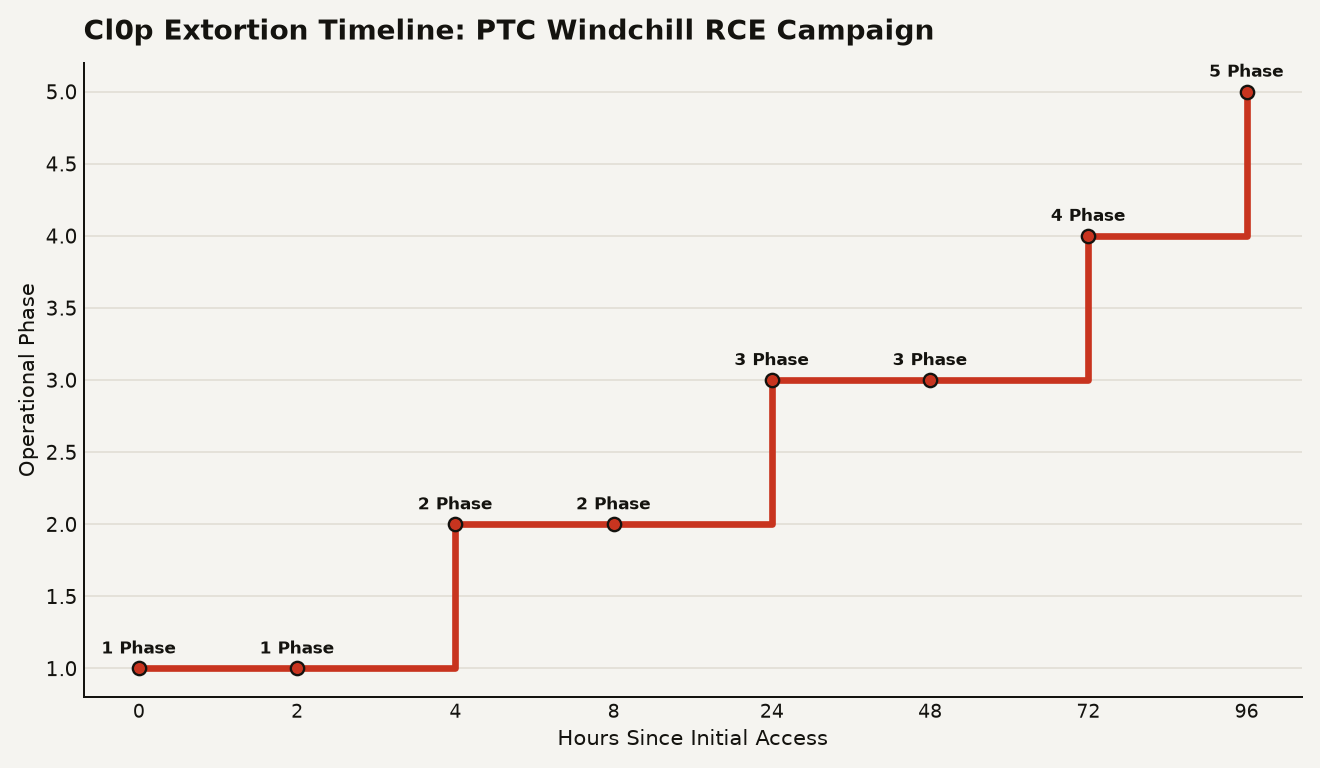
The chart above breaks down the attack path into its operational phases. The critical detail for defenders is the absence of a ransomware deployment phase. Cl0p, in this specific campaign, is acting as a data extortion operation. They steal sensitive files, intellectual property, and credentials, then threaten to publish the data if the victim does not pay. This mirrors their historical activity, notably the massive MOVEit transfer campaign in 2023. The attackers do not need to deploy encryptors across the network, which means your endpoint detection and response tools looking for mass file modification will not trigger until the data is already gone.
PTC Windchill is a product lifecycle management platform used heavily in manufacturing and engineering organizations to manage product data, parts, and documentation. FlexPLM is a related product, acquired by PTC, focused on retail and apparel product lifecycle management. Both systems often sit on the edge of corporate networks, sometimes exposed to the internet for supplier or partner collaboration, and they contain some of the most sensitive intellectual property a company holds. If an attacker steals this data, they do not just get customer records. They get blueprints, supplier contracts, and manufacturing processes.
Why does this Cl0p FlexPLM campaign matter for your infrastructure?
This campaign matters because the vulnerability chain bypasses standard authentication entirely. If your Windchill or FlexPLM instance is internet-facing, you are vulnerable to a complete server takeover. Attackers can inject web shells, pivot to internal databases, and dump credentials stored in configuration files.
The business stakes are high. PLM systems are the canonical source of truth for physical products. A breach here compromises the supply chain. Consider what an attacker gains:
- Intellectual property exposure: Product designs, engineering specifications, and manufacturing processes are exfiltrated and threatened with public release.
- Operational disruption: Even without encryption, the incident response and containment process can take critical PLM systems offline for days.
- Credential theft: Configuration files and connected databases often contain service accounts and database credentials that enable lateral movement.
The threat actor profile also raises the stakes. Cl0p operates with a high degree of operational sophistication. They are known for mass-exploiting single vulnerabilities across hundreds of organizations. If you are exposed, you are not facing a opportunistic scan-and-pray operation. You are facing a targeted campaign by a group that knows how to handle large volumes of stolen data.
This attack also highlights a broader pattern we have seen with edge appliances and exposed enterprise applications. We previously covered how Citrix Bleed 2 turned ransomware into identity theft, and the PTC Windchill situation follows a similar attacker logic: find an exposed, complex enterprise application, abuse a logic flaw to bypass authentication, and use the server-side access to quietly steal data.
What should you do right now about exposed PTC systems?
If you run PTC Windchill or FlexPLM, you need to move on this today. The threat is active and the attackers are already scanning for vulnerable instances.
Your immediate actions:
- Block external access immediately. If your Windchill or FlexPLM instances are exposed to the public internet, restrict access at the firewall or load balancer level right now. Expose these systems only through a VPN or a zero-trust access proxy. There is rarely a good reason for a PLM platform to be directly internet-accessible.
- Hunt for indicators of compromise. Review web server logs for anomalous requests to the FlexPLM WSDL endpoint and the Windchill login servlet. Look for unexpected POST requests, unusual parameter values, or requests from unfamiliar IP addresses. Check for the presence of unexpected web shells or JSP files in the web application root directories.
- Rotate credentials. If you find evidence of compromise, assume all local service accounts, database credentials, and API keys stored on the server are compromised. Rotate them immediately. Cl0p operators will mine the server for anything they can use to pivot deeper.
- Apply vendor patches. Check with PTC for available patches or mitigations for the information disclosure and login servlet flaws. If a patch is not yet available, implement WAF rules to block anomalous requests targeting the WSDL endpoint and login servlet.
Beyond the immediate response, this incident is a prompt to audit your entire external attack surface. Complex enterprise applications like PLM, ERP, and identity providers are frequent targets for exactly this kind of logic flaw exploitation. You should maintain an accurate inventory of what is exposed, why it is exposed, and whether that exposure is necessary.
The broader extortion playbook
Cl0p's shift to pure data extortion without encryption is a calculated business decision. Encryption campaigns are noisy. They trigger immediate incident response, backups are pulled, and law enforcement gets involved. Extortion is quieter. Attackers can operate undetected for weeks, staging data and negotiating with victims in the shadows. The victim only finds out when the extortion email arrives.
For builders and operators, this means your detection strategies need to shift. You cannot rely solely on file integrity monitoring to catch ransomware. You need to monitor for large outbound data transfers, unusual database access patterns, and unexpected administrative sessions on edge applications.
The kicker
Cl0p's campaign against PTC Windchill and FlexPLM is a reminder that the most dangerous vulnerabilities are not always in the code. They are in the deployment. An unauthenticated RCE on an internal PLM system is a problem. An unauthenticated RCE on an internet-exposed PLM system is a board-level incident.