Citrix NetScaler appliances are under active attack again, and the deadline to patch is this Saturday. CISA added CVE-2026-8452 to its Known Exploited Vulnerabilities catalog on Monday, ordering Federal Civilian Executive Branch agencies to secure affected systems by August 29 under Binding Operational Directive 26-04. The vulnerability is a memory overflow in NetScaler ADC and NetScaler Gateway appliances configured with Gateway VPN or AAA virtual servers. Citrix originally disclosed it in June as a denial-of-service risk. In August, security firm watchTowr demonstrated that the same flaw could be exploited for remote code execution as root on unpatched instances. Attackers are already using it in the wild. Kevin Beaumont reported that one of his honeypots was compromised with three web shells deployed. Shadowserver currently tracks over 22,000 NetScaler ADC appliances and nearly 1,800 Gateway instances exposed on the internet.
CVE-2026-8452 turned into RCE
Citrix first disclosed CVE-2026-8452 in a security bulletin in June 2026. At the time, the vendor described it as a memory overflow that "may lead to unpredictable behavior or denial of service" affecting NetScaler Gateway or AAA virtual servers. Citrix also stated it had not observed any exploitation of the vulnerability in unmitigated appliances.
That assessment changed in August. watchTowr published a technical analysis showing that the memory overflow could be weaponized for pre-authentication remote code execution, giving attackers root access to the appliance. The jump from DoS to RCE matters more than a typical severity re-rating. A denial-of-service condition takes a service offline temporarily. Root RCE gives an attacker full control of the appliance, its stored credentials, its configuration, and its position in your network as a trusted authentication gateway.
The vulnerability affects NetScaler ADC and Gateway appliances configured with Gateway VPN virtual servers, including VPN, ICA Proxy, CVPN, and RDP Proxy configurations, or AAA virtual servers. Administrators running on-premise appliances in these configurations need to act. Cloud-hosted NetScaler instances managed by Citrix are patched by the vendor directly.
Citrix has not yet updated its advisory to acknowledge the active exploitation that CISA, watchTowr, and independent researchers have all confirmed. This gap matters because organizations that rely on vendor advisories for risk decisions may still be operating under the June assessment that this is a DoS-only issue. If your change management process keys off vendor severity ratings, you may be underweighting the risk.
Shadowserver's exposure numbers
Shadowserver's scan data provides the most concrete picture of the attack surface. As of late August, the nonprofit tracks over 22,000 NetScaler ADC appliances and nearly 1,800 Gateway instances exposed on the public internet. Not all of these are necessarily vulnerable. Some may be running patched firmware, some may not have the required Gateway VPN or AAA configuration, and some may be honeypots. But the raw exposure number is large enough that any organization running an internet-facing NetScaler should assume they are in scope until they verify otherwise.
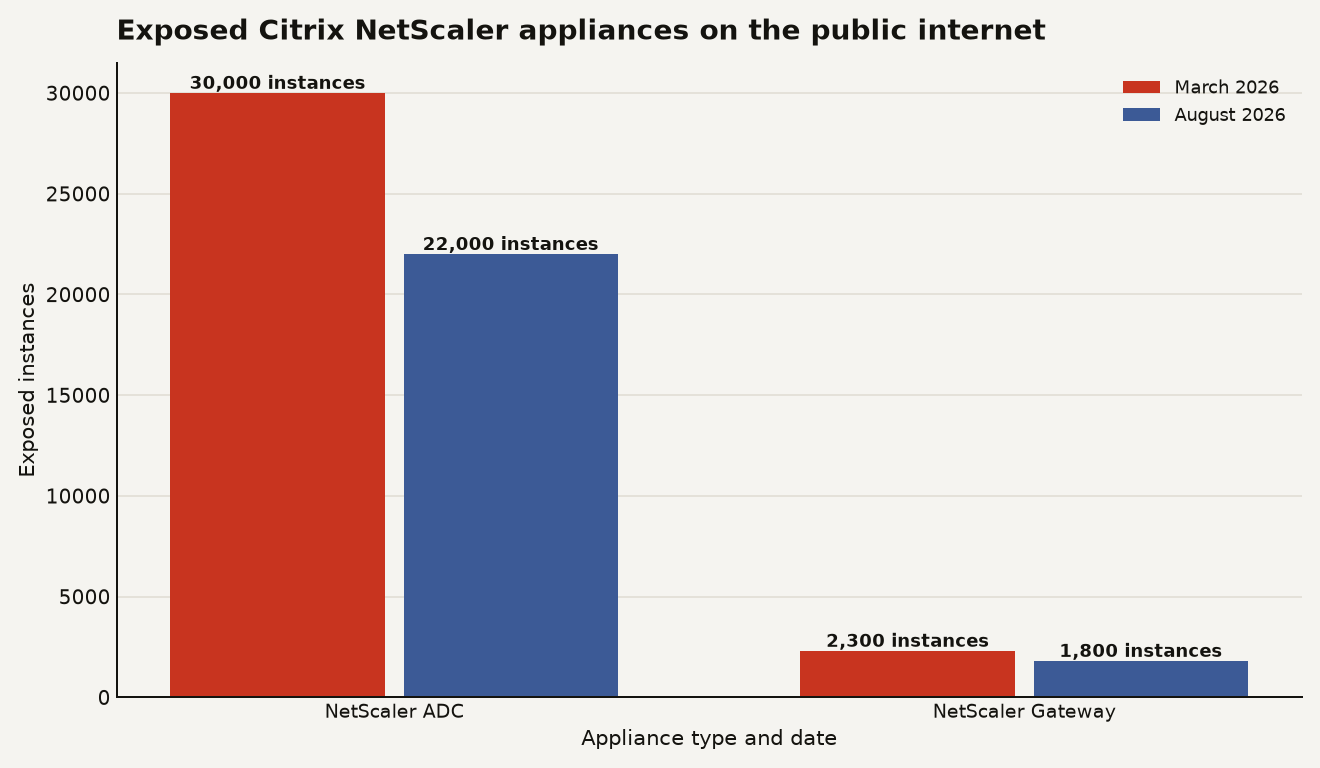
The exposure has actually decreased since March 2026, when Shadowserver tracked nearly 30,000 NetScaler ADC appliances and over 2,300 Gateway instances. That was around the time CVE-2026-3055, a separate memory overread vulnerability in NetScaler SAML identity provider configurations, was being actively exploited to steal administrative session IDs. Some organizations likely patched during that cycle. But roughly 22,000 ADC instances remain exposed five months later, which suggests a significant population of appliances that are either unmanaged, unmonitored, or running unsupported firmware.
The gap between March and August exposure numbers also tells you something about patching behavior in the NetScaler installed base. A drop from approximately 32,300 total exposed instances to approximately 23,800 over five months represents progress. It still leaves a population larger than many enterprise security teams would consider acceptable for edge authentication devices that have been repeatedly targeted by ransomware operators.
23 Citrix flaws in KEV since 2021
The pattern is hard to ignore. Since November 2021, CISA has flagged 23 Citrix vulnerabilities as exploited in the wild, and seven of those have been used by ransomware gangs. The CitrixBleed family of vulnerabilities alone has powered multiple breach campaigns against high-profile targets including Boeing and government organizations. In August 2025, CISA gave federal agencies a single day to patch CitrixBleed2. In March 2026, CVE-2026-3055 was exploited within days of Citrix releasing patches. Now CVE-2026-8452 is following the same trajectory, with the added twist that Citrix originally rated it as DoS-only before researchers proved RCE was possible.
A year earlier, in August 2025, Citrix fixed CVE-2025-7775, another critical memory overflow RCE in NetScaler that was actively exploited as a zero-day. The vendor confirmed exploitation at the time and said no mitigations were available. The same update also addressed CVE-2025-7776, a denial-of-service flaw, and CVE-2025-8424, an access control issue on the NetScaler management interface.
| CVE | Disclosed | Flaw type | Exploited? |
|---|---|---|---|
| CVE-2025-7775 | Aug 2025 | Memory overflow RCE | Yes, zero-day |
| CVE-2026-3055 | Mar 2026 | Memory overread | Yes, within days of patch |
| CVE-2026-8452 | Jun 2026 | Memory overflow to RCE | Yes, pray and spray |
| CVE-2026-19489 | Aug 2026 | Auth bypass | Not yet |
| CVE-2026-19490 | Aug 2026 | Denial of service | Not yet |
Several factors make NetScaler a recurring target. The appliances sit at the network edge, handling authentication and VPN access, which means a compromise gives attackers a trusted foothold inside the environment. They store session tokens, credentials, and configuration data. They are often managed by infrastructure teams rather than security teams, which can mean slower patch cycles. And Citrix has repeatedly downplayed initial severity assessments before researchers prove worse. CVE-2026-8452 went from "denial of service" in June to root RCE in August. CVE-2026-3055 was patched in March and exploited within days. The vendor's initial assessments have been wrong often enough that operators should treat them as a floor, not a ceiling.
One week before CISA's KEV addition for CVE-2026-8452, Citrix also urged admins to patch two other NetScaler vulnerabilities: CVE-2026-19490 and CVE-2026-19489, which allow remote unauthenticated attackers to cause denial of service or bypass authentication. Neither has been tagged as exploited in the wild yet, but given the pattern, that could change quickly.
Triage before the Saturday deadline
If you run NetScaler appliances, here is the triage:
- Identify every NetScaler ADC and Gateway instance in your environment, including ones managed by legacy teams or inherited through acquisitions. Shadowserver's numbers suggest thousands of exposed appliances that their owners may not realize are internet-facing.
- Check the configuration. CVE-2026-8452 only affects appliances configured with Gateway VPN or AAA virtual servers. If your appliance is not in one of those configurations, your exposure to this specific CVE is lower, but you should still patch given the other recent NetScaler flaws.
- Patch to the fixed builds immediately. Citrix has released fixed firmware versions. There are no mitigations available for the RCE path, so patching is the only option. If you cannot patch by Saturday, consider taking the appliance offline or restricting access from the internet.
- Review logs for signs of compromise. Look for unexpected web shell files, suspicious process execution, and anomalous authentication activity. Beaumont observed web shells named x.php, y.php, and z.php on compromised appliances. Check for these and any other unexpected PHP or script files in the appliance file system.
- Assume credential exposure. If an attacker achieved RCE on a NetScaler acting as a VPN gateway or AAA server, they may have extracted session tokens, user credentials, or configuration secrets. Rotate credentials and invalidate active sessions after patching.
- Check the CISA KEV catalog for the full list of NetScaler vulnerabilities that have been exploited. If you are running any appliance that has not been patched against prior KEV entries, treat it as potentially compromised. Edge gear on the KEV list deserves the same urgency as server-side criticals.
For organizations subject to BOD 26-04, the August 29 deadline is mandatory. For everyone else, the same exposure applies. CISA adds flaws to the KEV catalog when it confirms active exploitation, and the agency routinely urges private-sector defenders to treat KEV entries with the same urgency that federal agencies must.
The pattern is the problem
A single CVE gets patched and the news cycle moves on. But 23 exploited Citrix vulnerabilities since November 2021, seven tied to ransomware, tells you something about the attack surface that no single patch cycle will fix. NetScaler appliances are high-value targets that sit at the trust boundary of your network, and they have been proven exploitable again and again. If you treat each Citrix CVE as a one-off fire drill, you will keep running this same play every few months. The operators who sleep better are the ones who have already asked whether those appliances need to be internet-facing at all, whether the management plane is segmented, and whether the firmware lifecycle has an owner with a calendar reminder rather than a Slack channel.
Sources
- BleepingComputer - CISA orders feds to patch Citrix NetScaler RCE flaw by Saturday
- watchTowr Labs - Pre-auth RCE analysis for CVE-2026-8452
- Cyberplace Social - Kevin Beaumont on active exploitation and web shells
- BleepingComputer - Critical Citrix NetScaler memory flaw actively exploited (CVE-2026-3055)
- BleepingComputer - Citrix fixes critical NetScaler RCE flaw exploited in zero-day attacks (CVE-2025-7775)
- SecurityBuzz - CISA flags actively exploited Citrix NetScaler vulnerability
- CISA - Known Exploited Vulnerabilities Catalog