A crafted email lands in your Cisco Secure Email Gateway. Before it reaches a single inbox, the appliance parses it. That parsing step runs an SQL statement the attacker embedded in the message. The database executes it, the database runs as root, and now the attacker has a shell on your mail gateway with full privileges. No login required, no authentication, no user interaction beyond the appliance doing exactly what it was built to do: process incoming mail.
Bold standfirst: CVE-2026-76461 is a CVSS 9.8 SQL injection zero-day in Cisco Secure Email Gateway that grants root to anyone who can send you an email, and CISA gave federal operators three days to fix it.
Cisco disclosed the vulnerability on September 15, 2026, confirming that threat actors are already exploiting it in the wild. CISA added it to the Known Exploited Vulnerabilities catalog the day before, September 14, with a federal remediation deadline of September 17. If you run Cisco Secure Email Gateway on physical or virtual appliances in any configuration, you are on the clock.
What is CVE-2026-76461 and how does the exploit chain work?
The vulnerability sits in the email parsing logic of Cisco AsyncOS Software, the operating system that powers Secure Email Gateway appliances. Cisco's advisory describes it plainly: insufficient validation of email content lets an unauthenticated remote attacker inject malicious SQL statements inside a specially crafted email message. When the appliance processes that message, it executes the SQL against its internal database.
The SQL execution does not stop at data theft. It chains to operating system command execution with root privileges. That means the attacker gets a shell on the appliance itself, not just access to email metadata or queued messages. From there, they can read appliance configuration files, extract credentials and cryptographic material the gateway uses to talk to your mail servers and management infrastructure, install persistent backdoors, pivot into connected systems, and wipe local logs to cover their tracks.
The attack surface is the entire point of the product. Secure Email Gateway exists to sit on your network perimeter and inspect every message that arrives. Every email your organization receives passes through this parsing logic. An attacker does not need to phish a user, compromise a credential, or find a misconfigured port. They need to send mail to an address your gateway handles. That is the entire prerequisite.
The flaw affects physical and virtual Secure Email Gateway appliances in any configuration, across three AsyncOS release lines: 15.5 and earlier, 16.0, and 16.5. Secure Email and Web Manager and Secure Web Appliance are not impacted, which at least narrows the scope of your inventory sweep.
How widespread is the exposure?
Shadowserver currently tracks over 400 Cisco Secure Email Gateway appliances exposed to the internet. That number does not distinguish between patched and unpatched devices, and it does not filter out honeypots, so treat it as a ceiling on visibility rather than a count of vulnerable systems. But it tells you two things: the attack surface is small enough to inventory manually if you move today, and it is large enough that attackers have a meaningful pool of targets to scan and exploit.
This is the second Cisco Secure Email Gateway vulnerability to land on the CISA KEV list. The first, CVE-2025-20393, was a maximum severity AsyncOS flaw that China-linked threat actors began exploiting in November 2025 before Cisco patched it in January 2026. The fact that the same product line has now produced two KEV-listed zero-days in under a year should reframe how you think about its risk profile.
The broader pattern is worse. Since November 2021, CISA has flagged 98 Cisco vulnerabilities as actively exploited, including 7 abused by ransomware gangs. Just days before this disclosure, Cisco and CISA warned about attacks leveraging CVE-2026-20079 in Secure Firewall Management Center, a flaw that both Russian state-sponsored hackers and profit-driven criminals have used. You can read more about that FMC exploitation campaign in our Cisco FMC ransomware analysis. Cisco edge appliances are a recurring target, and the attackers range from intelligence services to ransomware crews.
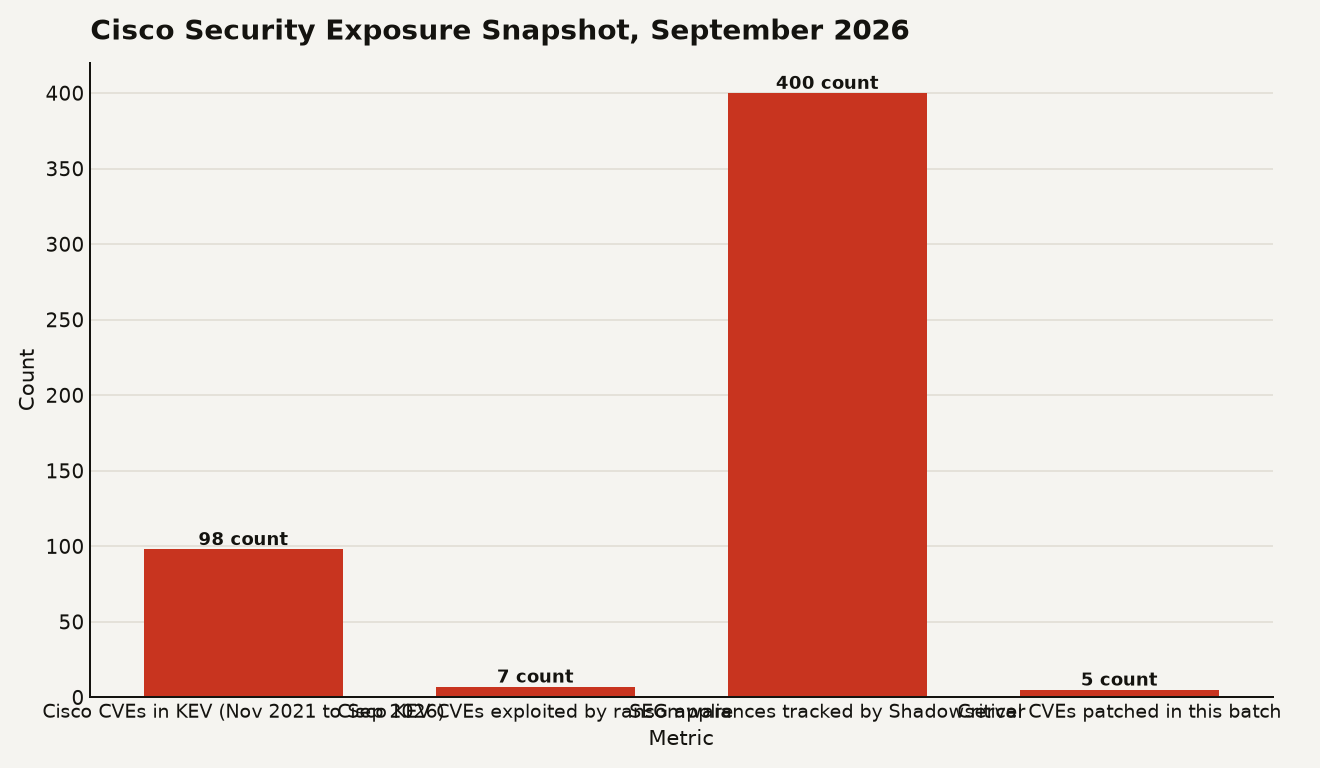
The chart above puts the exposure in context: 98 Cisco CVEs in KEV, 400 plus SEG appliances visible to scanners, and five critical flaws patched in this single advisory batch.
Why does a root shell on your mail gateway matter this much?
A compromised Secure Email Gateway is not a contained breach. It is a foothold in your most sensitive infrastructure. Consider what the appliance touches: it holds the credentials and certificates it uses to relay mail to and from your internal mail servers. It may have management connections to Secure Email and Web Manager clusters. It sits inside your DMZ with network paths to internal services. An attacker with root on the gateway can intercept or alter mail flow, steal credentials that unlock downstream systems, and use the appliance as a launchpad for lateral movement.
The logging problem compounds the severity. Cisco released indicators of compromise alongside the advisory and told administrators to inspect each cluster device's mail_logs for suspicious SQL statements. Finland's National Cyber Security Centre specifically flagged patterns resembling COPY.*TO PROGRAM in mail processing logs as an exploitation indicator. But Cisco also warned that attackers who obtain root privileges can remove or hide those IoCs. If the attacker got there first, the logs you are checking may already be clean.
That is why the standard patch, verify, and move on playbook is insufficient here. You need to patch, then assume compromise, then investigate accordingly.
Cisco acknowledged this directly. The company conducted remediation and recovery work for Secure Email Cloud devices where it identified possible compromise indicators and contacted affected customers individually. For on-premises appliances, you are on your own to determine whether exploitation happened before you patched.
What should you do right now?
The patch path is clear. Upgrade Cisco AsyncOS for Secure Email Gateway to the fixed release for your branch:
- 15.5 and earlier line: upgrade to 15.5.5-014
- 16.0 line: upgrade to 16.0.4-302
- 16.5 line: upgrade to 16.5.0-780
Cisco recommends migration to 16.5.0-780 where feasible. There is no workaround. If you cannot upgrade tonight, reduce exposure by limiting management access to trusted networks, separating mail processing and management interfaces where supported, disabling unnecessary services, and placing appliances behind filtering controls. These are stopgaps, not fixes.
After you patch, run a compromise check. Pull mail processing logs from every cluster member and search for anomalous SQL syntax, particularly the COPY.*TO PROGRAM pattern. Then cross-reference network and firewall logs for unexpected uploads, downloads, or connections to external IPs. Do not rely solely on appliance resident logs: a root level attacker can modify or delete those. Use externally retained network telemetry to corroborate.
If you suspect compromise of a virtual appliance, preserve forensic evidence, replace the appliance with a clean deployment running a fixed release, restore a validated configuration from a known good backup, and rotate every credential and piece of cryptographic material the appliance touched. That includes mail relay credentials, management interface credentials, TLS certificates, and any API keys or shared secrets configured on the gateway. For physical appliances with suspected compromise, contact Cisco TAC.
While you are in the advisory, patch the other four critical vulnerabilities Cisco disclosed in the same batch. CVE-2026-76440, CVE-2026-76441, CVE-2026-20353, and CVE-2026-76443 affect Secure Email Gateway and Secure Email and Web Manager appliances regardless of configuration. Cisco says it has no evidence these are being exploited yet. The word yet is doing heavy lifting there. If attackers are already sending crafted emails against the parsing bug, they are paying attention to this product line.
If your organization is subject to BOD 22-01 or follows CISA's KEV-driven patching guidance, the September 17 deadline is your outer bound. Everyone else should treat it the same way. Three days is not a suggestion when the exploit is a single email away.
What this means for your edge security posture
Cisco Secure Email Gateway is a perimeter appliance that must inspect untrusted input by design. That makes its parsing engine an inherent attack surface, and this is the second zero-day in under a year that weaponizes it. The lesson is not that Cisco builds bad products. The lesson is that any system whose core function is to parse untrusted data at the network edge will eventually have a parsing bug, and when that bug grants root, the blast radius is your entire mail infrastructure.
If you operate multiple Cisco edge appliances, SEG and FMC and whatever else, build a single inventory now. Know the appliance model, the AsyncOS or firmware version, the management interface exposure, and the last patch date for each one. When the next KEV entry drops, and it will, you should be able to identify every affected device in minutes, not hours. The teams that survive these windows are the ones who already know what they have and where it sits.