Anthropic released Claude Fable 5.1 on September 1, 2026, calling it their most advanced model for coding and long-running problem-solving. The headline number is a 52.6 percent score on a brand-new scientific research benchmark called Terminal-Bench-Science 0.1, more than double the 24.7 percent that the previous version, Fable 5, managed. For a beginner picking an AI model, the question is whether that benchmark jump matters for everyday coding or whether it is just a number for researchers to celebrate. The answer is that it does matter, but mostly if you are building complex software projects, and the new reasoning controls mean you need to learn how to dial the effort level or you will waste real money on simple tasks.
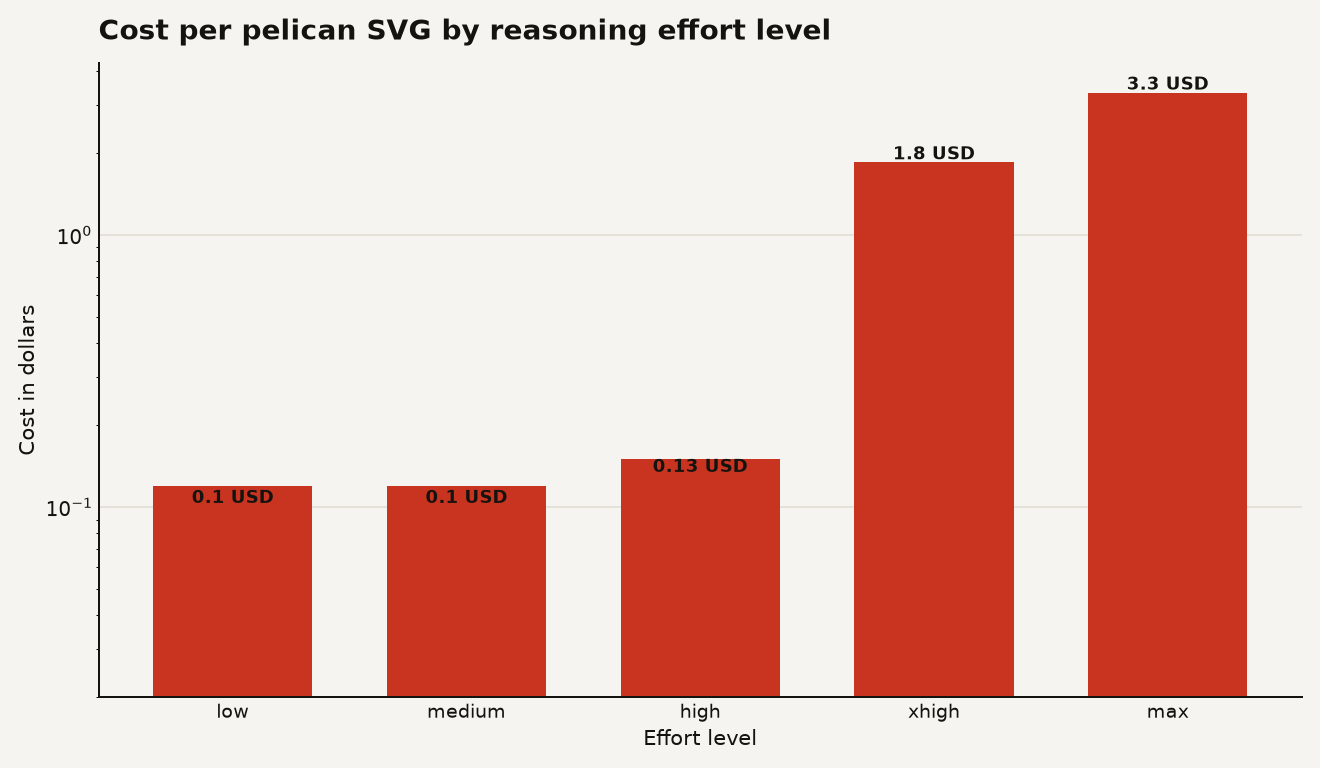
The effort level you pick changes the cost of a single response by 33 times.
Claude Fable 5.1 and the changes from Fable 5
Claude Fable 5.1 is the newest large language model from Anthropic, the company behind the Claude AI assistant. A large language model, or LLM, is a program trained on massive amounts of text that can generate human-quality writing and code. Think of it as a very advanced autocomplete that can reason through problems step by step.
Anthropic introduced Fable 5.1 and Mythos 5.1 together. Mythos 5.1 is a related model available only to a limited group of testers in a program called Project Glasswing, so for most readers Fable 5.1 is the one that matters.
The biggest change from Fable 5 is the performance on tasks that require the model to work through many steps on its own, something called agentic behavior. An AI agent is a model that does not just answer a single question but can take multiple actions, like reading a file, running code, checking the result, and then fixing errors, all without you guiding each step. Anthropic's published results show Fable 5.1 scoring 55.8 percent on Terminal-Bench 4.0, a test of agentic coding, up from 42.0 percent for Fable 5. It also scored 31.4 percent on AutomationBench, a business workflow test, nearly double the 17.1 percent of its predecessor.
Another change is cost. Anthropic says Fable 5.1 costs an estimated 25 percent less than Fable 5 at comparable effort levels, with cache reads (reusing previously processed information) at a quarter of the previous price. The model accepts up to 1 million tokens of input, which is roughly 750,000 words, and can generate up to 128,000 tokens of output. Its knowledge cutoff, meaning the date of the most recent data it was trained on, is June 2026.
52.6 percent on Terminal-Bench-Science
The benchmark getting all the attention is Terminal-Bench-Science 0.1. Anthropic announced it on August 27 as a test of whether a model can carry out real scientific research workflows. That means the model sits in a terminal environment (a text-based interface for running commands) with access to scientific tools and has to read papers, run computations, and draw conclusions across multiple steps.
Fable 5.1 scored 52.6 percent on this test. Fable 5 scored 24.7 percent. Claude Opus 5, the previous flagship model, scored 29.0 percent. GPT-5.6 Sol, a competing model from OpenAI, scored 22.4 percent. The jump from 24.7 to 52.6 in a single version is unusually large for an AI benchmark.
The important caveat is that this is a version 0.1 benchmark. That means the task set is young and the scores are likely to shift as the benchmark matures and more tasks are added. As one analysis noted, the standard error is plus or minus 3.5 to 4.5 percentage points per model, which means the exact ranking could wiggle. But the gap between Fable 5.1 and everything else is wide enough that the signal is real: this model is meaningfully better at multi-step research tasks.
For a beginner, the takeaway is that if you are doing simple tasks like asking a chatbot to summarize an article or write a short function, the science benchmark does not tell you much. If you are trying to build a tool that has the AI read documentation, write code, test it, and iterate on failures, the benchmark is relevant because it measures exactly that kind of multi-step work.
Reasoning levels and their price
This is where Claude Fable 5.1 gets interesting for anyone paying for API access. Reasoning, also called thinking or chain-of-thought, is when a model generates hidden text that walks through a problem before producing its final answer. Fable 5.1 has thinking turned on permanently. There is no option to disable it entirely, as the model documentation confirms.
Instead, you control the depth of thinking with five effort levels: low, medium, high, xhigh (extra high), and max. The default is high in Claude Code, which is Anthropic's terminal-based coding tool, and medium in Claude Cowork and on the Claude.ai website.
Simon Willison, a developer known for his thorough LLM testing, ran the same prompt at all five effort levels and published the results. The prompt was simple: generate an SVG (a type of vector image file) of a pelican riding a bicycle. The cost differences are staggering.
At low effort, the model produced about 2,000 output tokens, took 23.8 seconds, and cost 10.017 cents. At medium, it used 1,977 tokens, took 23 seconds, and cost 9.912 cents. At high, it produced 2,612 tokens, took 29.6 seconds, and cost 13.087 cents.
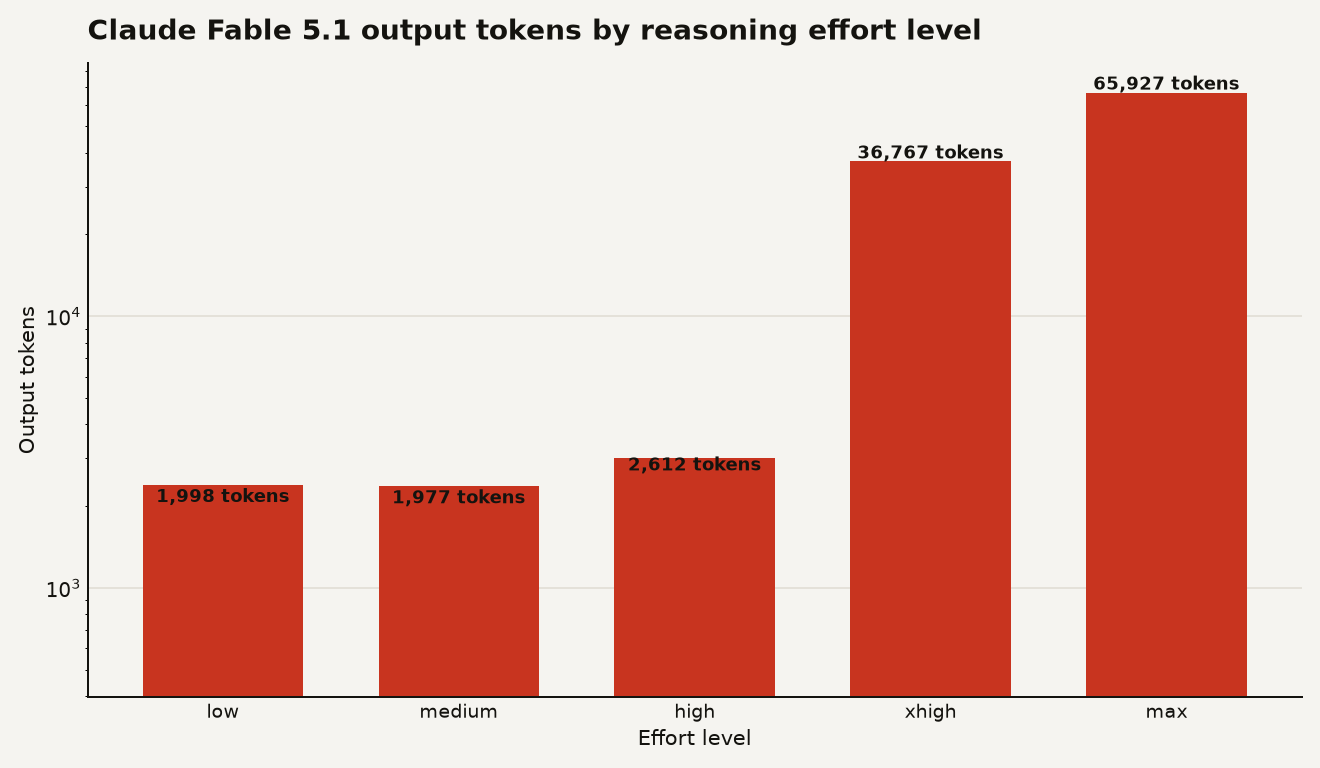
Then the jump. At xhigh, the model produced 36,767 output tokens, took 7 minutes and 51 seconds, and cost $1.83. At max, it produced 65,927 tokens, took 13 minutes and 54 seconds, and cost $3.30. That is 33 times the cost of the low effort level for the same prompt.
The quality difference between the effort levels is real. Willison wrote that the max effort pelican was the best he had seen from any Anthropic model, with a tasteful background, legs on either side of the frame, feet on the pedals, a wing on the handlebars, a blue hat, and a basket with a fish. The reasoning trace at max effort shows the model debating details like whether to add a bicycle helmet versus keeping the pelican's natural crest, adjusting coordinates to prevent the beak from overlapping the helmet, and checking vent line placements on the helmet to make sure they stay within its circular boundary.
But here is the strange part. At low and medium, the model appeared to skip reasoning entirely, producing no visible reasoning text and generating roughly the same token counts. The output quality was similar to high effort. This means for simple tasks, there may be a sweet spot at low or medium where you get most of the quality at a fraction of the cost.
Start with Sonnet unless you need Fable
The honest answer depends on what you are building. Anthropic's own model selection guide says to start with Claude Opus 5 for most workloads and use Fable 5.1 only for demanding reasoning and long-horizon agentic work. That is sound advice.
If you are a beginner using Claude.ai for casual questions, you will get Fable 5.1 automatically when the website routes you to it, and the default medium effort will keep costs predictable. You do not need to change anything.
If you are a beginner writing code with an AI assistant, the effort levels matter a lot. Here is a practical breakdown:
- Use low or medium effort for quick tasks: writing a single function, explaining an error message, generating a short config file. You will spend around 10 cents per response instead of dollars.
- Use high effort (the default in Claude Code) for normal coding sessions: writing a feature that spans a few files, debugging an issue that requires reading stack traces, refactoring a module.
- Reserve xhigh or max for genuinely hard problems: architecting a system from scratch, debugging a race condition across multiple services, or any task where the model needs to explore many approaches before settling on one. These levels cost $1.83 to $3.30 per response in Willison's test, so use them when a single good answer saves you hours of work.
The CursorBench 3.2.0 results, which measure performance in the Cursor code editor, show Fable 5.1 at 73.4 percent versus Opus 5 at 70.0 percent. That is a 3.4-point gap on a model that costs more. For everyday coding, the difference is marginal. If you are happy with your current model, there is no urgent reason to switch.
If you want a deeper look at how these models compare across every available option, our AI agent guide for 2026 breaks down which model to pick for different task types.
Terminal-Bench-Science will keep changing
The Terminal-Bench-Science 0.1 benchmark is new and will evolve. As more models are tested on it, expect scores to shift. A 52.6 percent score on a version 0.1 test is impressive, but it will not stay the gold standard forever.
The reasoning level behavior is the thing to monitor. Willison found that low and medium effort produced no visible reasoning traces, which raises a question: is the model reasoning silently, or is it genuinely skipping the thinking step? If it is skipping, that could affect quality on harder tasks in ways that the pelican prompt does not reveal. Watch for community testing on more complex prompts to see where the low and medium effort levels break down.
The cost curve is also worth tracking. At max effort, a single response cost $3.30. If you are building an application that calls the API in a loop, an agent that runs 50 iterations at max effort could cost $165 before you even check the results. Set spending limits in your Anthropic account dashboard before you start experimenting.
One more thing to watch: Anthropic released Fable 5.1 and Mythos 5.1 together, but Mythos is limited to Project Glasswing participants. If Mythos 5.1 eventually becomes widely available, it could change the picture again. For now, Fable 5.1 is the model you can actually use.
The effort dial is the feature
The benchmark scores will get the press coverage, but the effort dial is what will change your daily experience. A model that can think for 14 minutes and produce a masterful result is valuable. A model that costs you $3.30 when you needed a 10-cent answer is a problem. Learn the five levels, test them on your own prompts, and default to the cheapest one that does the job.
Sources
- Anthropic - Introducing Claude Fable 5.1 and Claude Mythos 5.1
- platform.claude.com - Claude Fable 5.1 model documentation
- simonwillison.net - Claude Fable 5.1 made me a really nice animated pelican
- apidog.com - Claude Fable 5.1 Benchmarks: What the Numbers Actually Say
- datasciencedojo.com - Claude Fable 5.1: Benchmarks, pricing, and safety changes