This is the full research report behind the video: every number, source, and chart the script was written from.
How a Supreme Court ruling turned Trump's trade war into a corporate windfall, and what it means for your wallet
Finance Research Team Date: August 4, 2026 Report No. 2026-08-04-AMZN-TARIFF
Executive summary
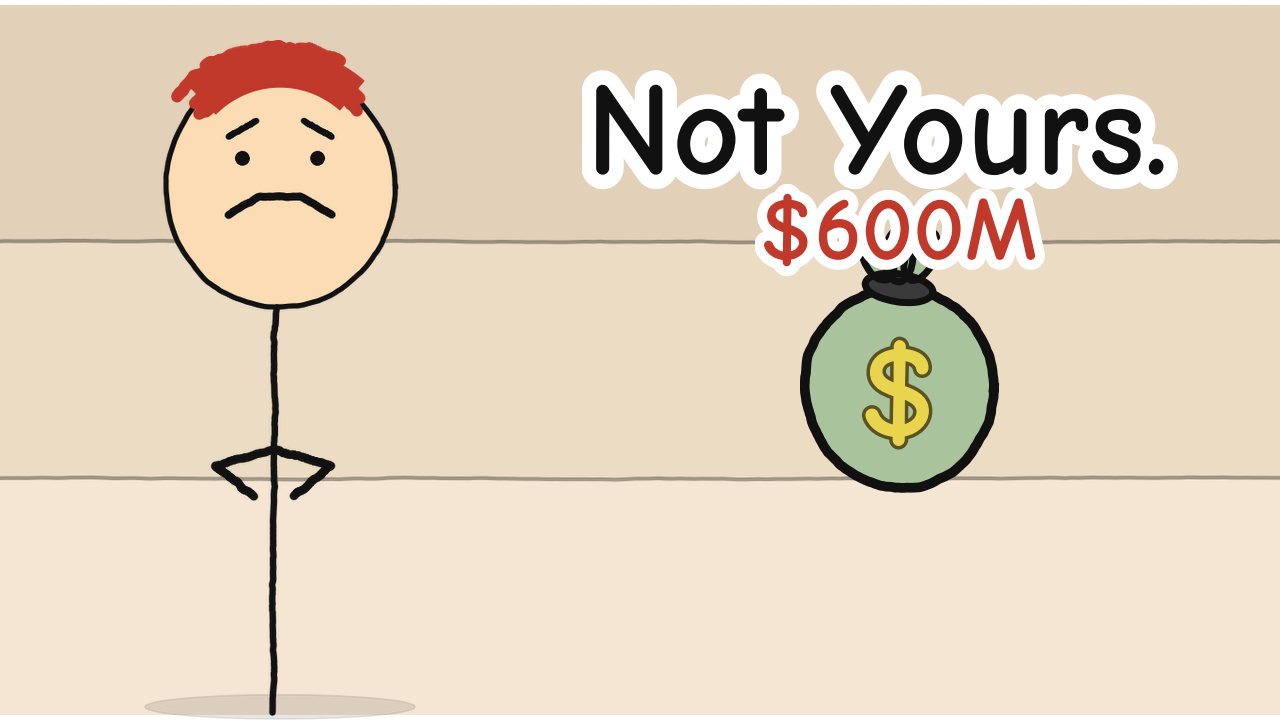
On July 30, 2026, Amazon's chief financial officer Brian Olsavsky told analysts on a Q2 earnings call that the company had received roughly $600 million in tariff refunds from the U.S. government. The money came back because the Supreme Court ruled 6-3 in February 2026 that President Donald Trump's sweeping import tariffs, imposed under the International Emergency Economic Powers Act (IEEPA), were illegal. The federal government is now returning more than $166 billion to over 301,000 importers who paid those duties. Amazon's $600 million slice is among the largest publicly disclosed payouts, alongside General Motors, which expects about $500 million.
Amazon says it will pass some of that money back to customers in "a limited set of circumstances" where it can trace specific import charges to specific purchases. Most customers, Olsavsky said, never saw separate tariff charges because Amazon "largely absorbed" the higher costs and stockpiled inventory before the tariffs hit. Walmart and Costco have made similar pledges to return refund money through lower prices. But an opinion piece published the same week noted that gadget prices are not dropping despite the refunds rolling in, and a consumer class-action lawsuit filed in June 2026 accused Amazon of pocketing tariff overcharges before the company announced its refund plan.
The story connects three threads: a president who used emergency powers to tax $175 billion worth of imports, a Supreme Court that said he could not do that, and a set of mega-corporations that collected the refunds and are now deciding how much, if any, to return to the people who actually paid higher prices at the checkout. The historical parallels run from the Gilded Age tariff machine of the 1890s to the Smoot-Hawley disaster of 1930, both of which share a core pattern with today: tariffs are paid by importers, absorbed into retail prices, and the benefits of any reversal flow first to the companies with the scale and legal firepower to claim them.
Key findings
- Amazon received approximately $600 million in IEEPA tariff refunds in Q2 2026, which Olsavsky called "the majority of refunds we expect to receive."
- The Supreme Court struck down Trump's IEEPA tariffs on February 20, 2026, in Learning Resources Inc. v. Trump, ruling 6-3 that the president exceeded his authority under the emergency powers statute.
- More than 301,000 U.S. importers paid $175 billion in tariff penalties between February and December 2025; the government is now processing over $166 billion in refunds.
- Amazon's stock rose 35.2% from the Supreme Court ruling through August 3, 2026, reaching a record $284.02 and a $3 trillion market cap, outpacing the S&P 500's return over the same period.
- Amazon was sued in a consumer class action in June 2026 for allegedly keeping tariff overcharges; the company's refund announcement came weeks later.
- The Trump administration has pivoted to new tariffs under Section 122 and Section 301 of the Trade Act, and 25 states sued on August 3, 2026, to block those as well.
Chapter 1: What this means for your wallet
If you bought anything imported from Amazon, Walmart, or Costco between February 2025 and early 2026, you probably paid more than you should have. That is not a vague feeling. It is a documented fact. The Trump administration slapped tariffs of 10% to 25% on goods from dozens of countries using a law called the International Emergency Economic Powers Act, or IEEPA (pronounced "eye-EE-pa"). That law lets the president block financial transactions during national emergencies. It does not let the president impose taxes on imports. The Supreme Court said so on February 20, 2026, in a 6-3 ruling. The tariffs were illegal. The money collected from them, $175 billion from more than 301,000 importers, is now being returned.
Here is the part that should make you sit up. The companies that paid those tariffs, Amazon chief among them, built the cost into the prices you paid. A phone case that cost $12 in January 2025 might have cost $14 by April. A blender, a set of wrenches, a kid's toy, a USB cable. The tariff was levied on the importer, but the importer passed it along to you. Now the government is giving the money back to the importers. Amazon got $600 million. GM expects $500 million. Walmart and Costco have not disclosed their amounts but have said they will use refunds to lower prices.
The question is whether any of that money makes it back to you.
Amazon says it will. On the Q2 earnings call on July 30, CFO Brian Olsavsky said the company identified "a limited set of circumstances where we can trace that we pass specific import charges onto customers." In those cases, Amazon will "proactively contact affected customers and automatically issue refunds to them." No need to fill out a form. No need to call customer service. The money would just show up.
But here is the catch. Olsavsky also said most Amazon customers never paid separate import charges. Amazon "largely absorbed" the higher costs, he said, and the company stockpiled inventory before the tariffs took effect so it could keep selling at pre-tariff prices for a while. That means Amazon ate some of the tariff cost itself, and now it is getting that money back from the government. If Amazon absorbed the cost rather than passing it to you, the refund belongs to Amazon, not to you. That is the company's position, and it is probably correct for the majority of the $600 million.
The gap between what companies paid, what they passed on, and what they are returning is where the anger lives. An opinion piece published on August 4, 2026, carried the headline "The Tariff Refunds Are Rolling in, but Gadget Prices Aren't Dropping." A consumer class-action lawsuit filed in June 2026, before Amazon announced its refund plan, accused the company of keeping tariff overcharges. Bernstein analyst Zhihan Ma told Barron's that consumers should not expect big checks in the mail. Companies will pay some refund money to suppliers, she said, and Walmart and Costco would most likely "pass on value to their customers/members" through lower prices rather than direct payments.
So what should you actually watch for? If you bought something on Amazon that had an explicit import charge or tariff surcharge listed on your receipt, you may get an automatic refund. Amazon has not said how much, when, or to whom. If you never saw a separate charge, you probably will not get money back directly. Your benefit, if any, will come in the form of slightly lower prices over time as retailers cycle through their refund money. That is thin gruel compared to the $600 million Amazon is booking as a recovery.
The bigger picture is this. Tariffs are taxes on imported goods. The importer pays the government, but the cost flows through the supply chain to the retail price. When the tariff is reversed, the refund flows back to the importer. Whether it flows all the way back to the consumer depends on the company's margins, its competitive pressure, and whether it can trace the specific charge to your specific purchase. Amazon, with its vast data infrastructure, is better positioned than almost anyone to do that tracing. But "better positioned" does not mean "willing." The $600 million is sitting on Amazon's balance sheet right now. How much of it leaves is a business decision, not a legal obligation.
Chapter 2: Tariffs, kickbacks, and crashes: a short history of America taxing imports
The fight over who pays tariffs and who profits from them is older than the income tax. For most of the 19th century, tariffs were the federal government's main source of revenue. That fact alone made the tariff schedule a magnet for corruption. If you were a steel baron or a sugar refiner in the 1880s, getting your product's tariff rate raised by a few percentage points was worth millions in protected profits. You hired lobbyists. You donated to campaigns. You offered railroad stock to friendly congressmen. The tariff schedule was, in effect, a menu of legal kickbacks, and the Gilded Age political machine ate from it daily.
The McKinley Tariff of 1890 was the high-water mark of this system. Named after Representative William McKinley of Ohio, who would become president seven years later, it raised average import duties to nearly 50%. The bill was negotiated line by line, with each Republican congressman trading votes to protect the industries in his district. Wool growers got higher rates on imported wool. Tinplate producers got a tariff on imported tin. Sugar refiners got a deal that protected their margins. The public, meanwhile, paid higher prices for everyday goods. The political backlash was swift. In the 1890 midterm elections, Republicans lost 78 seats in the House, and McKinley himself lost his own race. The tariff was so unpopular that Democrats campaigned against it for the next four years and won the presidency in 1892 with Grover Cleveland.
But the protectionist instinct did not die. In 1897, the Dingley Tariff pushed rates even higher, to an average of about 57% on dutiable imports. It was the highest peacetime tariff in American history up to that point. The logic was the same as always: protect domestic industry, raise government revenue, and let consumers foot the bill. The system persisted because the beneficiaries were concentrated and politically organized, while the costs were spread across millions of shoppers who each paid a few extra cents per purchase and had no idea why.
That same logic, concentrated benefits and diffuse costs, is what makes tariff refunds in 2026 feel so galling. The $175 billion collected under Trump's IEEPA tariffs was paid by importers, but the cost was embedded in retail prices across the economy. Now the refunds are flowing back to the importers. The consumers who paid higher prices are not getting a proportional check. The structure of the harm and the structure of the remedy do not match.
The second historical parallel is the Smoot-Hawley Tariff Act of 1930, which is the most famous tariff disaster in American history. Signed by President Herbert Hoover on June 17, 1930, it raised tariffs on more than 20,000 imported goods. Hoover signed it against the advice of more than 1,028 economists who petitioned him to veto the bill. Henry Ford called it "an economic stupidity." Thomas Lamont, the chief executive of J.P. Morgan, said he "almost went down on [his] knees to beg Herbert Hoover to veto the asinine Hawley-Smoot tariff." Hoover signed it anyway, yielding to pressure from his party and business leaders.
The retaliation was immediate. Canada imposed new tariffs on 16 products that accounted for roughly 30% of U.S. exports to its largest trading partner. France, Italy, Spain, Argentina, Australia, and others followed. American exports to countries that retaliated fell by 31%. U.S. imports dropped 66% from $4.4 billion in 1929 to $1.5 billion in 1933. Exports fell 61% from $5.4 billion to $2.1 billion. World trade shrank by about 66% between 1929 and 1934. Unemployment, which was 8% when the bill passed, hit 25% by 1932.
Economists still argue about how much of the Great Depression Smoot-Hawley caused versus how much it merely worsened. The Depression was already underway after the stock market crash of October 1929, driven by financial instability and banking failures. Milton Friedman and other monetarists considered Smoot-Hawley a minor factor compared to the collapse of the money supply. But the consensus is that it deepened the crisis by shrinking global trade and triggering retaliation that closed foreign markets to American exports. The lesson that stuck was not subtle: when you tax imports, your trading partners tax your exports, and everyone ends up poorer.
What carries over to today? Three things. First, tariffs are always sold as protecting domestic industry and always end up costing consumers more than the protected industries gain. Second, the political backlash comes when consumers notice the prices, not when the tariffs are imposed. McKinley lost his seat. Hoover lost the presidency in a landslide. Third, the legal reversal of a tariff does not automatically reverse the price increases it caused. The Smoot-Hawley rates were reduced by the Reciprocal Trade Agreements Act of 1934, but prices did not snap back to 1929 levels. The damage was done. Today's IEEPA tariffs were struck down in February 2026, but the prices you paid in 2025 are gone. The refund goes to the importer. Whether it reaches you is a separate question, and history suggests the answer is usually no.
Chapter 3: How Trump's IEEPA tariffs happened, and how the Supreme Court killed them
The story begins on February 1, 2025. President Trump, back in office less than two weeks after his inauguration for a second term, signed an executive order imposing sweeping tariffs on imports from dozens of countries. The legal basis was the International Emergency Economic Powers Act, a 1977 law passed in the wake of the Watergate scandal to rein in presidential power. IEEPA lets the president regulate international commerce after declaring a national emergency with respect to an "unusual and extraordinary threat" to national security, foreign policy, or the economy. It was designed for situations like freezing terrorist assets or blocking trade with hostile nations. It had never been used to impose broad tariffs on goods from allied and adversarial nations alike.
From February through April 2025, the administration rolled out tariff after tariff. Some were country-specific, targeting China, Mexico, Canada, and the European Union. Others were "reciprocal" tariffs, matching the rates other countries charged on American goods. The rates ranged from 10% to 25% and applied to a vast swath of consumer goods, industrial components, and agricultural products. By mid-December 2025, more than 301,000 U.S. importers had paid $175 billion to the Treasury in tariff penalties, according to data cited by CNET. The money flowed in fast. The Treasury's revenue from customs duties in 2025 was the highest in modern American history, measured as a share of GDP.
The legal challenge came from an unlikely source. Learning Resources Inc. is a family-owned toy company based in Vernon Hills, Illinois. The company makes educational toys and learning materials, many of them imported. Stephen Woldenberg, whose family founded the company, decided to challenge the tariffs in court. According to reporting from the Associated Press, Woldenberg said his decision was rooted in a moral obligation shaped by his family's Jewish values. The company argued that IEEPA did not give the president authority to impose tariffs, that the "emergency" declaration was a pretext, and that the tariffs violated the Constitution's separation of powers by letting the executive branch legislate tax rates that Congress alone has the power to set.
The Supreme Court agreed. On February 20, 2026, the Court ruled 6-3 in Learning Resources Inc. v. Trump that the IEEPA tariff program was illegal. The majority held that the statute, which authorizes the president to "regulate" international commerce during a declared emergency, does not extend to imposing taxes on imports. Tariffs are a form of taxation, the Court reasoned, and the power to lay taxes is vested in Congress under Article I of the Constitution. The president cannot convert an emergency economic powers statute into a general tariff authority by declaring an emergency and then using the statute to set import duty rates on goods from most of the world's countries.
The ruling was sweeping. It invalidated not just one tariff but the entire IEEPA-based tariff program. The government was ordered to stop collecting the duties and to begin refunding the money already paid. The scale of the refund operation is enormous. Over $166 billion in tariff refunds are being processed, according to legal analysis published by JD Supra. The Court of International Trade, which handles customs and trade cases, is managing the refund process. Importers who paid the tariffs are filing claims, and the government is returning the money.
The Trump administration did not take the ruling lying down. Within weeks, it pivoted to new legal theories for imposing tariffs. According to reporting from multiple outlets, the administration imposed new 10% to 12.5% levies on 60 economies, using different statutory authorities. Trump also imposed 15% tariffs under Section 122 of the Trade Act of 1974, which allows temporary import surcharges to address balance-of-payments crises. The administration has also turned to Section 301 of the Trade Act, the same provision used during Trump's first term to impose tariffs on Chinese goods, to launch new tariff investigations.
The legal fight is not over. On August 3, 2026, the Associated Press reported that 25 states sued the Trump administration over its latest tariffs, calling them a "pretext" to replace the IEEPA tariffs the Supreme Court had struck down. Two lawsuits filed in the U.S. Court of International Trade argue that the government unlawfully used Section 301 to impose the new duties. An opinion piece in the New York Post on July 25, 2026, argued that the new Section 301 tariffs are "based on sham investigations" and violate the major questions doctrine and the nondelegation doctrine, the same legal theories that drove the Learning Resources decision.
The pattern is clear. The administration finds a statute, stretches it to cover tariffs, imposes the duties, collects the money, and then scrambles to find a new statute when the courts strike it down. The importers pay, the consumers pay more, and the legal whack-a-mole continues. Amazon's $600 million refund is a direct product of this cycle. The company paid the tariffs under the IEEPA program, the Supreme Court killed the program, and the Treasury returned the money. Now Amazon is deciding what to do with it.
Chapter 4: Who got the money: Amazon, Walmart, GM, and the refund scramble
The $166 billion in tariff refunds is not going to small businesses first. It is going to the companies with the scale, the legal teams, and the customs infrastructure to file claims quickly and accurately. Amazon's $600 million is the largest publicly disclosed refund so far, but it is not alone. General Motors expects about $500 million. Walmart and Costco have not disclosed specific figures but have confirmed they are receiving refunds and plan to pass some benefit to customers. UPS, FedEx, and DHL, which pay tariffs on imported packages and logistics equipment, told reporters they would pass refunds through to their shipping customers.
The refund process works like this. When an importer pays a tariff, the payment goes to U.S. Customs and Border Protection, a division of the Treasury Department. The importer's customs broker files the entry documents and pays the duty. If the tariff is later struck down by a court, the importer can file a protest under 19 U.S.C. section 1514, challenging the legality of the duty collection. If the protest is denied, the importer can sue in the Court of International Trade. In the case of the IEEPA tariffs, the Supreme Court's ruling in Learning Resources effectively established that all duties collected under the program were unlawful, so the refund process is being streamlined rather than fought case by case.
Amazon's $600 million came in during the second quarter of 2026, which ended June 30. Olsavsky said on the earnings call that this represented "the majority of refunds we expect to receive." That phrasing matters. It means Amazon does not expect another $600 million in future quarters. The $600 million is roughly the total of what Amazon paid in IEEPA tariffs, minus whatever portion was already refunded or offset. It is a one-time recovery, not a recurring revenue stream.
The question of who else got money, and how much, is harder to answer because most companies have not disclosed their refund amounts. Public companies are required to disclose material events in their SEC filings, but "material" depends on the company's size. For Amazon, with $775 billion in trailing 12-month revenue, $600 million is less than 0.1% of revenue. It is material enough to mention on an earnings call but not large enough to move the stock on its own. For a mid-size importer with $1 billion in annual revenue, a $50 million refund would be far more significant.
The companies that have disclosed their plans for the money fall into three camps. Amazon says it will automatically refund customers in "a limited set of circumstances" where it can trace specific import charges to specific purchases. Walmart says it will use refunds to lower product prices across its stores. Costco says it will compensate customers "in some form," perhaps not necessarily with direct payments. Bernstein analyst Zhihan Ma told Barron's that companies will also pay some refund money to their suppliers, who bore part of the tariff cost through negotiated price reductions. The refund money does not flow cleanly back to consumers. It flows back to the companies, which then decide how to split it among shareholders, suppliers, and customers.
That decision is where the politics gets ugly. Amazon's CEO Andy Jassy conceded in January 2026 that tariffs were hitting prices, months before the $600 million refund came to light. A lawsuit filed in June 2026, before the refund announcement, accused Amazon of "favoring Trump" by keeping tariff overcharges rather than passing them back to consumers. The lawsuit was filed as a consumer class action, seeking refunds for shoppers who paid higher prices because of the IEEPA tariffs. Amazon's July 30 announcement that it would issue automatic refunds to some customers may have been partly a response to the legal pressure, though the company has not acknowledged any connection.
The optics are uncomfortable. Amazon, a company with a $3 trillion market cap, is booking a $600 million recovery from the government while telling customers that most of them will not see a dime because Amazon "absorbed" the costs. The company's profit margin in its North American retail segment is thin, around 3% to 5%, so $600 million is real money for the retail business even if it is a rounding error for the company as a whole. The refund boosts Amazon's reported earnings for Q2 2026, which already beat analyst expectations thanks to strong AWS growth. Amazon's stock jumped 4.58% on August 1, 2026, the first trading day after the earnings call, closing at a record $284.02 and pushing the company's market cap above $3 trillion for the first time.
The refund scramble is not over. The government is still processing claims. Companies that have not yet filed are racing against deadlines. And the Trump administration's new tariffs, imposed under different legal authorities, are generating a fresh round of payments that may eventually need to be refunded if those tariffs are also struck down. The cycle continues.
Chapter 5: The numbers behind Amazon's $600 million
To understand what $600 million means for Amazon, you need to see it in context. Amazon's trailing 12-month revenue as of June 2026 was $775.68 billion. Its net income was $135.28 billion. Its market capitalization crossed $3 trillion on August 3, 2026. Against those numbers, $600 million is small. It is 0.077% of revenue. It is 0.44% of net income. It is 0.02% of market cap. If you are an Amazon shareholder, the tariff refund is a nice surprise but not a game-changer.
But if you narrow the lens to Amazon's retail business, the picture shifts. Amazon does not break out the profitability of its first-party retail operation separately, but the North America segment, which includes retail and advertising, reported an operating margin of roughly 5% in recent quarters. The $600 million refund, if it flows through to operating income, represents a meaningful bump for a segment that operates on thin margins. It is the kind of number that can make a quarterly earnings beat look more impressive than the underlying business performance would suggest.
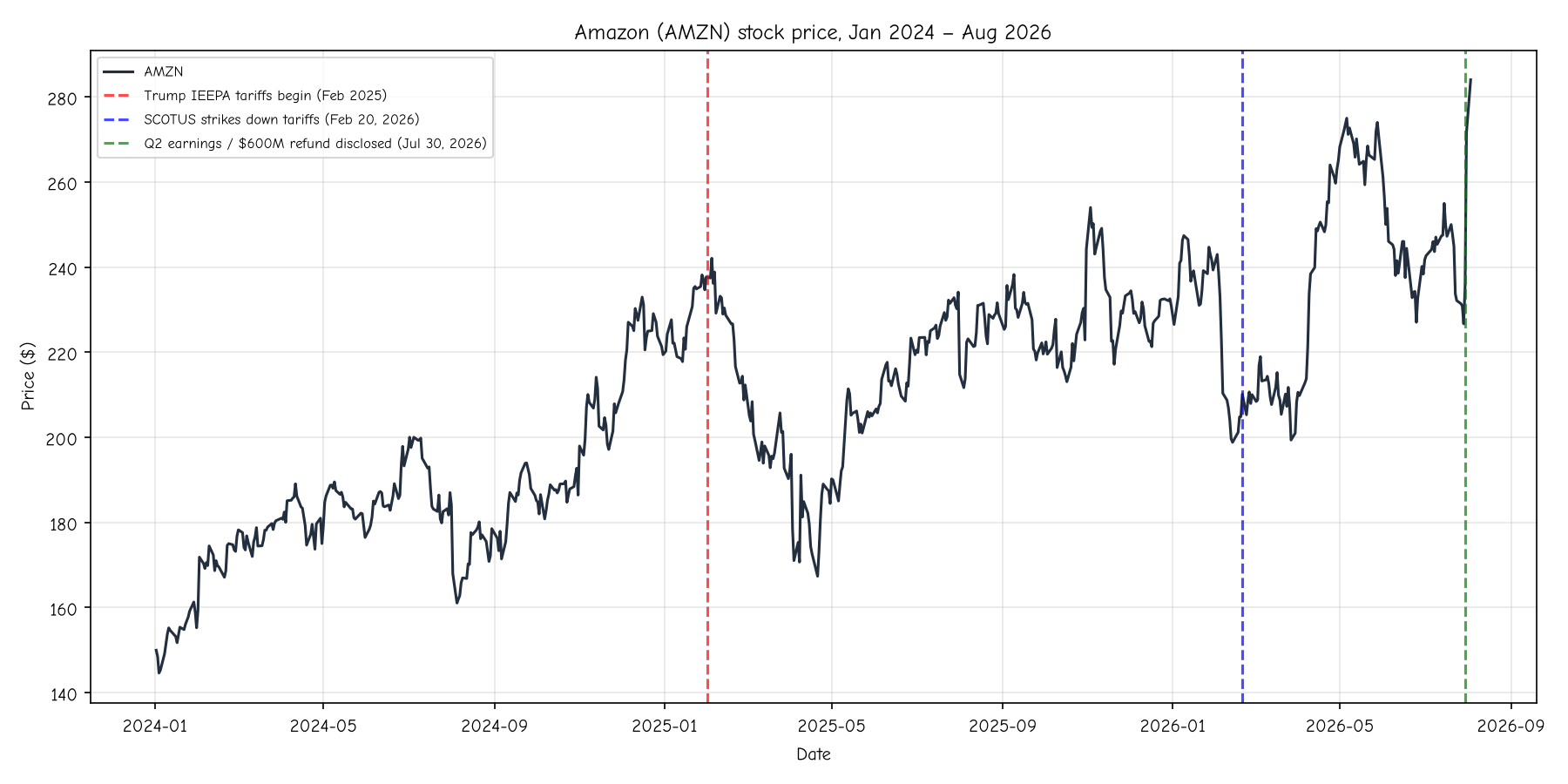
The stock chart tells the story. Amazon's shares traded at $149.93 on January 2, 2024. By the time Trump's IEEPA tariffs began in February 2025, the stock had risen to roughly $220. The tariff period, from February 2025 through February 2026, was volatile. The stock dipped, recovered, and then surged after the Supreme Court ruling on February 20, 2026. From that date through August 3, 2026, Amazon returned 35.2%, rising from $210.11 to $284.02. The S&P 500 returned roughly 20% over the same period. Amazon outperformed.
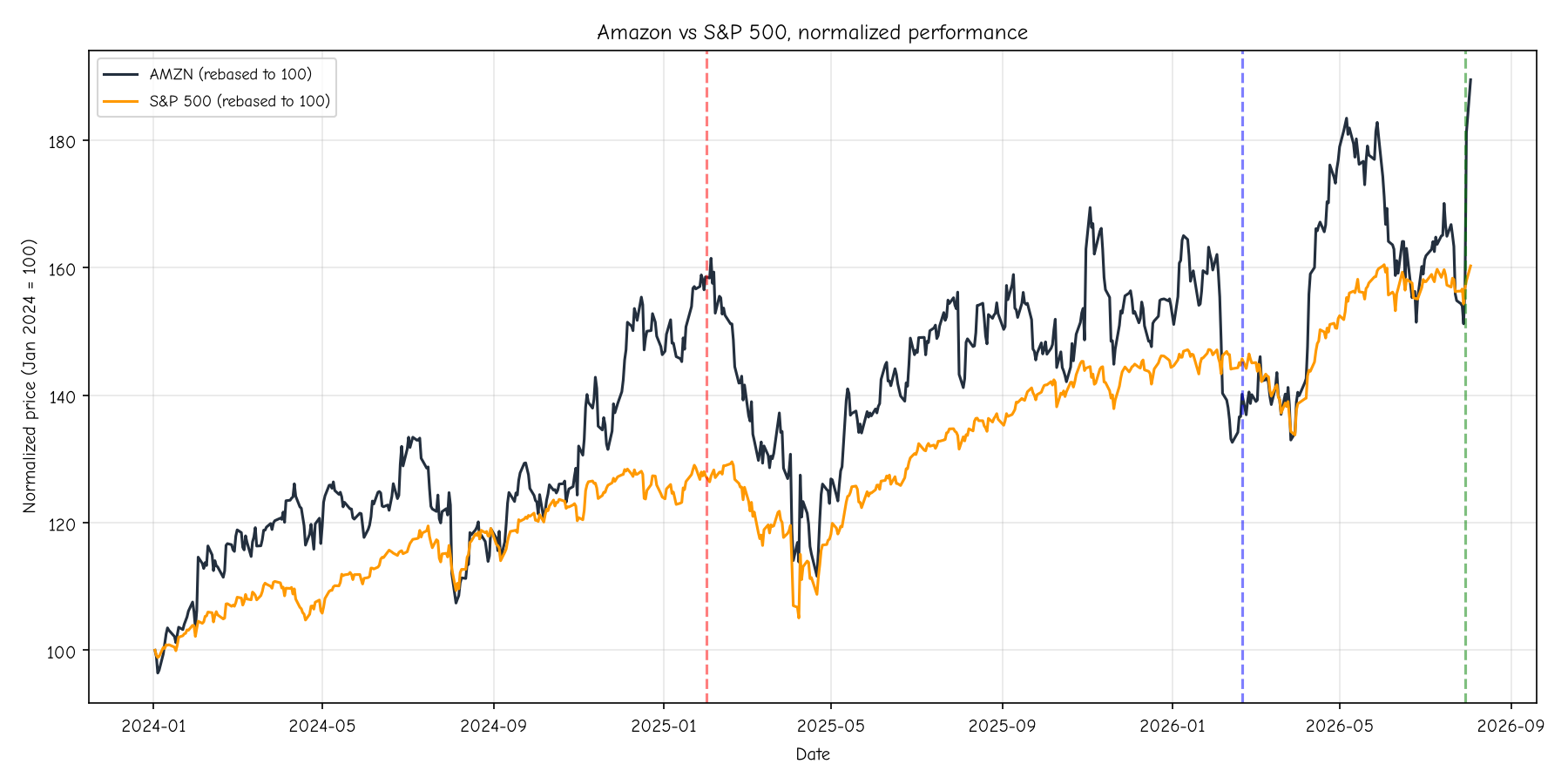
The outperformance is not solely about the tariff refund. Amazon's Q2 2026 earnings were strong across the board. AWS revenue growth accelerated, driven by AI-related demand. Advertising revenue grew at a double-digit rate. The company's guidance for Q3 was above consensus. The $600 million refund was a footnote in a earnings report that was dominated by AI and cloud computing. But it was a footnote that added to the positive tone.
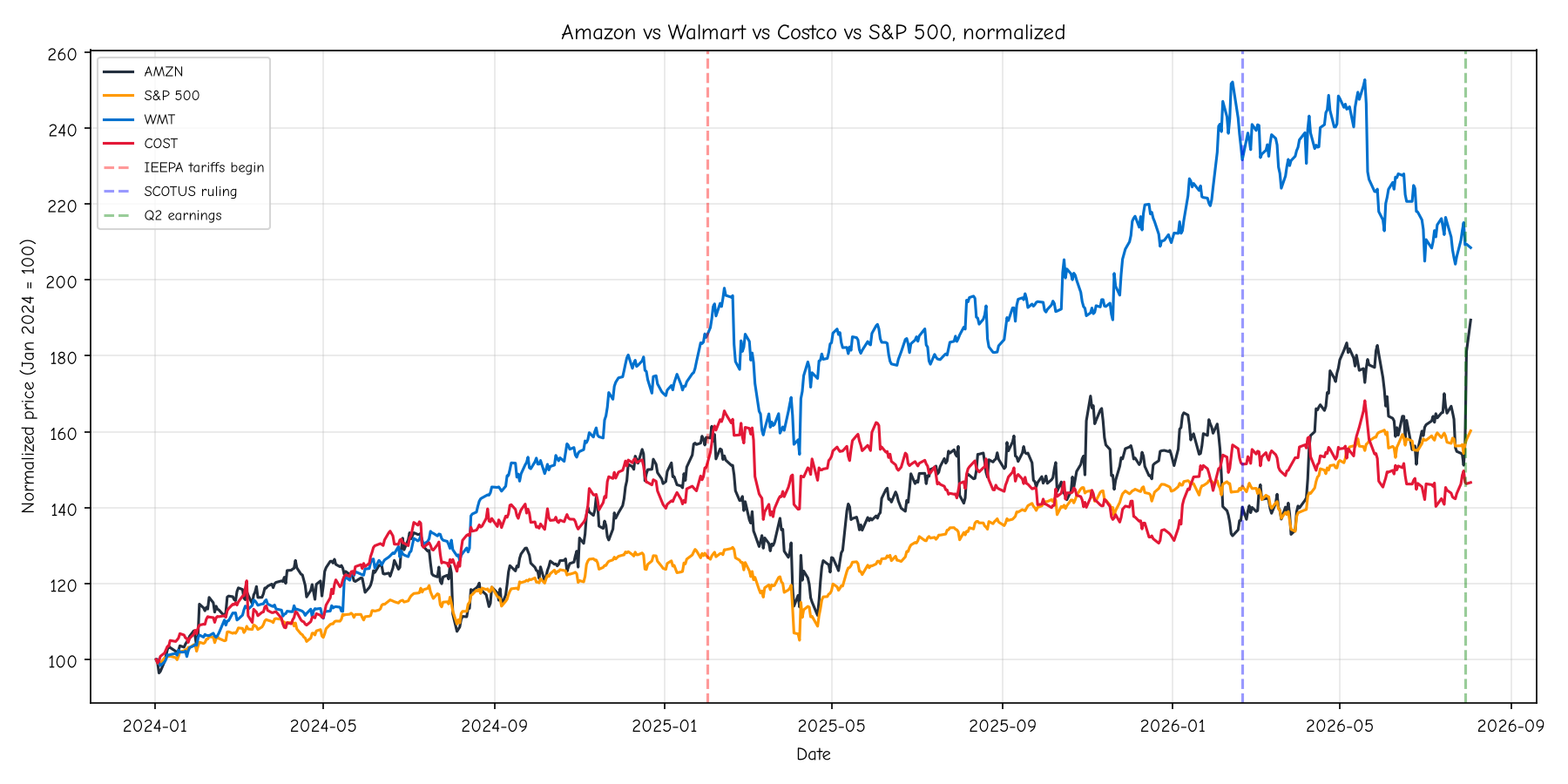
Comparing Amazon to its retail peers tells a different story. Walmart and Costco also faced tariff costs, and both have said they will pass refunds to customers. But their stock performance has been less dramatic. From January 2024 through August 3, 2026, Walmart returned roughly 30% and Costco roughly 45%, while Amazon returned 89.4%. The gap reflects Amazon's AWS and advertising businesses, which are not exposed to tariffs in the same way as physical retail. The tariff refund is a retail story, but Amazon's stock is increasingly an AWS story.
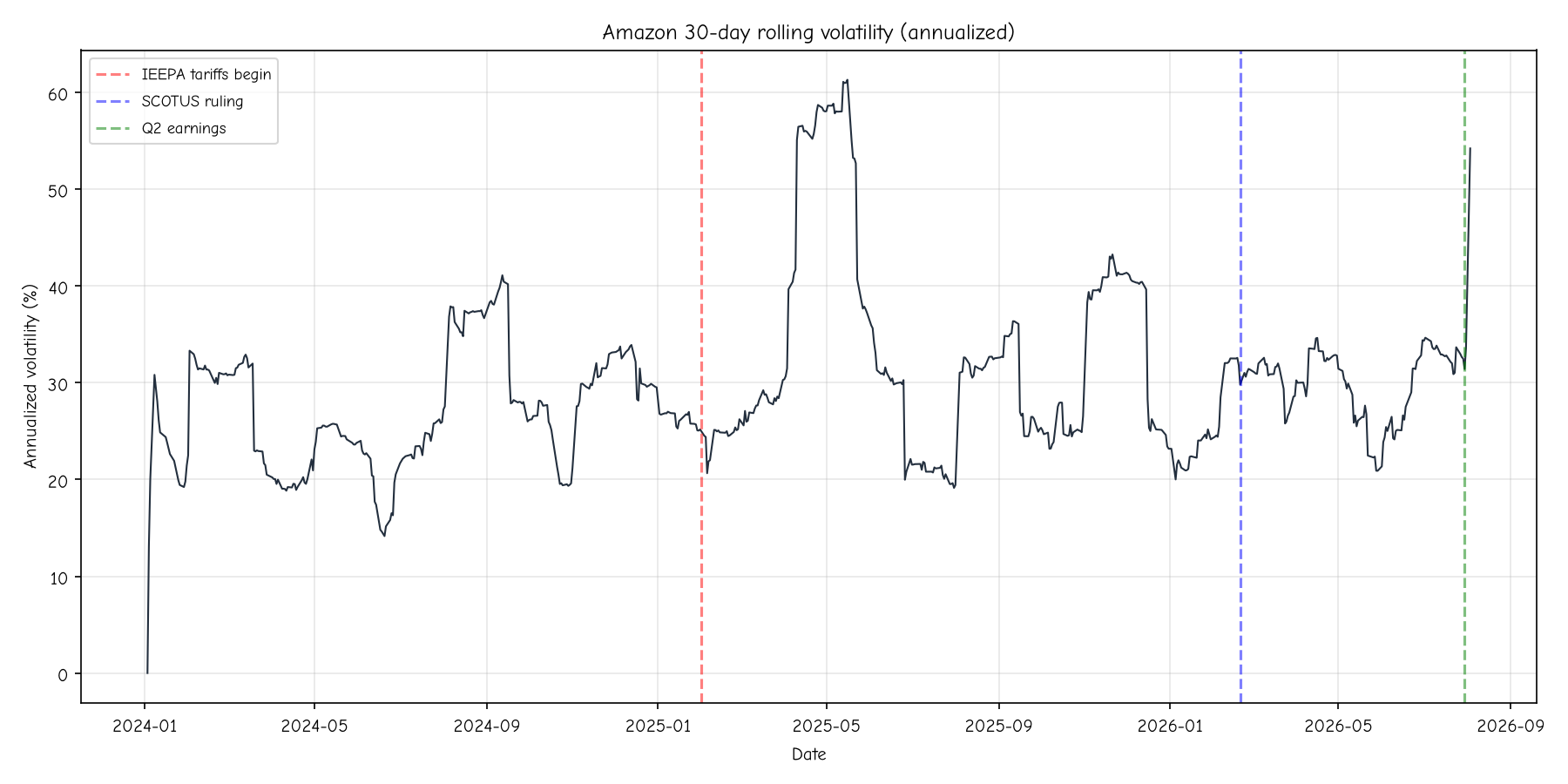
The volatility data adds another layer. Amazon's 30-day rolling annualized volatility spiked during the tariff period in 2025, particularly around the announcements of new tariff rounds in February and April 2025. Volatility declined after the Supreme Court ruling in February 2026, as the legal uncertainty around tariffs resolved. But it ticked up again in late July 2026 around the Q2 earnings call and the announcement of new Trump administration tariffs under Section 122 and Section 301.
The $600 million also needs to be understood against the total tariff burden. If 301,000 importers paid $175 billion in IEEPA tariffs, the average importer paid roughly $581,000. Amazon's $600 million is about 1,000 times the average, which makes sense given that Amazon is one of the largest importers in the country. But it also means that Amazon's tariff burden was proportionate to its import volume, not outsized. The company did not get a special deal. It got back what it paid, minus whatever portion was absorbed in higher costs that were not passed through to customers.
One number that Amazon has not disclosed is how much of the $600 million it plans to return to customers. Olsavsky's language was deliberately narrow. He said there was "a limited set of circumstances" where Amazon could trace specific import charges to specific customers. That suggests the customer refund pool is a small fraction of the $600 million. If Amazon had planned to return a large share, the language would have been broader. The company's silence on the specific amount is itself a signal. If the number were large enough to matter to investors, Amazon would have disclosed it. The fact that it did not suggests the customer refunds are a minor portion of the total.
The math is simple. Amazon has roughly 310 million active customer accounts worldwide. If the company returned the entire $600 million to customers, each account would get about $1.94. If it returned 10%, each account would get about 19 cents. If it returned 1%, each account would get about 2 cents. The reality is probably somewhere between 1% and 10% of the total, distributed only to customers who paid specific import charges on specific items. For most Amazon shoppers, the refund will be zero.
Chapter 6: Will you actually get a refund? The mechanics and the lawsuits
The mechanics of Amazon's customer refund plan are vague by design. Olsavsky said on the earnings call that Amazon had "identified a limited set of circumstances where we can trace that we pass specific import charges onto customers." In those cases, "we will proactively contact affected customers and automatically issue refunds to them." He did not say how many customers, how much money, or when the refunds would arrive. An Amazon representative told CNET that the company had no further comment beyond Olsavsky's remarks.
To understand why the refund pool is likely small, you need to understand how Amazon handles import costs. Amazon operates two main retail models. In the first-party model, Amazon buys products from manufacturers or distributors, imports them, and sells them directly to customers. In this model, Amazon is the importer of record and pays the tariff. The tariff cost is embedded in the retail price, but it is not listed as a separate line item on your receipt. You see a price of $29.99 for a blender, not $27.99 plus $2.00 import duty. Because the charge is not separated, Amazon cannot "trace" it to your specific purchase in the way Olsavsky described. The refund for these products stays with Amazon.
In the third-party model, independent sellers list products on Amazon's marketplace and handle their own importing. Some of these sellers may have passed tariff costs to customers as explicit charges, particularly for international shipping and customs fees. If a seller listed a product at $19.99 plus a $3.00 import fee, and the customer paid $22.99, then Amazon can trace the $3.00 charge and refund it. This is the "limited set of circumstances" Olsavsky was describing. It applies to a narrow slice of Amazon's total sales volume, probably concentrated in cross-border purchases and specific categories where import charges are itemized.
The gap between what Amazon is keeping and what it is returning is the target of the consumer class-action lawsuit filed in June 2026. According to Women's Wear Daily, the suit accused Amazon of keeping tariff overcharges rather than passing them back to consumers. The lawsuit was filed before Amazon announced its refund plan, which means the company's July 30 announcement may have been partly a defensive move. Legal analysis published by JD Supra in July 2026 noted that retailers and consumer brands face a "new litigation risk" from proposed consumer class actions alleging that customers paid higher prices because of tariffs that were later ruled unlawful. The article identified the Amazon suit as one of the first of these cases.
The legal theory behind these lawsuits is straightforward. If a company charged customers for a tariff that was later declared illegal, the customers overpaid and are entitled to restitution. The practical problem is proving the overcharge. If the tariff cost was embedded in the retail price and not separately listed, the customer cannot point to a specific charge and say "this is the illegal tariff." The company can argue that the price increase was due to market factors, not just tariffs. Amazon has a strong defense because Olsavsky explicitly said the company "largely absorbed" tariff costs rather than passing them through. If Amazon absorbed the cost, the customer did not overpay. Amazon did, and Amazon is now getting its money back from the government.
But the lawsuit may still have legs. Andy Jassy conceded in January 2026 that tariffs were hitting prices. That admission could be used to argue that Amazon did pass some costs through, even if it did not itemize them. The plaintiffs will try to show that Amazon's prices rose more than they would have without the tariffs, and that the difference represents an overcharge that should be refunded. Amazon will argue that its prices are set by market forces, not by tariff costs alone, and that any price increase was justified by factors beyond tariffs.
The outcome of this lawsuit could set a precedent for the entire retail sector. If the plaintiffs win, every major retailer that raised prices during the IEEPA tariff period could face similar class actions. Walmart, Costco, Target, Home Depot, and any company that imported goods subject to the tariffs could be on the hook. The legal fees alone would be substantial. A settlement or judgment could dwarf Amazon's $600 million refund, because it would be based on the total price increase passed through to consumers, not just the tariff amount the company paid.
There is also a political dimension. The opinion piece published on August 4, 2026, argued that "consumers were always going to take the brunt of Donald Trump's bungled reciprocal tariff scheme" and that the "trickle-down" of refunds to shoppers has been minimal. The piece noted that gadget prices have not dropped despite the refunds rolling in. This is the public sentiment that could drive political pressure on Amazon and other retailers to return more of the money. Senator Elizabeth Warren and other critics of corporate power have historically used moments like this to push for legislation or regulatory action. Whether that happens in this case depends on how much public anger the story generates.
For now, the practical advice for Amazon customers is simple. Check your order history for any purchases that listed an import charge, customs fee, or tariff surcharge as a separate line item. If you see one, you may be eligible for an automatic refund. If you do not, you probably will not get money back directly. Your benefit, if any, will come from lower prices as Amazon and other retailers cycle through their refund money. Do not hold your breath.
Chapter 7: What comes next: new tariffs, more lawsuits, and the political fallout
The Supreme Court's ruling in Learning Resources v. Trump did not end the tariff war. It restarted it under different legal labels. The Trump administration has moved on three fronts since February 2026.
First, it imposed new 10% to 12.5% levies on 60 economies, using authorities that the administration believes are less vulnerable to the major questions doctrine that drove the IEEPA ruling. The exact statutory basis for these levies has not been fully specified in public reporting, but administration officials have pointed to a combination of trade remedy laws and national security statutes.
Second, Trump imposed 15% tariffs under Section 122 of the Trade Act of 1974. That provision allows the president to impose temporary import surcharges of up to 15% for up to 150 days to address a balance-of-payments deficit. The legal theory is that the U.S. trade deficit constitutes a balance-of-payments problem that justifies emergency action. Critics, including the New York Post opinion piece published on July 25, 2026, argue that this is another stretch, that the trade deficit is not the kind of crisis Section 122 was designed to address, and that the tariffs will face the same legal challenge as the IEEPA duties.
Third, the administration has turned to Section 301 of the Trade Act, the same provision used during Trump's first term to impose tariffs on Chinese goods. Section 301 allows the U.S. Trade Representative to impose duties after an investigation finds that a foreign country's trade practices are "unreasonable or discriminatory." The administration has launched new Section 301 investigations targeting a range of countries and practices. Two lawsuits filed in the U.S. Court of International Trade in late July 2026 argue that these investigations are "sham" proceedings designed to reach a predetermined outcome, and that the resulting tariffs violate the same constitutional principles that drove the Learning Resources decision.
The legal landscape is fragmenting. On August 3, 2026, the Associated Press reported that 25 states sued the Trump administration over its latest tariffs, calling them a "pretext" to replace the IEEPA tariffs the Supreme Court struck down. The states argue that the administration is simply relabeling the same tariffs under different statutes, and that the courts should see through the maneuver. This argument has appeal because the timing is suspicious. The new tariffs were announced within weeks of the Supreme Court ruling, they cover many of the same countries and products, and the rates are similar. If a court finds that the new tariffs are functionally identical to the old ones, the administration's legal theory collapses.
The risk for importers is a repeat of the IEEPA cycle. Companies pay the new tariffs, build the costs into prices, and then face refunds and lawsuits when the courts strike the tariffs down. The difference is that the new tariffs are being imposed under statutes that have been upheld in the past. Section 301 tariffs on China survived legal challenges during Trump's first term. Section 122 has not been tested in court in the same way, but it has a narrower scope and a time limit. The administration may be able to keep some of these tariffs in place longer than the IEEPA duties.
For Amazon, the second-order effects are mixed. If the new tariffs stick, Amazon will pay them again, and prices will rise again. The company's stockpiling strategy from 2025, buying inventory before tariffs hit, worked once but is harder to repeat. Supply chains have adjusted, and the window for pre-tariff buying is shorter. Amazon's CFO said on the earnings call that shipping costs escalated at the highest rate in more than three years during Q2 2026, partly because of the tariff disruption and partly because of the Iran war's impact on oil prices and shipping routes. The company faces cost pressure from multiple directions.
If the new tariffs are struck down, Amazon gets another refund, and the cycle repeats. But the political and legal costs of each cycle are rising. Consumer class actions are multiplying. State attorneys general are suing. The Court of International Trade is managing an unprecedented refund operation. Each round of tariffs and refunds generates more litigation, more legal fees, and more public scrutiny of how companies handle the money.
The macroeconomic risk is harder to quantify. The IEEPA tariffs collected $175 billion in roughly 10 months. That money is now being returned, which means the Treasury is effectively writing a $166 billion check to importers. The fiscal impact is significant, though the Treasury has not disclosed how the refunds are being accounted for in the federal budget. The Congressional Budget Office has not published an analysis of the refund operation's impact on the deficit. The refunds are a liability that was not anticipated when the tariffs were collected, because the administration assumed the tariffs were legal and permanent.
For investors, the tariff cycle creates a specific kind of risk. Companies that import heavily are exposed to both the cost of tariffs and the legal uncertainty around them. Amazon's $600 million refund was a positive surprise, but the next round of tariffs could be a negative surprise if they stick. The stock market has so far treated the tariff story as a minor factor for Amazon, focusing instead on AWS growth and AI spending. But if the new tariffs are broader or higher than the IEEPA duties, the retail margin impact could be material. Amazon's North America segment operates on thin margins, and a 15% tariff on a significant share of its imported inventory would compress those margins unless the company can raise prices or shift sourcing.
The most likely scenario is a prolonged legal battle. The administration imposes tariffs, companies pay, plaintiffs sue, courts rule, and the cycle repeats. Each iteration takes months. The IEEPA tariffs lasted about 12 months before the Supreme Court struck them down. The new tariffs could last longer if the administration uses statutes with stronger legal foundations. But the fundamental tension remains: the president wants to impose tariffs that Congress has not authorized, and the courts are increasingly willing to say no. The Learning Resources decision was 6-3, not a narrow 5-4. The majority included justices from across the ideological spectrum. That suggests the Court's willingness to constrain presidential tariff authority is broad, not partisan.
The political fallout is harder to predict. Trump ran on tariffs in 2024 and won. His base supports protectionist trade policy. But the consumer price impact of tariffs is the kind of kitchen-table issue that can erode support quickly. If the new tariffs push prices up again, and the refunds from the old tariffs do not reach consumers, the political narrative shifts from "protecting American jobs" to "taxing American shoppers to give money to Amazon." That is a story the administration does not want told.
Conclusion
The $600 million that Amazon received from the government is your money, in a sense. You paid it, through higher prices, and the government collected it, and the courts said it was illegal, and now the government is giving it back. But it is going back to Amazon, not to you. Amazon will return some of it to some customers in some circumstances. Most customers will get nothing.
That is not a scandal. It is how tariffs work. The importer pays the government. The cost gets embedded in the retail price. When the tariff is reversed, the refund goes to the importer. Whether the importer passes it back to the consumer depends on the importer's business model, competitive pressure, and willingness to trace the specific charge to the specific purchase. Amazon is doing more than most companies by offering automatic refunds in any circumstances at all. Walmart and Costco are promising lower prices, which is a diffuse benefit that is hard to measure. GM is keeping its $500 million. UPS, FedEx, and DHL are passing refunds to their shipping customers, who are mostly businesses, not individuals.
What should a normal person take away from this? Three things.
First, check your Amazon order history for any purchase that listed an import charge, customs fee, or tariff surcharge as a separate line item. If you find one, watch for an automatic refund. Amazon says it will contact affected customers proactively. If you do not hear anything within a few months, call customer service and ask.
Second, do not expect prices to drop. The opinion piece published on August 4, 2026, was right: gadget prices are not falling despite the refunds. Retailers cycle through refund money slowly, and the new tariffs the Trump administration is imposing under Section 122 and Section 301 may push prices back up before the old refunds have fully worked their way through the system. The net effect on your wallet over the next year is probably a wash, or slightly negative if the new tariffs are higher than the old ones.
Third, watch the legal battles. The 25-state lawsuit filed on August 3, 2026, and the Section 301 cases in the Court of International Trade, will determine whether the new tariffs survive. If they are struck down, the refund cycle starts again. If they stick, prices will stay elevated. Either way, the pattern is now clear: tariffs go on, prices go up, courts get involved, tariffs come off, refunds go to companies, and consumers are left where they started, paying a little more than they did before.
The historical parallel is not comforting. After Smoot-Hawley was passed in 1930, it took four years and a new president to reverse course with the Reciprocal Trade Agreements Act of 1934. Prices did not snap back. The damage to global trade persisted for years. After the McKinley Tariff of 1890, it took a political rebellion and two election cycles to roll back the rates. The consumers who paid higher prices in the interim never got their money back. The refund mechanism that exists today, through the Court of International Trade, is better than nothing. But it returns money to the companies that paid the tariffs, not to the people who paid the higher prices. That gap is as old as the American tariff system itself.
Amazon's $600 million is a big number. It is also a small number relative to Amazon's size. The real number that matters is the one you will never see: the total amount you overpaid for imported goods between February 2025 and February 2026, across all the stores you shop at, because of tariffs the Supreme Court later said were illegal. That number is probably somewhere between $50 and $500 for most American households. It is gone. The refund is going to Amazon. And Amazon is deciding what to do with it.
Sources
- CNET, "Amazon Will Give Tariff Refunds to Some Customers," August 1, 2026, https://www.cnet.com/personal-finance/amazon-will-give-tariff-refunds-to-some-customers/
- Wikipedia, "Smoot, Hawley Tariff Act", https://en.wikipedia.org/wiki/Smoot%E2%80%93Hawley_Tariff_Act
- Encyclopaedia Britannica, "Tariff" (updated August 3, 2026), https://www.britannica.com/topic/tariff/United-States
- Yahoo Finance, AMZN historical price data (via Yahoo Finance Chart API), https://query1.finance.yahoo.com/v8/finance/chart/AMZN
- CNBC, "Amazon.com Inc AMZN: NASDAQ" quote page (accessed August 4, 2026), https://www.cnbc.com/quotes/AMZN
- BBC Business news page (accessed August 4, 2026), https://www.bbc.com/news/business
- CNN Business news page (accessed August 4, 2026), https://www.cnn.com/business
- The New York Times, Business section (accessed August 4, 2026), https://www.nytimes.com/section/business
- The Guardian, Amazon topic page (accessed August 4, 2026), https://www.theguardian.com/technology/amazon
- SEC EDGAR, Amazon.com Inc. 10-Q filing, filed July 30, 2026 (CIK 0001018724, Acc-no. 0001018724-26-000026), https://www.sec.gov/cgi-bin/browse-edgar?action=getcompany&CIK=0001018724&type=10-Q
- About Amazon, news page (accessed August 4, 2026), https://www.aboutamazon.com/news
- Business Insider, Amazon company page (accessed August 4, 2026), https://www.businessinsider.com/amazon
- Bing News search, "Amazon tariff refund Olsavsky earnings" (accessed August 4, 2026), https://www.bing.com/news/search?q=Amazon+tariff+refund+Olsavsky+earnings
- Bing News search, "Amazon tariff refund Supreme Court" (accessed August 4, 2026), https://www.bing.com/news/search?q=Amazon+%22tariff+refund%22+%22Supreme+Court%22
- Bing News search, "Trump administration new tariffs Supreme Court IEEPA defeat" (accessed August 4, 2026), https://www.bing.com/news/search?q=Trump+administration+new+tariffs+Supreme+Court+IEEPA+defeat
- Bing News search, "Learning Resources Trump tariff Supreme Court IEEPA ruling" (accessed August 4, 2026), https://www.bing.com/news/search?q=%22Learning+Resources%22+Trump+tariff+Supreme+Court+IEEPA+ruling
- Bing News search, "Amazon sued tariff refunds class action lawsuit consumers" (accessed August 4, 2026), https://www.bing.com/news/search?q=Amazon+sued+tariff+refunds+class+action+lawsuit+consumers
- Bing News search, "Amazon tariff refund Total Retail 600 million" (accessed August 4, 2026), https://www.bing.com/news/search?q=Amazon+tariff+refund+Total+Retail+%22600+million%22
- Bing News search, "Woldenberg Learning Resources tariff challenge Supreme Court" (accessed August 4, 2026), https://www.bing.com/news/search?q=Woldenberg+Learning+Resources+tariff+challenge+Supreme+Court
- Bing News search, "Amazon tariff refund limited set of circumstances customers automatic" (accessed August 4, 2026), https://www.bing.com/news/search?q=Amazon+tariff+refund+%22limited+set+of+circumstances%22+customers+automatic
- Bing News search, "Amazon won't seek tariff refunds shoppers suing" (accessed August 4, 2026), https://www.bing.com/news/search?q=Amazon+won%27t+seek+tariff+refunds+shoppers+suing
- Associated Press (via Bing News), "25 states sue over Trump's new tariffs, calling them 'pretext' to replace his old ones," August 3, 2026, https://www.bing.com/news/search?q=25+states+sue+Trump+administration+latest+tariffs
- JD Supra (via Bing News), "Tariff Refunds and Consumer Class Actions: A New Litigation Risk for Retailers and Consumer Brands," July 2026, https://www.bing.com/news/search?q=Tariff+Refunds+Consumer+Class+Actions+litigation+risk+retailers
- Women's Wear Daily (via Bing News), "Amazon Hit With Consumer Lawsuit Over Trump Tariff Refunds," June 2026, https://www.bing.com/news/search?q=Amazon+Hit+Consumer+Lawsuit+Trump+Tariff+Refunds
- New York Post (via Bing News), Opinion: "Trump Imposes Massively Harmful and Illegal Section 301 Tariffs," July 25, 2026, https://www.bing.com/news/search?q=Trump+Imposes+Illegal+Section+301+Tariffs
- Associated Press (via Bing News), "Jewish family's toy company challenged Trump's tariffs, the Supreme Court agreed," February 2026, https://www.bing.com/news/search?q=Jewish+family+toy+company+challenged+Trump+tariffs+Supreme+Court
- Barron's (via CNET), Bernstein analyst Zhihan Ma quoted on tariff refund consumer expectations, referenced in CNET article [1]
- Total Retail (via Bing News), "Amazon Received $600M in Tariff Refunds in Q2," August 4, 2026, https://www.bing.com/news/search?q=Amazon+Received+600M+Tariff+Refunds+Q2+Total+Retail