ARTICLE BODY:
SharePoint CVE-2026-45659 just crossed the line from patch queue item to active incident candidate. CISA added the Microsoft SharePoint Server deserialization flaw to its Known Exploited Vulnerabilities catalog on July 1, 2026, and NVD lists a July 4, 2026 due date for covered federal remediation in its CVE record.
That does two things for anyone running SharePoint Server. First, it confirms exploitation is happening outside the lab. Second, it tells you the sane private sector clock is now measured in hours and days, not the next scheduled SharePoint weekend.
The affected estate is on premises SharePoint Server: Enterprise Server 2016, Server 2019, and Subscription Edition appear in the affected version data published in the NVD record for CVE-2026-45659. Microsoft 365 tenants still need to watch identity and document access logs, but the emergency patch work sits with operators who own SharePoint Server farms.
The uncomfortable part is the vulnerability shape. NVD describes the bug as deserialization of untrusted data in Microsoft Office SharePoint that lets an authorized attacker execute code over a network. The CVSS 3.1 vector in NVD is 8.8 HIGH, with network attack vector, low attack complexity, low privileges required, no user interaction, and high confidentiality, integrity, and availability impact.
If your SharePoint is internet reachable, partner reachable, or reachable from a flat corporate network, treat the box like an identity adjacent server. It likely holds documents, workflow hooks, service accounts, and enough trust to make lateral movement boringly practical.
Evidence of exploitation put it in KEV
CISA added CVE-2026-45659 to the KEV catalog because it had evidence of active exploitation, according to the agency's July 1 alert on the SharePoint vulnerability. KEV status matters because it separates theoretical severity from field use. A bug with a pretty CVSS score can wait behind your highest risk assets. A KEV bug on a public SharePoint farm gets executive attention.
NVD's CVE page records the same KEV status and lists the required action as applying vendor mitigations under CISA's BOD 26-04 guidance and its forensics triage requirements. The same NVD entry shows CISA's SSVC assessment changing exploitation from none to active on July 1, 2026. That change is the signal. Somebody has working exploit paths, and defenders are already behind unless they patched and checked exposure before the alert.
The timeline is short. NVD published the CVE on May 22, 2026, CISA added it to KEV on July 1, 2026, and the KEV due date shown in NVD is July 4, 2026. The chart below shows the operator window: 40 days from NVD publication to KEV addition, then 3 days from KEV addition to the federal deadline.
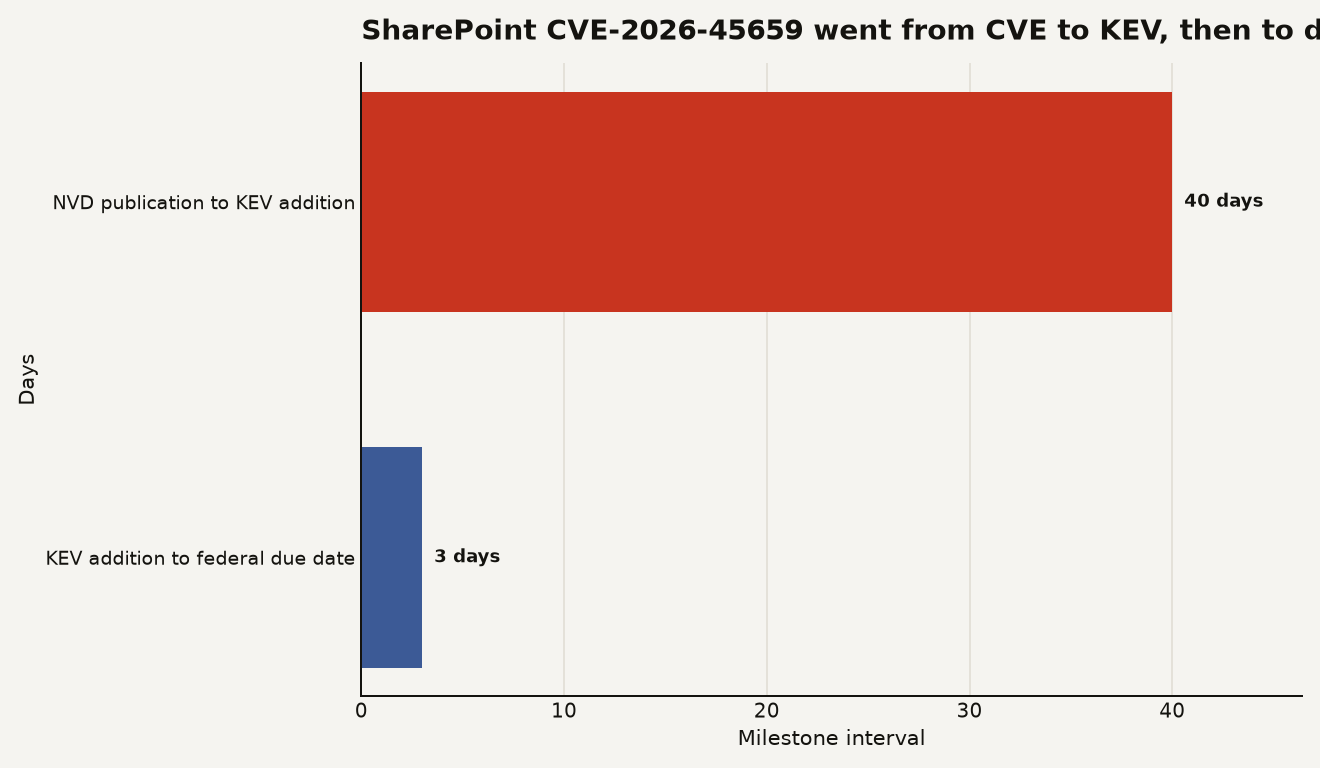
That gap is the lesson. If you waited for KEV before triage, you got a loud signal but lost 40 days of optionality. For production teams, KEV should be the escalation trigger, not the first inventory trigger.
CISA's newer risk framing also matters. The agency says BOD 26-04 requires Federal Civilian Executive Branch agencies to prioritize rapid remediation of high risk KEV vulnerabilities on publicly exposed assets that grant total control after exploitation, according to CISA's BOD 26-04 directive page. Private operators can ignore the legal mandate. They should copy the prioritization model.
SharePoint is exactly the kind of product where that model earns its keep. A compromised collaboration server can expose documents, deliver malware through trusted files, harvest internal identities, and become a staging point inside the network. The attacker does not need to win every server. One useful SharePoint farm can do a lot of work.
A narrow list of vulnerable products
The vulnerable product list is narrow enough to inventory fast. NVD's change history lists Microsoft SharePoint Enterprise Server 2016, Microsoft SharePoint Server 2019, and Microsoft SharePoint Server Subscription Edition as affected products, with fixed version thresholds in the same CVE change record. If you run one of those, the question is version, exposure, and compromise history.
Use three buckets.
- Public or partner exposed farms: Patch first, isolate if patching cannot happen immediately, and start compromise triage before you declare victory.
- Internal farms reachable by broad user populations: Patch next, because the vulnerability needs low privileges rather than administrator level access.
- Restricted administrative or lab farms: Patch inside the same campaign, but let exposure and data sensitivity decide the order.
The privilege detail matters. NVD's CVSS vector includes PR:L, which means low privileges are enough for the base scenario. That makes the bug more operationally dangerous than a flaw that needs a farm admin or shell access. Any environment with too many SharePoint members, stale contractors, weak conditional access, or long lived service accounts has a larger practical attacker pool.
This is where many patch dashboards lie to you. A server may be marked internal while it is still reachable through VPN, partner network routes, VDI, a published reverse proxy, or a forgotten load balancer rule. Your scanner label is not the boundary. Your routing table is.
If you have an exposure management tool, query for SharePoint endpoints and validate from outside the network. If you do not, use load balancer configs, DNS, certificate transparency, firewall policy, and endpoint telemetry. A plain list beats a beautiful dashboard that misses the farm under old ownership.
Builders running AI enabled internal search should pay extra attention. SharePoint often feeds retrieval systems, document copilots, and workflow bots. A compromise there can poison content, expose embeddings pipelines, or turn trusted document stores into prompt injection delivery. That is the same pattern behind our guide on why KEV listed edge gear changes your patch order: the asset that bridges users and data deserves a shorter clock.
Check for compromise before patching
Patch management and incident response need to run in parallel. CISA's alert says BOD 26-04 establishes expectations for when agencies must check whether threat actors compromised a system before the patch was applied. That line is easy to skip because it sounds federal. Do not skip it.
Start with preservation. Capture current SharePoint and IIS logs before rotation or cleanup jobs erase the useful bits. Snapshot or export relevant Windows event logs. Record current build numbers, web application URLs, service account mappings, installed SharePoint solutions, and recent administrator changes. If legal, regulatory, or customer notification could follow, chain of custody beats frantic Slack archaeology.
Then hunt for the boring signs first. Most real intrusions leave operational crumbs before they leave cinematic malware.
- Unexpected process trees: Look for SharePoint worker processes spawning command shells, scripting runtimes, archive tools, or network utilities.
- New or modified files: Review recent writes in web roots, SharePoint layouts paths, temporary directories, and uploaded content locations.
- Suspicious authentication: Check successful logins from unusual geographies, new device fingerprints, stale accounts, and low privilege accounts suddenly touching administrative pages.
- Configuration drift: Compare web.config, farm solutions, timer jobs, and service account permissions against known good baselines.
- Outbound traffic: Inspect connections from SharePoint hosts to unfamiliar IPs, file sharing endpoints, paste services, VPS ranges, or domains created in the last month.
The word authorized in the CVE description should shape the hunt. An attacker may arrive with a real account, then use the flaw for code execution. That means failed login spikes are useful, but successful weirdness is more useful. Look for accounts that behaved normally for months, then suddenly accessed SharePoint at 03:17, pulled unusual pages, or triggered server side execution paths.
Do not let the patch close the ticket by itself. If exploitation happened before the fix, the updated DLLs do not remove stolen credentials, web shells, rogue scheduled tasks, persistence, or data already copied out. A clean version number is a control state. It is not a breach assessment.
For Microsoft specific remediation, use the vendor advisory as the canonical patch reference. Microsoft publishes update guidance for CVE-2026-45659 in the Security Update Guide, and your change record should name the installed fixed build for every farm member.
A break-glass lane in the patch queue
Move SharePoint CVE-2026-45659 into a break glass lane for exposed or sensitive farms. The minimum operating plan is simple.
- Inventory every SharePoint Server farm by July 3, 2026. Include 2016, 2019, and Subscription Edition, plus standby and disaster recovery nodes.
- Patch internet exposed or partner exposed farms first. If patching needs downtime, take the downtime or isolate the service until the fix lands.
- Run compromise checks before and after patching. Preserve logs first, then hunt for process, file, identity, and outbound network anomalies.
- Rotate exposed secrets if the host looks suspicious. Service account passwords, app pool identities, certificate private keys, API tokens, and integration credentials are the obvious set.
- Validate fixed builds across all farm members. One unpatched web front end behind a load balancer keeps the exploit path alive.
The business consequence is also simple. SharePoint downtime is annoying. A SharePoint compromise can become a document breach, credential incident, and internal foothold at the same time. If the farm supports customer portals, regulated data, M&A files, legal holds, or engineering design docs, the risk calculation should be brutal.
Security leaders should also change the SLA language. A generic critical patch SLA of 15 or 30 days is too slow for KEV items on exposed assets. Use a separate lane for exploited vulnerabilities with production owner escalation inside 24 hours, approved emergency change windows, and a documented exception process that requires compensating controls. The point is not to patch everything instantly. The point is to stop pretending every CVE deserves the same queue.
Developers have work too. If your app integrates with SharePoint, inventory the permissions it holds and the data it can read. Over broad OAuth grants, service accounts with site collection admin rights, and legacy add ins can turn a server level incident into a wider data incident. Least privilege is dull until the day it caps blast radius.
Three follow-on signals after July 4
Watch for three follow on signals.
First, look for Microsoft advisory updates. Vendor guidance can change when exploitation details become clearer, especially around detection, fixed builds, or mitigations. If your patch automation only checks package availability, somebody still needs to read advisory revisions.
Second, watch for exploitation reporting from incident responders. CISA's KEV listing proves active exploitation, but it does not tell you the campaign size, attacker identity, or favorite post exploitation actions. Those details matter for hunting. A campaign that drops web shells needs one playbook. A campaign that steals documents through valid accounts needs another.
Third, watch your own telemetry for delayed effects. Attackers who got in before July 1 may wait. Build a 30 day review window around SharePoint authentication, file access, process creation, and outbound traffic. If that sounds tedious, automate the queries now and make them part of the farm's operating model.
The caveat: CVE-2026-45659 is high severity, not the highest possible CVSS score. That can tempt teams to let it sit behind flashier 9.8s. Resist that reflex. KEV status plus SharePoint's data gravity beats a higher theoretical score on a buried system with no route from users or the internet.
A good patch program in 2026 is a routing system for attention. CVSS tells you how bad a bug can be. KEV tells you attackers cared enough to use it. Asset context tells you whether it can hurt your business. CVE-2026-45659 now has all three ingredients for urgent work on exposed SharePoint Server fleets.
The quiet SharePoint server is now a front door
Every company has a server nobody wants to touch because it is old, important, and faintly cursed. SharePoint often wins that contest.
CISA just made the decision easier. If the farm is exposed and still vulnerable, it is on the wrong side of an active exploitation line. Patch it, check it, and make the owner prove it is clean. The maintenance window can move. The attacker already did.