Edge appliances are the soft underbelly of enterprise networks, and threat actors know it. On July 14, 2026, SonicWall confirmed that two zero-day vulnerabilities in its Secure Mobile Access (SMA) 1000 series appliances are under active exploitation in the wild. The more severe of the two, CVE-2026-15409, carries a CVSS score of 10.0 and requires no authentication to trigger. CISA added both flaws to its Known Exploited Vulnerabilities catalog the same day patches dropped, giving federal agencies a three-day window to remediate or pull the plug. If you run SMA 1000 gear at your edge, this is a patch-now situation, not a patch-this-quarter situation.
The chain matters more than either bug alone: the SSRF gets attackers in, the code injection gives them command execution.
SonicWall's advisory on two zero-days
SonicWall's Product Security Incident Response Team published an advisory on July 14, 2026 detailing two vulnerabilities in the SMA 1000 series, the appliances that sit at the network edge and broker remote access sessions.
The first flaw, CVE-2026-15409, is a server-side request forgery bug in the Appliance Work Place interface. A remote, unauthenticated attacker can force the appliance to make requests to unintended locations. CISA's Automated Decision Processing assigned it a CVSS 3.1 base score of 10.0 with the vector AV:N/AC:L/PR:N/UI:N/S:C/C:H/I:H/A:H, which is about as bad as the scale gets: network-reachable, low complexity, no privileges, no user interaction, and full impact across confidentiality, integrity, and availability.
The second flaw, CVE-2026-15410, is a post-authentication code injection vulnerability in the Appliance Management Console. It carries a CVSS score of 7.2 and allows a remote authenticated administrator to execute arbitrary operating system commands. On its own, requiring admin privileges makes this less alarming. The problem is that attackers are chaining the two together: the SSRF opens the door, and the code injection gives them a shell once they have a foothold.
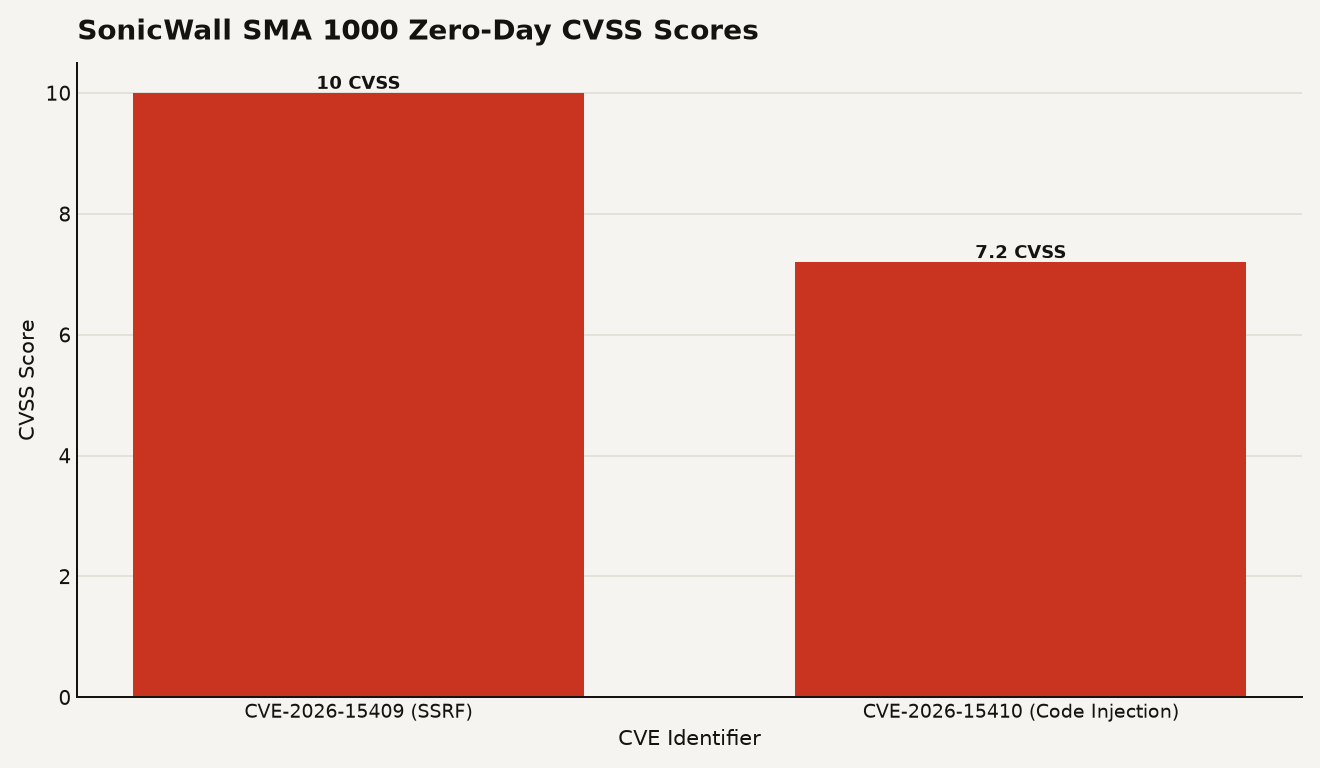
The chart above shows the severity gap between the two CVEs. SonicWall assigned the overall advisory a combined CVSS of 10.0, reflecting the chained risk rather than the individual scores.
CISA confirmed active exploitation by placing both CVEs on the KEV catalog on July 14, 2026. Federal agencies must secure affected systems by July 17, 2026 under Binding Operational Directive 26-04 or discontinue use of the product if mitigations cannot be applied. That is a three-day deadline for federal networks, and it signals that CISA's analysts see real, ongoing attacks, not theoretical ones.
SMA 6210, 7210 and 8200v affected
The vulnerabilities affect SMA 1000 models 6210, 7210, and 8200v running the following platform-hotfix releases:
- 12.4.3-03245
- 12.4.3-03387
- 12.4.3-03434
- 12.5.0-02283
- 12.5.0-02624
- 12.5.0-02800
Patches are available in platform-hotfix versions 12.4.3-03453 and 12.5.0-02835, and later releases. SonicWall reportedly sent advance alerts to customers before publishing the advisory publicly, directing them to contact support for the hotfixes ahead of the July 14 release date.
SonicWall has been clear about what is not affected: SSL-VPN running on SonicWall firewalls and the SMA 100 Series product line are not impacted by these CVEs. If you are running those products, your patch clock is not ticking on this one.
There are no workarounds or mitigations. The only fix is installing the hotfix.
The two flaws chained together
According to reporting by BleepingComputer and Help Net Security, the two bugs are being exploited in tandem. The attack chain follows a predictable pattern for edge appliance compromises.
First, the attacker uses the SSRF to reach internal services and functionality that the appliance's authentication would normally protect. The SSRF effectively bypasses the access controls on the Work Place interface by making the appliance itself issue requests to unintended locations. From that position, the attacker can interact with the Appliance Management Console and exploit CVE-2026-15410 to inject code and execute OS commands as an administrator.
The end result is full appliance compromise. An attacker with OS-level access on a remote access gateway positioned at your network edge has a launchpad into everything behind it.
SonicWall has stated that these vulnerabilities are "not unique to SonicWall," a phrase that likely refers to the class of SSRF-plus-code-injection patterns common across edge appliances rather than to the specific CVEs. The broader point stands: if you run any vendor's remote access appliances at your perimeter, the SonicWall incident is a useful proxy for the attack pattern your gear faces.
SonicWall's indicators of compromise
SonicWall published a set of indicators of compromise that administrators should check immediately, even before patching. The company has been emphatic that patching alone is not sufficient if compromise has already occurred.
Check your logs for these signs:
- Requests to
/__api__/loginor/__api__/logoutwith HTTP 200 status inextraweb_access.log - Requests to
/wsproxywith suspicious host parameters and HTTP 101 status inextraweb_access.log - Hotfix rollbacks with path traversal names in
ctrl-service.log - Routes for
/__api__/loginor/__api__/logoutin/var/lib/unit/conf.json(these URIs do not exist in legitimate configuration)
If any of these indicators are present, SonicWall advises a full reset, not just a patch. The remediation steps for a compromised device are:
- Re-image physical appliances or redeploy virtual appliances from a known-good state
- Change all user and administrator passwords
- Reset all TOTP tokens
SonicWall has also developed a script that support can run on behalf of affected customers to assist with detection and resolution.
An urgent action plan
The action plan is straightforward but urgent.
Identify exposure
Inventory your SMA 1000 deployments and check firmware versions against the affected list. Models 6210, 7210, and 8200v running the listed hotfix versions are in scope. Anything on 12.4.3 prior to 03453 or 12.5.0 prior to 02835 needs the patch.
Patch immediately
Contact SonicWall Support if you have not already received the hotfix. The fixes are in 12.4.3-03453 and 12.5.0-02835. There is no mitigation, no workaround, no firewall rule that substitutes for the patch.
Hunt for compromise
Run the IOC checks against your logs and configuration files before and after patching. If you find evidence of compromise, do not assume the patch cleans it up. Re-image, rotate credentials, and reset TOTP tokens.
Assume lateral movement
A compromised SMA 1000 appliance is a beachhead. If your IOC checks come back positive, treat this as an incident response exercise, not a patching task. The attacker had OS-level access on a gateway that sits between the internet and your internal network. What did they touch? What credentials did they harvest? What sessions did they intercept?
For broader context on why edge gear keeps showing up in CISA's KEV catalog, our guide to CISA KEV edge gear vulnerabilities covers the pattern and what it means for your perimeter strategy.
The familiar pattern of edge appliances
The SonicWall SMA 1000 incident fits a now-familiar pattern: a network-edge appliance with admin interfaces, a chaining opportunity that combines an unauthenticated entry point with an authenticated escalation, active exploitation before a patch exists, and a KEV listing that compresses the patch window to days. We saw it with Citrix, we saw it with Fortinet, and we are seeing it again here.
The structural problem is that remote access appliances are designed to straddle the trust boundary. They run web servers, management consoles, and VPN tunnels on the same hardware, often with shared code paths and overlapping trust domains. When one component falls, the attacker gets a position that the other components were never designed to resist.
For builders and operators, the takeaway is operational, not architectural. You will not redesign your edge overnight. But you can make sure your patch pipeline treats these appliances as critical infrastructure with hours-to-days SLAs, not quarterly maintenance items. CISA's three-day deadline for federal agencies is a reasonable benchmark for the private sector too, at least for gear that sits at the network perimeter.
The patch is the floor, not the ceiling
Installing the hotfix closes the vulnerability. It does not undo what an attacker already did with it. The gap between when exploitation started and when you patched is the gap where your incident response needs to live. Run the IOC checks, trust nothing on a box that was reachable, and rotate credentials like the appliance was captured, because from the attacker's perspective, it was.