Signal backup recovery keys are now part of the attack surface. That sounds like a niche mobile-app detail until you map it to how sensitive work actually happens: founders, incident responders, journalists, lawyers, board members, campaign staff, and security teams move high-value context through encrypted messengers because email is already treated as hostile terrain.
The operating mistake is treating encrypted messenger backups as a convenience feature. For high-risk teams, they are account recovery infrastructure.
On June 26, 2026, CISA said Russian intelligence services continue to target commercial messaging applications, updating the March FBI and CISA warning with recent tactics, mitigations, and sample phishing messages in a new commercial messaging applications advisory. The sharper risk is Signal backup recovery keys: if an attacker convinces a target to hand over the key, one successful phishing exchange can move from current account access into historical message recovery.
This is the kind of threat that production teams tend to under-own. It sits between corporate identity, endpoint security, executive protection, legal retention, and human behavior. Nobody wants the ticket.
That is exactly why it deserves one.
What did CISA and the FBI say changed on June 26?
CISA’s June 26 update says Russian intelligence services are still running phishing campaigns against commercial messaging applications, and the agency framed it as a continuation of a March 20, 2026 public warning from the FBI and CISA in IC3 alert I-032026-PSA. The March alert said the activity targets people with high intelligence value, including current and former U.S. government officials, military personnel, political figures, and journalists.
The important operational phrase in the March warning was commercial messaging applications, or CMAs. That means the target is the account and user workflow around Signal, WhatsApp, Telegram-style communications, and similar tools. The FBI and CISA said the campaign had resulted in unauthorized access to thousands of individual CMA accounts in the March alert, which is a scale signal even if your company is not in government.
The attacker playbook is boring in the way that works. The March warning describes phishing messages that impersonate automated messaging-app support accounts, ask users to click links, provide verification codes, or share account PINs, and then use that action to link an attacker device or take over the account.
The June 26 update matters because backup recovery keys widen the prize. A linked-device scam can let an attacker mirror future messages. An account takeover can give control of the user’s presence. A stolen backup recovery key can turn a fresh phish into a historical collection event.
The chart below puts the timeline in plain view: Signal introduced Secure Backups in September 2025, the FBI and CISA published the broader commercial-messaging warning 193 days later, and CISA updated the warning 291 days after Signal’s backup announcement.
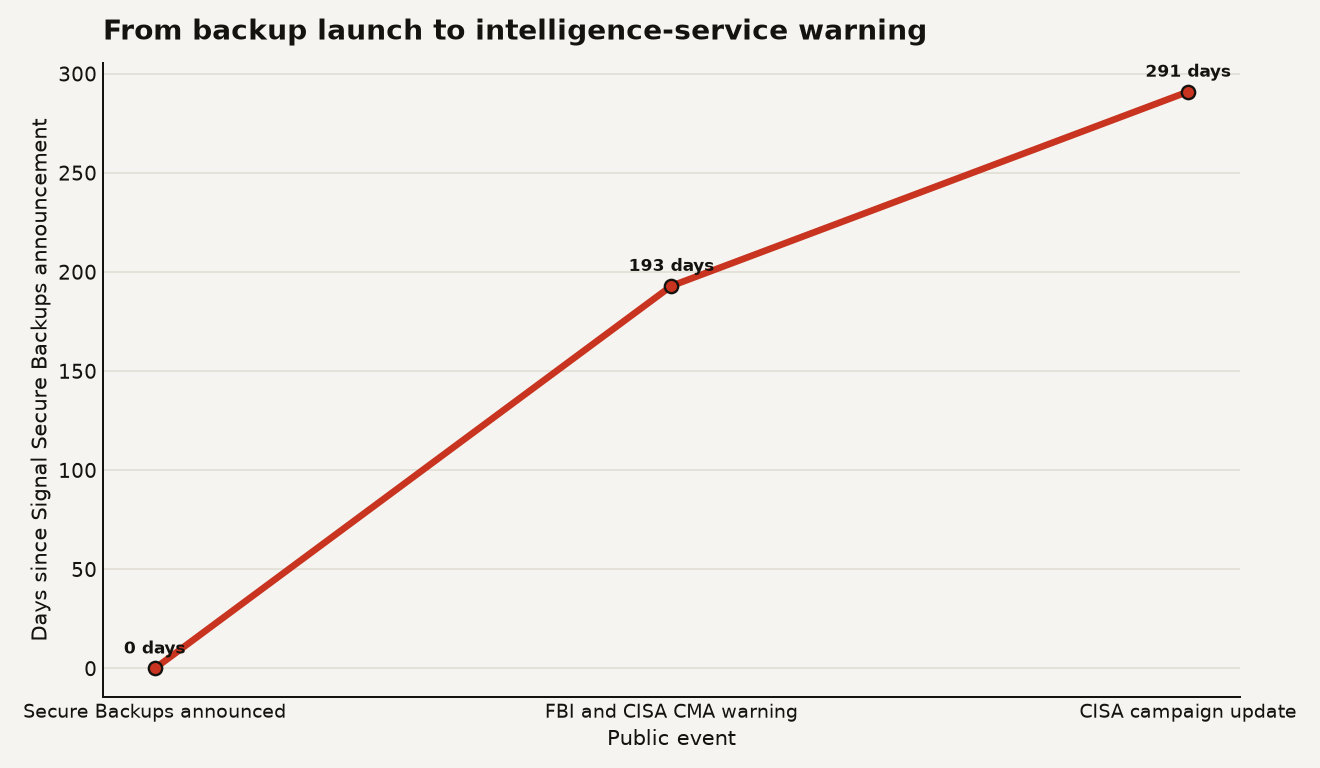
That 291-day gap is short for security culture. Plenty of teams still have no policy for messenger backups, no inventory of who enables them, and no runbook for a phished recovery key. They have SSO conditional access diagrams the size of a subway map, then leave the CEO’s encrypted-chat recovery material to muscle memory.
Why does a Signal backup recovery key change the blast radius?
Signal designed Secure Backups so users can recover conversations after losing or replacing a device, and Signal said in its September 8, 2025 announcement that the system uses a 64-character recovery key generated on the user’s device. Signal also said that key is never shared with Signal servers and is the only way to unlock a backup.
That design is privacy-preserving. It also makes the key a crown jewel.
Signal’s own support documentation says Secure Backups are protected by a 64-character recovery key and that Signal cannot recover, reset, or bypass that key if it is lost in its troubleshooting guidance. In operator language: there is no help-desk override, no admin reset, and no provider-side rescue path you can lean on during an incident.
That has three consequences for anyone running production systems.
First, the key is more like a password-manager master secret than a normal app setting. If a user types it into a chat with a fake support account, the security boundary has already moved outside the app. Your MDM profile will not save you from a trusted human pasting a recovery secret into the wrong conversation.
Second, the value of the account changes with time. A fresh account takeover is bad because the attacker can impersonate the person and see new messages. Backup recovery adds older conversations, attachments, names, project details, incident history, investor threads, customer escalations, and sensitive group membership. The past becomes queryable.
Third, the remediation path is messy. With a normal password phish, you rotate the credential, revoke sessions, force MFA reset, and review logs. With encrypted messenger backups, the hard part is answering what the attacker may have restored before you knew anything happened. That is an evidence problem, a legal problem, and a leadership problem.
Signal warns users that its staff will never initiate contact by phone, SMS, or social media, and will never ask for verification codes, recovery keys, or payment details in its phishing and impersonation guidance. That is clear guidance, but clarity does not equal coverage. You still need to turn it into a control.
How should production teams treat encrypted messenger backups now?
Treat them the way you treat break-glass credentials, hardware security keys, cloud root accounts, and signing keys: few people should have them, fewer workflows should expose them, and incidents should have a clock.
The useful mindset shift is this: encrypted messenger security is no longer just endpoint hygiene. It is identity security with a personal-device wrapper.
For a builder or operator, the stakes are concrete:
- Codebase risk: private chats often contain staging URLs, incident screenshots, one-time migration plans, customer identifiers, and pasted logs. If those chats are restored, the attacker may get context that never appeared in GitHub, Jira, or your SIEM.
- Roadmap risk: founders and product leads discuss launches, pricing, acquisition interest, and customer churn in chat because it feels informal. A backup restore can expose months of business intent.
- Incident-response risk: security teams move fast in Signal and similar apps during outages. If an adversary reads the old incident room, they learn your responders, your escalation style, and the gaps you were still patching.
- Impersonation risk: the FBI and CISA said compromised CMA accounts can be used to view messages and contact lists, send messages, and conduct additional phishing against other accounts in the March IC3 warning. That turns one compromise into a trust graph attack.
This resembles the edge-device lesson in our guide to CISA KEV vulnerabilities on edge gear: the ugly failures happen where ownership is fuzzy. Firewalls are infrastructure, so they get patch windows. Messaging backups feel personal, so they get vibes. Attackers love vibes.
The practical control is to classify messenger backup recovery material as a secret. Write that sentence into policy. Then make it boring:
- No employee, contractor, executive, board member, or advisor should ever provide a messenger recovery key, PIN, or verification code inside a chat, SMS thread, phone call, social media DM, or support conversation.
- High-risk staff should store recovery keys only in approved password managers or offline vaults, never in screenshots, notes apps, shared docs, or chat with themselves.
- Security should maintain a small high-risk roster for people whose messaging accounts create organizational blast radius: executives, finance approvers, legal leads, incident commanders, infrastructure owners, communications staff, and anyone handling government, defense, media, or activist contacts.
- The company should define when backups are allowed, when disappearing messages are required, and what retention obligations override deletion preferences.
That last point matters. The FBI and CISA recommended message expiration features in the March alert while also warning employer-issued device users to verify that retention policies allow those settings. Builders love a clean technical answer. Regulated teams get a lawyer in the room first.
What should you change in the next 24 hours?
Start with the people who can hurt the company by being believable.
Send a direct advisory to your high-risk roster today. Keep it short enough to read on a phone. Say that Signal support will not ask for recovery keys, PINs, or verification codes. Say that any request for a backup recovery key is a security incident. Say whom to contact by an alternate channel.
Then update the runbook. A useful first version has six steps:
- Freeze the channel. If a user reports a suspicious support message, tell them to stop replying and preserve screenshots.
- Verify out of band. Call the user on a known number or use a pre-established corporate channel.
- Review linked devices. Have the user remove unfamiliar linked devices and document what was present.
- Rotate what can be rotated. Change the Signal PIN if appropriate, review registration lock, and replace exposed recovery material where the app allows a new key.
- Scope exposed content. Ask what backups were enabled, what groups were sensitive, and whether incident, customer, legal, finance, or credential material appeared in chats.
- Notify the right parties. Route to security, legal, privacy, executive protection, and law enforcement reporting channels if the target profile or data sensitivity warrants it.
Do not bury this in annual phishing training. The March and June warnings describe targeted social engineering, not a generic invoice scam. A fake support message that references a real device, a real group, or a current geopolitical event will beat a poster about suspicious links.
You should also change your security questionnaires. If you handle sensitive customers, ask vendors and critical advisors how they manage encrypted messenger backups. That sounds intrusive until a law firm, PR agency, fractional CFO, or incident-response partner becomes the easiest way into your private decisions.
For internal tooling, add a lightweight reporting path. A Slack workflow or security email alias is enough if somebody watches it. The label should be obvious: “Report suspicious Signal or messaging-app support request.” Do not make a targeted user decide whether this belongs under phishing, mobile, identity, executive support, or privacy.
Finally, rehearse one case. Pick a simulated executive or incident commander. Assume they pasted a recovery key into a fake support chat at 9:17 p.m. Ask what you know by 10 p.m. If the answer is mostly silence, you have found the gap.
The uncomfortable lesson for encrypted ops
End-to-end encryption still matters. It protects messages in transit and keeps providers from casually reading the archive. The June 26 warning points at a different layer: the recovery path around the human.
That is where serious attackers keep finding room.
If your team uses encrypted messengers for real work, backups deserve the same discipline as SSO, admin credentials, and production secrets. A 64-character recovery key may look like a user feature. In the wrong chat window, it becomes a time machine for an adversary.
Sources
- CISA Advisories: Russian Intelligence Services Continue to Target Commercial Messaging Applications
- FBI IC3: Russian Intelligence Services Target Commercial Messaging Application Accounts
- Signal Blog: Introducing Signal Secure Backups
- Signal Support: Troubleshooting Signal Secure Backups
- Signal Support: Staying Safe from Phishing, Scams, and Impersonation