Your phone system just joined the weekend incident queue. Cisco Unified CM CVE-2026-20230, an SSRF flaw in Cisco Unified Communications Manager, now has the one label that changes patch triage: known exploited.
As of Saturday, June 27, 2026, CISA has given federal civilian agencies until Sunday, June 28, 2026 to remediate CVE-2026-20230 or stop using the affected product, according to the agency's Known Exploited Vulnerabilities JSON feed. The private sector does not inherit that legal deadline, but production operators should steal the urgency. Voice infrastructure is identity-adjacent, network-connected, and often treated like plumbing until it floods the building.
Cisco published the advisory on June 3, 2026, with a CVSS 8.6 score, a Critical security impact rating, and no permanent workaround besides upgrading, according to Cisco's security advisory. The exploit path matters: an unauthenticated remote attacker can send crafted HTTP requests, write files to the underlying operating system, and use those files later to elevate privileges to root. That is a bad sentence for any appliance sitting near directories, call records, admin consoles, or internal routing.
CISA set a June 28 deadline
CISA added CVE-2026-20230 to KEV on June 25, 2026, and set a June 28 due date, which creates a 3 day remediation window from catalog entry to deadline in the agency's current KEV feed. That is the operational signal. A vulnerability can sit in a vendor advisory for weeks while teams plan a maintenance window. A KEV entry with a three day fuse is a different workflow: assign an incident owner, prove exposure, patch or isolate, then hunt.
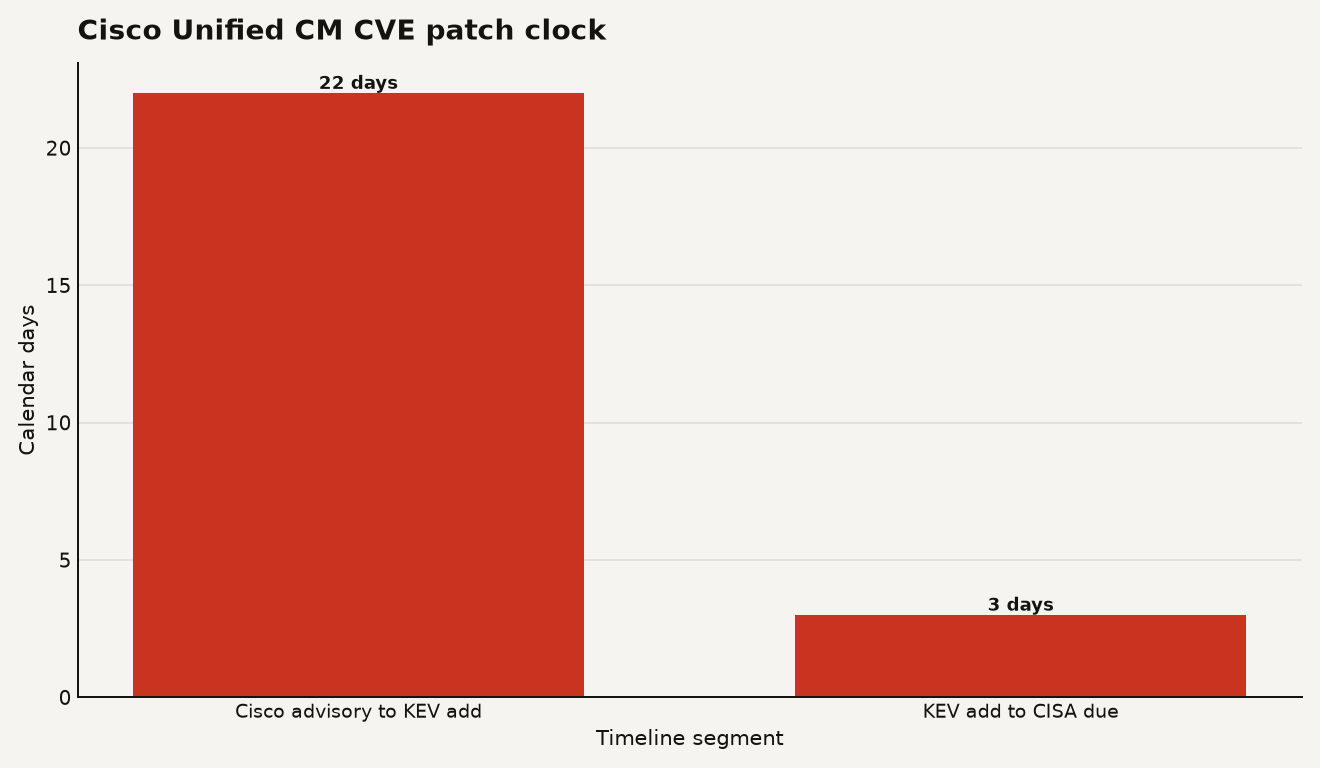
The chart below shows the compressed timeline. Cisco disclosed the flaw on June 3. CISA added it to KEV on June 25. The mandated remediation date is June 28. That means 22 days from disclosure to KEV addition, then 3 days from KEV addition to deadline.
The same KEV update also added PTC Windchill and FlexPLM CVE-2026-12569 with the same June 28 deadline, and CISA's catalog listed 1,629 known exploited vulnerabilities in release version 2026.06.25 of the KEV data. That pairing is useful context. Attackers are targeting more than perimeter VPN boxes and firewalls. They are also hitting the systems that keep plants, product teams, and collaboration stacks alive.
Cisco's advisory says WebDialer must be enabled for CVE-2026-20230 to be exploitable, and Cisco notes that WebDialer is disabled by default in the affected product guidance. Do not let that line make the ticket feel optional. Disabled by default is a deployment fact, not an asset inventory. Plenty of long-lived Unified CM environments have services enabled for a user story that nobody remembers until the audit asks.
Find every Unified CM before lunch
The exposure test is simple enough to run before lunch: find every Cisco Unified CM and Unified CM SME instance, check whether Cisco WebDialer Web Service is running, and map which nodes can receive HTTP requests from user networks, management networks, VPN pools, and the internet. Cisco says administrators can check WebDialer status by going to Cisco Unified Serviceability, then Tools, then Control Center Feature Services, where the Cisco WebDialer Web Service is either Started or Not Running in the vendor's advisory steps.
The fix path has a catch. Cisco lists release 14 fixed in 14SU6, while release 15 is fixed in 15SU5, planned for September 2026, or a version-specific COP patch, according to Cisco's fixed software table. If you run release 15, the decision tree is more annoying than a normal upgrade ticket. You may be applying a COP patch now, then folding the durable fix into a later service update.
Cisco also says there are no workarounds that fully address the vulnerability, although administrators may disable WebDialer until a patch can be applied, according to the advisory's mitigation section. That distinction should drive your change record. Disabling WebDialer is a risk reduction step. It is not a closure condition unless your policy explicitly accepts temporary mitigation for an exploited KEV item and you have evidence the service stays off.
The uncomfortable part is persistence. Cisco describes a successful exploit as file write to the underlying operating system that can later support elevation to root in the advisory summary. A patch can close the door while leaving footprints inside the room. If your Unified CM server was reachable and WebDialer was started before June 28, treat remediation and triage as two separate tasks.
Voice servers are production dependencies
Because communications platforms are operational dependencies with security blast radius. A compromised voice server can become a place to stage files, move inside trusted networks, disturb call routing, or target administrators who still use privileged sessions from jump boxes. Nobody wants to explain a customer outage by saying the phone system was in the low priority maintenance pile.
This is the same pattern we covered in the Splunk SIEM clock: once CISA puts an exploited infrastructure flaw on a short deadline, the useful unit of work changes from vulnerability ticket to production change. You need a named commander, a rollback plan, an exposure proof, and a detection pass. A stale spreadsheet of appliances will lose to a three day KEV window every time.
There are three business consequences here:
- Maintenance windows shrink. The June 25 to June 28 clock gives teams 3 calendar days, not a comfortable sprint, to decide whether they can patch, disable WebDialer, or isolate the service.
- Asset ownership gets tested. Unified CM often lives between telecom, network, and security teams, which means the first hour can vanish into ownership archaeology.
- Forensics becomes mandatory hygiene. File write plus potential root escalation means you need logs, file integrity checks, and admin session review even after the patch installs.
PTC's parallel KEV entry reinforces the point. PTC warned customers on June 25 that it had received continued reports of heightened threat activity and urged immediate remediation in its Windchill and FlexPLM advisory. The vendor also published concrete indicators, including 5 network IP addresses in its June 25 update and multiple JSP webshell paths under the Windchill login directory. Different product, same operator lesson: exploited enterprise platforms demand patching and hunting in the same motion.
Start with scope before June 28
Start with scope. Query CMDB, EDR inventory, network scans, Cisco Smart Licensing records, backup catalogs, and telecom runbooks for Unified CM and Unified CM SME. If you find one node, assume there are peers. Clusters, lab systems, standby nodes, and disaster recovery copies count.
Then run this order of operations:
- Confirm version and service state. Record the Unified CM release, node role, and whether Cisco WebDialer Web Service is Started.
- Patch to the fixed path. Move release 14 systems to 14SU6 where applicable, and use Cisco's release 15 COP path or planned 15SU5 path based on your support guidance.
- Disable WebDialer where you cannot patch immediately. Cisco provides a temporary mitigation by unchecking Cisco WebDialer Web Service under Service Activation in the official workaround guidance.
- Restrict HTTP reachability. Limit access to management and application interfaces to known admin networks, VPN groups, and required application integrations.
- Hunt for file-write artifacts. Review web access logs, system file changes, unexpected JSP or script files, and privilege changes around June 3 to June 28.
- Reset exposed secrets if compromise is plausible. Admin passwords, local integration credentials, service accounts, SNMP communities, and backup credentials are all candidates.
- Document the exception if you cannot finish. For a KEV item, an undocumented delay is just risk with worse paperwork.
The fastest useful detection pass is boring by design. Look for HTTP requests to Unified CM endpoints from unusual networks, spikes in 4xx or 5xx responses, new files created by the web service account, and any shell-like child processes that do not belong in normal appliance behavior. If your EDR coverage on voice appliances is weak, compensate with network logs, configuration backups, file integrity snapshots, and Cisco support tooling.
Also check whether WebDialer is actually used. If a business owner cannot name a current dependency after 24 hours, disabling it is a strong default while you patch. Make the exception prove itself. This is one of those rare cases where removing a forgotten feature can reduce risk without creating much user pain.
Three updates to watch
Watch for three updates. First, Cisco may revise the advisory if exploitation evidence, fixed release details, or detection guidance changes. Second, CISA may update KEV metadata if ransomware use becomes known, since the current catalog marks ransomware campaign use for CVE-2026-20230 as Unknown in the June 25 feed. Third, security vendors may publish more precise detection logic as incident responders see real compromised systems.
Do not build a giant theory around the attacker yet. The identity of the threat actor matters less than the exploit economics this weekend. An unauthenticated remote path, public proof of concept noted by Cisco on June 3, and a known exploited CISA entry on June 25 are enough to prioritize action without waiting for a campaign name.
For the roadmap, this should push one item above the line: production communications infrastructure needs the same vulnerability handling as identity, SIEM, VPN, and edge gear. That means owner, internet exposure field, emergency patch path, and logs you can actually query. If your voice platform sits outside the normal security change loop, CVE-2026-20230 is the audit finding arriving early.
The quiet lesson: your phones run software too
The easy mistake is to file this as a Cisco voice bug. The sharper read is that any enterprise platform with HTTP endpoints, legacy service toggles, and unclear ownership can become weekend work. Attackers do not care which team owns the console. They care whether the server writes files.
Patch Cisco Unified CM CVE-2026-20230 now, or isolate the affected service until you can. Then keep hunting. A closed port is comforting. A clean box is better.