
Your SD-WAN controller is the brain of your wide-area network. If someone walks into it as admin without a password, they own every tunnel, every policy, and every site you manage. That is exactly what CVE-2026-76504 lets an attacker do to Cisco Catalyst SD-WAN Manager, and Cisco confirmed active exploitation in September 2026.
A CVSS 9.8 authentication bypass in Cisco Catalyst SD-WAN Manager is being exploited right now, and CISA added it to the Known Exploited Vulnerabilities catalog on October 1, 2026, giving Federal Civilian Executive Branch agencies until October 3 to apply fixes. The flaw needs no credentials and no user interaction. It works over the network against any exposed SD-WAN Manager instance that has not been patched.
Cisco published a full advisory with fixed releases, indicators of compromise, and hardening guidance. The UK's NCSC and NHS England both issued alerts calling further exploitation highly likely. If you run Cisco Catalyst SD-WAN Manager on premises, this is a same-week patch, not a backlog item.
What exactly does CVE-2026-76504 let an attacker do?
The vulnerability sits in the API session-based authentication management of Cisco Catalyst SD-WAN Manager. Cisco's advisory explains the root cause: improper handling of URI encoding in an HTTP request, which lets the request bypass an authentication rule intended to restrict access to a specific API endpoint.
In plain terms, the authentication filter checks whether an incoming request targets a protected endpoint. But when an attacker URL-encodes a single character in the request path, the filter fails to match it against the blocked pattern. The request sails through to the API endpoint as if it were legitimate, and the attacker gets a session with admin-level privileges.
Cisco's IOC documentation gives a concrete example. An attacker sends a POST request to /%6a_security_check instead of /j_security_check. The %6a is the URL-encoded form of the letter j. The authentication rule looks for j_security_check in the raw path, does not find it because the character is encoded, and lets the request through. The server then decodes the path, processes the authentication check, and returns a valid admin session.
Cisco notes that %6a is only an example. Any single character encoded in the request path will trigger the bypass. That means simple string-based blocklists or WAF rules looking for specific encoded sequences will not catch every variant. The fix has to come from the patched software, not from a downstream filter.
The attacker needs no credentials, no prior access, and no user interaction. They need network reachability to the SD-WAN Manager API. If your vManage instance is exposed to the internet, the attack surface is direct. If it is internal-only, the risk drops but does not disappear, because any foothold inside the network can reach it.
Which versions are affected and what are the fixed releases?
Cisco's advisory lists six affected release trains and their first fixed releases. Here is the full table:
| Affected Release | First Fixed Release |
|---|---|
| Earlier than 20.9 | Migrate to a fixed release |
| 20.9 | 20.9.10.1 |
| 20.12 | 20.12.8.2 |
| 20.15 | 20.15.6.1 |
| 20.18 | 20.18.4.1 |
| 26.1 | 26.1.2.1 |
| 26.2 | 26.2.1 |
If you are running anything earlier than 20.9, Cisco says to migrate to a fixed release entirely. There is no incremental patch for old trains.
For Cisco SD-WAN Cloud (Cisco Managed) environments, Cisco has already deployed the fix in Release 20.15.605. No user action is required there. For on-premises deployments, you need to upgrade manually.
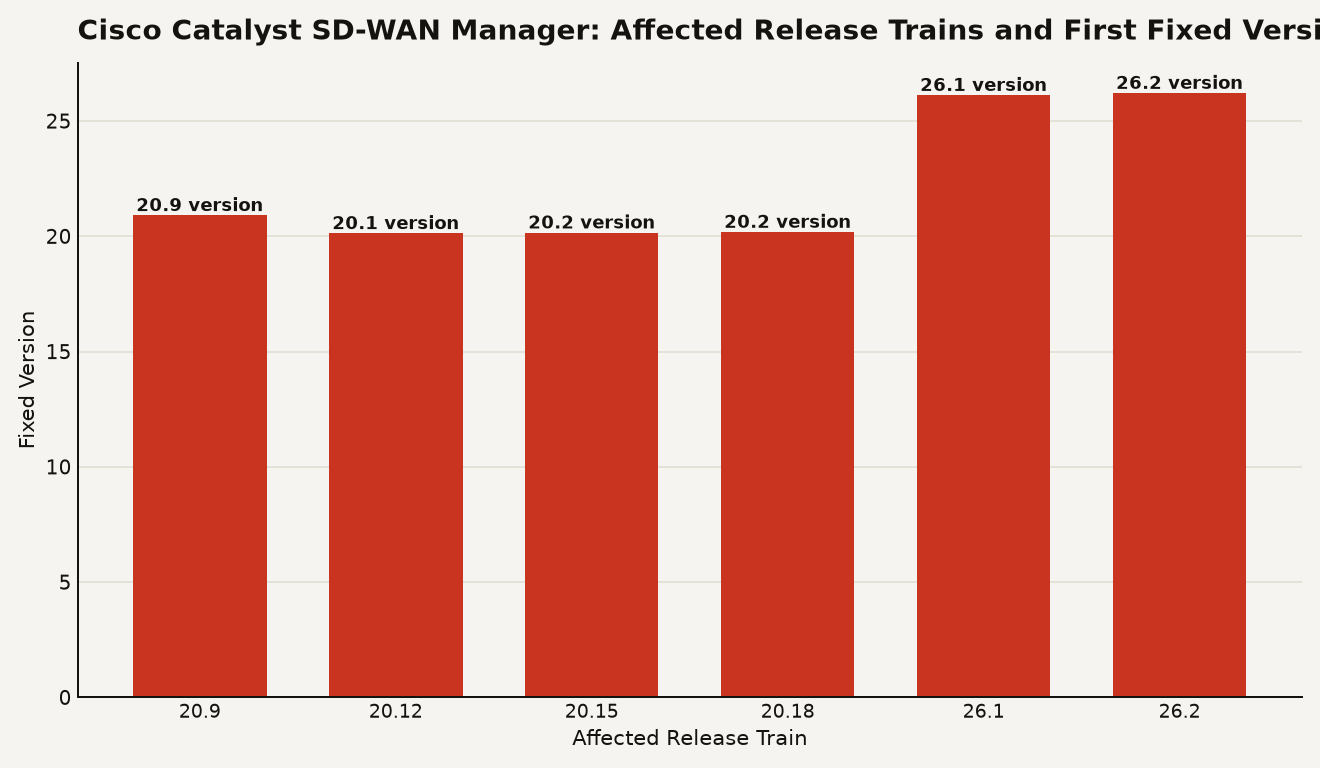
The chart above shows each affected release train alongside its first fixed version. The gap between your current version and the fixed version tells you how big the upgrade is. If you are on 20.9.x, the jump to 20.9.10.1 is a maintenance bump. If you are on 20.12, 20.15, or 20.18, you are also looking at a maintenance-level fix within your train. The 26.x train fixes are similarly minor version bumps.
Cisco says there are no workarounds that address this vulnerability. The only real fix is upgrading to a patched release. Mitigations exist but they are temporary, and Cisco explicitly calls them out as stopgaps.
How do I check whether my SD-WAN Manager has already been compromised?
This is the step NHS England says to do first, before patching. The reason is simple: patching can overwrite logs and destroy evidence of a prior intrusion. If an attacker already used this bypass to get admin access, they may have created rogue users, changed policies, or set up persistence. You need to know that before you wipe the slate clean.
Cisco identifies two log files to audit:
The first is serviceproxy-access.log, located at /var/log/nms/containers/service-proxy/serviceproxy-access.log. Look for POST requests to paths containing j_security_check from unknown or unauthorized IP addresses. Cisco provides a sample malicious log entry:
[2026-09-29T23:11:13.948-05:00] "POST /%6a_security_check HTTP/1.1" 200 - 48 0 4 - "10.10.10.47,192.168.1.174" "Mozilla/5.0" "92980fc6-bb3c-4b67-8a6d-af5ceb236d4c" "vmanage-9999.example.com" "127.0.0.1:8080"
The telltale sign is the encoded character in the path (%6a in this example) paired with a 200 response code, meaning the authentication bypass succeeded. Any encoded single character in a j_security_check path is suspicious.
The second log is vmanage-server.log, located at /var/log/nms/vmanage-server.log. Look for j_security_check entries associated with usernames starting with viptela-reserved-. These are reserved system accounts that should not appear in normal authentication flows. If they show up in login events from unfamiliar IPs, that is a strong indicator of exploitation.
Cisco also warns that some IOCs may appear during standard operations. You need to assess them against your normal network posture to avoid false positives. If you are unsure, Cisco recommends running the request admin-tech command from vManage and opening a TAC case as Severity 3 with the CVE-ID in the title.
If you find evidence of compromise, do not just patch and move on. Treat it as an incident. Rotate all credentials stored in or accessible through vManage, review all user accounts and policies for unauthorized changes, and check whether the attacker used SD-WAN Manager as a jumping point into your broader network.
What mitigations work while I plan the upgrade?
Cisco's mitigation guidance is straightforward: restrict access from unsecured networks to the SD-WAN Manager system. If the instance does not need to be internet-facing, take it off the internet immediately. If remote access is required, limit it to known, trusted hosts on specific ports and protocols.
Put the SD-WAN control components behind a firewall. Cisco recommends a two-layer firewall architecture so that end users never connect directly to the outer DMZ. Filter traffic to and from the system, allowing only known, trusted hosts.
Additional hardening steps from Cisco's advisory:
- Change the default administrator password to a strong variant. Default credentials on top of an auth bypass is a worst-case scenario.
- Create user accounts based on least-privilege access requirements. Do not let every operator use the admin account.
- Create operator accounts for all administrators so their actions are individually attributable.
- Obtain SSL certificates from a certificate authority rather than using self-signed or default certificates.
- Send web log traffic to an external server and retain it long enough for post-event investigation.
For cloud-hosted deployments, Cisco says the mitigation is already deployed. If you are on the cloud-managed offering, your exposure is lower, but you should still verify your software version using the Help function in the service GUI.
What does this mean for your broader Cisco security posture?
This is the third major Cisco authentication bypass or privilege escalation CVE in 2026 that CISA has flagged for urgent patching. The pattern matters. Cisco's management interfaces are becoming a recurring target, and the flaws share a theme: authentication logic that breaks on edge cases like URI encoding, session handling, or input parsing.
You may already be tracking the Cisco ISE zero-day CVE-2026-76460 that grants root access, or the Cisco FMC flaw CVE-2026-20079 that went from root access to ransomware exploitation. The CISA KEV catalog is putting edge gear on watch across multiple vendors, and Cisco management planes keep showing up.
The operator takeaway is this: if you run Cisco infrastructure, build a process for fast management-plane patching now. Do not treat vManage, ISE, FMC, or Secure Email Gateway as set-and-forget systems. They are high-value targets with admin-level access to your network, and attackers know it.
For this specific CVE, the window between Cisco's September 2026 awareness of exploitation and CISA's October 3 deadline is tight. State-sponsored and opportunistic attackers scan for newly disclosed Cisco flaws quickly. The UK's NCSC flagged this vulnerability as actively exploited, and NHS England's cyber alert assesses further exploitation as highly likely. Every day an unpatched instance sits on your network is a day it can be used against you.
The clock is already running
Federal agencies have until October 3, 2026. Everyone else should treat that as their own deadline, because the exploit is public, the IOCs are published, and the attacker playbook is written. Audit your logs first, patch second, and harden third. If your SD-WAN Manager faces the internet and you have not touched it since deployment, assume it is a target and act accordingly.
Sources
- Cisco PSIRT: Cisco Security Advisory cisco-sa-sdwan-webauth-xr8beuuU
- thehackernews.com: CISA Adds Exploited Cisco Catalyst SD-WAN Manager Auth Bypass to KEV
- securityaffairs.com: U.S. CISA adds Cisco Catalyst SD-WAN Manager flaw to KEV catalog
- ncsc.govt.nz: CVE-2026-76504 affecting Cisco Catalyst SD-WAN Manager
- digital.nhs.uk: Critical Zero-Day Vulnerability in Cisco SD-WAN Manager, NHS England Digital