Muse Code is Meta's new AI coding agent, launched on August 5, 2026 alongside an updated model called Muse Spark 1.2. If you are just starting to explore AI coding tools, this is a significant release because Meta is not just shipping a smarter model. They are shipping a model and a tool that were built to work together, with a pricing twist that could change how beginners access capable AI.
Muse Code is Meta's first dedicated coding agent, co-trained with Muse Spark 1.2 to handle whole-project work, at a price as low as $0.10 per million input tokens.
To understand why this matters, you need some background. An AI "agent" is a system that does not just answer a single question. It can take multiple steps: read your files, write code, run it, see what breaks, fix the errors, and repeat until the task is done. This is different from a chatbot that gives you one response and stops. The "agentic" part means the AI uses tools, like a terminal or a file browser, to accomplish tasks on its own over many turns.
Muse Code and Muse Spark 1.2
Meta announced two things together: Muse Code and Muse Spark 1.2.
Muse Spark 1.2 is the latest version of Meta's AI model. A "model" is the underlying brain: you give it text (or images), and it predicts what should come next. Muse Spark is what Meta calls "natively multimodal," meaning it was built from the ground up to handle both text and images, not bolted on as an afterthought. The 1.2 update focuses specifically on coding: writing code, debugging it, understanding entire codebases, and completing end-to-end developer workflows.
Muse Code is the new coding agent that sits on top of the model. Think of it as the hands and eyes: Muse Code is the tool that reads your project files, makes edits, runs tests, and reports back. Meta co-trained the model and the agent together so they work better as a pair than either would alone. Simon Willison, a well-known AI commentator, noted that the most important characteristic of any AI model today is "long-sequence agentic tool calling," and Meta built Muse Code specifically to deliver that.
The training data matters here. Meta says Muse Spark 1.2 was trained on what they call "long-horizon coding tasks," which means the model practiced on projects that take many steps to complete: generating an entire repository of code, building large projects from start to finish, and conducting "auto-research" where the model explores a problem and proposes solutions. This is a step beyond models trained mainly on short coding snippets.
Meta also says they trained the model by having it attempt coding tasks many times, keeping the attempts that worked, and teaching it to break big goals into smaller sub-tasks that can be managed and compressed when the context gets too long.
Unusual pricing for budget watchers
Here is where it gets interesting for beginners watching their budget. Meta offers Muse Spark 1.2 under two different "model IDs." A model ID is just the name you type when you call the API, which is the interface programmers use to talk to the model. Same underlying model, two names, two very different prices.
The standard version, called muse-spark-1.2, costs $1.25 per million input tokens and $4.25 per million output tokens, according to Willison's analysis. A "token" is roughly three-quarters of a word, so a million tokens is about 750,000 words. Input tokens are what you send to the model; output tokens are what it generates back.
The cheaper version, called muse-spark-1.2-contributor, costs $0.10 per million input tokens and $0.20 per million output tokens. That is roughly 12 times cheaper on input and 21 times cheaper on output. The catch: if you use the contributor version, you agree to let Meta use your data to improve their products. Your prompts and code become training material. That is a significant trade-off if you are working on anything proprietary or sensitive.
For context, the chart below shows how the standard pricing compares to other models in the market.
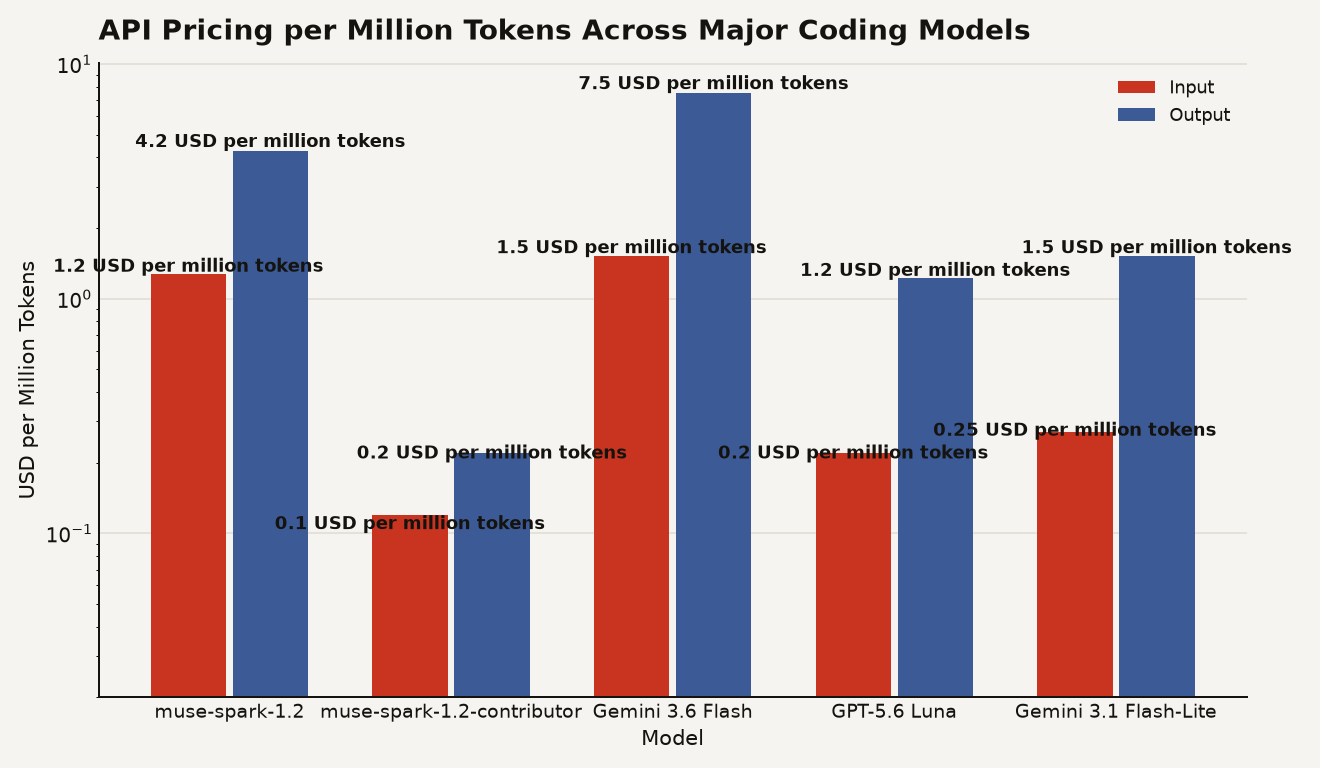
Gemini 3.6 Flash costs $1.50 per million input and $7.50 per million output. GPT-5.6 Luna costs $0.20 per million input and $1.20 per million output. The contributor tier at $0.10 and $0.20 is close to the cheapest models available from any major provider. New API accounts also get $20 in free credits to start, according to reporting from CNBC.
The pricing structure tells you something about Meta's strategy. They want developers using their platform, and they are willing to give a steep discount to anyone willing to let their data flow back into Meta's training pipeline. If you are a beginner experimenting with side projects and learning, the contributor tier is a remarkable deal. If you are a company with code you cannot share, the standard tier is competitive but not dramatically cheaper than alternatives.
Muse Code against Copilot, Cursor and Claude
If you have used tools like GitHub Copilot, Cursor, or Claude's coding features, you might wonder where Muse Code fits. The key difference is integration. Most coding assistants today are built by third-party companies that connect to models made by OpenAI, Anthropic, or Google. Muse Code is built by the same company that made the model it runs on.
Meta says Muse Spark 1.2 works with popular agentic setups and supports features like "planning mode," where the model outlines a plan before acting, and "compaction," where long conversations are summarized to fit within the model's memory limits. These are features that matter when an agent is working on a task that takes dozens of steps. A model that forgets what it was doing halfway through a project is useless for real coding work.
The model also supports "subagents," which means it can spin up smaller specialized agents to handle parts of a larger task. Imagine you ask the AI to build a web app. One subagent might handle the front end, another the database, and a third the deployment script. The main agent coordinates them.
Meta's own evaluation claims Muse Spark 1.2 shows improvements over the previous version, Muse Spark 1.1, which launched in July 2026. The 1.1 release was described in Meta's blog post as their strongest model for agent work, and it showed large gains over the original Muse Spark that launched in April 2026 to select partners. Willison compared the SVG drawings produced by versions 1.1 and 1.2 and called the improvement "small but material," which suggests the gains are real but incremental rather than revolutionary.
For a broader look at where this fits, check our earlier guide on which AI to use for different tasks in 2026, which breaks down the AI coding tools available before this release.
Agentic tool calling is the main story
Yes, and here is why it matters for beginners specifically.
When you first start using AI for coding, you probably use it as a chatbot: you paste an error message, it suggests a fix, you copy it into your code. That is useful, but it is limited. You are doing the manual work of moving code between the AI and your project.
Agentic tool calling changes the workflow. Instead of copying and pasting, the AI reads your files directly, makes changes, runs your code, sees the errors, and fixes them. You describe what you want in plain English, and the agent does the mechanical work. This is what Muse Code is designed to do.
The reason Willison calls long-sequence agentic tool calling "the most important characteristic of any model these days" is that the gap between a model that can take five steps and one that can take fifty steps is enormous. Most models degrade quickly as conversations get longer: they lose track of context, repeat mistakes, or drift from the original goal. Training a model specifically to maintain coherence over long sequences of tool calls is hard, and it is where Meta is focusing their effort.
For you as a beginner, this means the question is shifting from "which model writes the best single function?" to "which agent can stick with a project long enough to finish it?" Muse Code and Muse Spark 1.2 are betting that the answer is a model and agent built together, not bolted together after the fact.
A switching guide by starting point
Here is the practical read, broken down by where you are.
-
If you are a beginner learning to code and experimenting with AI tools: the contributor pricing makes Muse Spark 1.2 worth trying. At $0.10 per million input tokens, you can send a lot of code and questions before you spend a dollar. The $20 in free credits gives you room to explore without commitment. The trade-off is your data, so do not paste in anything you would not be comfortable seeing in someone else's training set.
-
If you are working on a project you hope to commercialize: stick to the standard tier or compare it against alternatives like GPT-5.6 Luna, which our guide on OpenAI's price cut covers in detail. Luna at $0.20 per million input and $1.20 per million output is still cheap and does not require you to hand over your data.
-
If you are already happy with your current coding assistant: there is no urgent reason to switch today. The gains from version 1.1 to 1.2 are described as incremental. The bigger question is whether Meta's approach of co-training a model and agent together produces a meaningfully better experience over the next few months as Muse Code matures.
What to watch in the coming weeks: whether Muse Code gets broad public access quickly or stays limited to certain users, whether third-party tools like Cursor and Cline add support for Muse Spark 1.2, and whether the contributor pricing tier persists or turns out to be a launch promotion. Meta's original Muse Spark launched in April to select partners only, and it took until July for version 1.1 to reach a wider API through a developer portal. Expect a similar rollout curve for the newest version.
Ecosystems matter more than benchmark gaps
The models are getting close enough on raw coding ability that the differences between them are shrinking. What separates winners from the rest now is whether an agent can sustain a long, multi-step workflow without falling apart, and whether the pricing lets you actually afford to use it all day. Meta is attacking both fronts with Muse Code and the contributor tier. Whether they execute on the first remains to be seen, but the second is already the most aggressive pricing in the market.
Sources
- simonwillison.net - Introducing Muse Code and Muse Spark 1.2
- ai.meta.com - Introducing Muse Spark 1.1
- cnbc.com - Meta jumps into AI coding market to chase Anthropic and OpenAI
- ai.meta.com - Introducing Muse Spark: Scaling Towards Personal Superintelligence
- ai.meta.com - Muse Spark 1.1 Evaluation Report