OpenAI just made its best chatbot sharper and its cheapest model free. On August 6, 2026, the company rolled out two updates to ChatGPT that matter even if you never read release notes: GPT-5.6 Sol, the flagship model, now gives more focused answers with fewer factual mistakes, and GPT-5.6 Luna, the fast low-cost tier, is now the default for free users with unlimited text chats.
If you are building anything with AI right now, the free tier just became a real testing ground.
GPT-5.6 is OpenAI's current model family, launched July 9, 2026. It comes in three tiers: Sol for demanding work, Terra for balanced everyday use, and Luna for speed and low cost. You can read our beginner guide to the full GPT-5.6 family for the full breakdown. This week's update touches the top and bottom of that ladder at the same time.
Two ChatGPT updates shipped together
Two separate updates shipped together, one for paying users and one for free users.
For Plus and Pro subscribers, OpenAI updated GPT-5.6 Sol inside the Chat experience (the main ChatGPT interface, not the API or Codex). The model now gives more direct answers, uses tighter formatting, and avoids dumping extra detail when it does not help. It also adapts its level of detail to the question. A quick question gets a short answer. Complex planning gets a fuller response. OpenAI says 1 billion people use ChatGPT every week, so even small tone adjustments affect a lot of conversations.
A new slider lets paying users choose how much reasoning the model does before answering. Keep it low for quick questions. Push it up for research, coding, or decisions that need more thought. Before this update, the Instant and Thinking modes in ChatGPT felt like different models with different personalities. Now the same Sol model powers both, so moving from a quick answer to a deeper one feels like the same assistant spending more time, rather than a personality swap.
For free users, the default model switched to GPT-5.6 Luna. Free users also get unlimited text chats, which removes the rate limits that previously cut off long conversations. A new Think button lets free users ask Luna to spend more effort on harder questions. File uploads, images, and other tools still have limits.
More for free users, with clear limits
More than before, with clear boundaries.
The headline change is unlimited text. If you are a free user, you can keep a conversation going as long as you want without hitting a message cap. That matters for brainstorming, drafting, and iterative work where you need several rounds of back-and-forth to refine an idea.
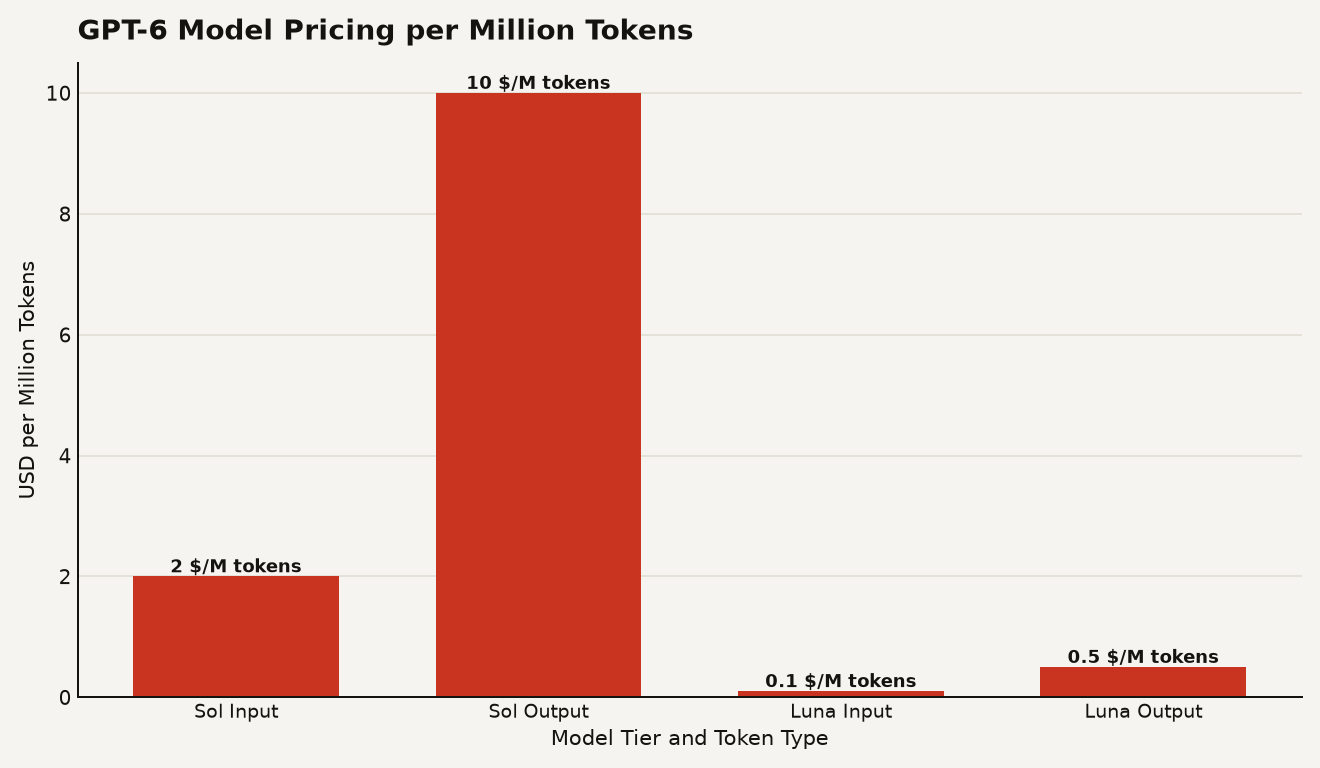
The Think button is the other piece. Luna is the fastest, lowest-cost model in the GPT-5.6 family. It was priced at $1 per million input tokens and $6 per million output tokens when it launched, and OpenAI cut Luna's API price by 80 percent on July 30, dropping it to 20 cents per million input tokens and $1.20 per million output tokens. For API users, Luna is cheap. For free ChatGPT users, it costs nothing. The Think button gives free users a way to ask Luna to reason harder on demand, which narrows the gap between free and paid tiers for text-only conversations.
But the boundaries are real. Free users still face limits on file uploads, image generation, and other tools. The Think button gives Luna more reasoning time, but Luna is still the lightest model in the family. It will not match Sol on complex multi-step planning or high-stakes factual work. If you need the strongest model, you still need a paid plan.
Fewer factual mistakes on hard prompts
OpenAI ran an internal evaluation on financial, medical, and legal prompts that require factual precision. The results: responses containing at least one factual error were about 62 percent less common with GPT-5.6 Luna and 68 percent less common with GPT-5.6 Sol than with GPT-5.5 Instant, the previous default. The chart below shows the relative error rates, with GPT-5.5 Instant set as the baseline at 100.
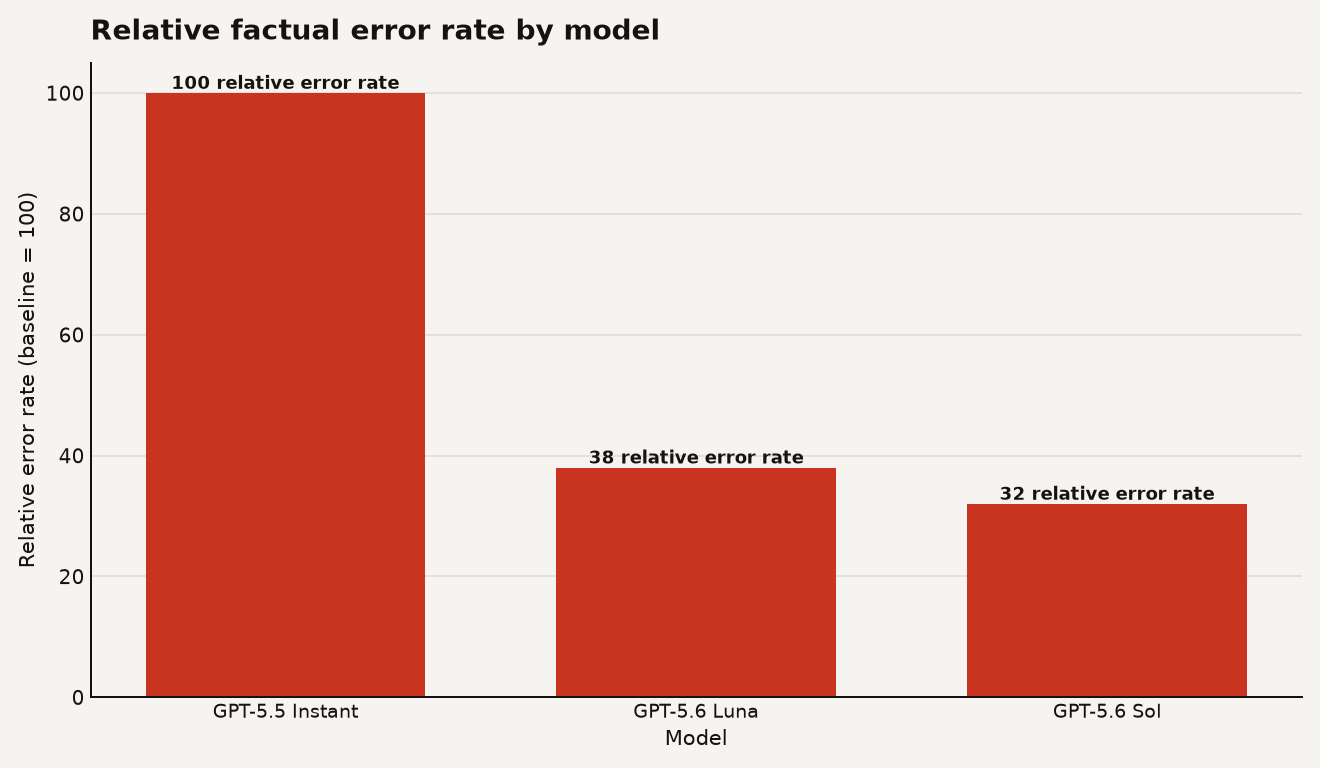
That is a meaningful improvement, but read it carefully. A 62 percent reduction means the error rate dropped by roughly two-thirds relative to the old baseline. It does not mean the model is 62 percent accurate, or that it never makes things up. If the old model produced factual errors in, say, 10 out of 100 responses, the new Luna would produce them in about 4 out of 100, and Sol in about 3. The absolute error counts are not published, so you cannot calculate the true error rate. What you can say is that the direction is right and the magnitude is large enough to notice.
The improvement comes from better use of sources. OpenAI says the updated Sol is better at using the sources it finds during web searches to answer questions, especially when answers depend on dates, numbers, rules, or assumptions. That is the kind of improvement that helps with real tasks: looking up a regulation, checking a financial figure, or confirming a deadline.
It depends on how you use ChatGPT
It depends on how you use ChatGPT.
If you are a free user who has been hitting rate limits, this is a clear win. Unlimited text means you can use ChatGPT for longer sessions without interruption. The Think button gives you a way to get better answers on harder questions without paying. For a beginner exploring AI or building a small project, the free tier is now genuinely useful for sustained text work.
If you are a Plus or Pro user, the Sol update changes the feel of ChatGPT more than the raw capability. The slider is the practical upgrade. Being able to control reasoning effort means you can keep things fast for simple questions and dial it up for complex work. The consistency between Instant and Thinking modes means you will stop noticing the jarring tone shifts that happened when you switched between them.
If you are building with the API, this update does not change your models. OpenAI explicitly says the Sol update only applies to the Chat experience in ChatGPT, not the version that powers Work, Codex, or the API. Your API calls still hit the same Sol, Terra, and Luna models as before. If you want the improved behavior, you will have to wait for OpenAI to ship it to the API, or test whether prompt engineering can approximate the more focused output style.
For developers thinking about model selection, the tier structure is getting more useful. OpenAI's own coding example shows Sol resolving ambiguity and defining a plan, while Luna implements specified changes, runs tests, and evaluates results. That pattern, using a strong model for the hard thinking and a cheap model for execution, is becoming the standard approach for cost-conscious AI pipelines. A support pipeline might use Luna for high-volume classification, Terra for ordinary customer drafting, and Sol for a novel complaint with legal consequences.
A few practical steps
A few practical steps:
- If you are on the free tier, try a longer conversation this week. Pick a project you would normally hit a rate limit on and see how far you get. Use the Think button on questions where you need the model to reason through steps.
- If you pay for Plus or Pro, experiment with the slider. Try the lowest setting on simple questions and the highest on a planning task. Notice where the extra thinking actually helps and where it just adds latency.
- If you build with the API, do not assume this update helps you. The improved Sol is Chat-only for now. Keep an eye on whether OpenAI ports the changes to the API version, but do not hold your roadmap hostage to it.
- If you are choosing between tiers for a workflow, remember the July 30 price cut already made Luna and Terra cheaper. Luna at 20 cents per million input tokens is cheap enough for high-volume classification, extraction, and first-pass work. Save Sol for the steps where mistakes are expensive.
- If you work with users under 18, read the safety section of the announcement. OpenAI added age-appropriate boundaries around romantic roleplay, dangerous activities, sexual content, and body-image risks, plus new evaluations for under-18 performance.
The free tier is now your testing ground
The real story is that the gap between free and paid is shrinking for text-only work. A beginner with no budget can now run unlimited conversations on a current-generation model and even ask it to think harder on demand. That changes the calculus for anyone deciding whether to pay for AI access or build with it.
The paid tiers still have real advantages: the strongest model, file uploads, image tools, and the slider for fine-grained control. But for learning, prototyping, and everyday text work, the free tier is no longer a demo. It is a workspace.
Sources
- OpenAI: Improving GPT-5.6 Sol in ChatGPT and expanding access to Luna for free users
- Horizon IA: GPT-5.6 Launches Worldwide From OpenAI Today
- Hyperdine Systems: OpenAI cuts GPT-5.6 Luna pricing by 80 percent, Terra by 20 percent
- GitHub: GSD model defaults advance to GPT-5.6 Sol, Terra, and Luna family