OpenAI just made its cheapest AI models dramatically cheaper. On July 30, 2026, the company announced a GPT-5.6 price cut that drops Luna, its fastest model, by 80 percent, and Terra, its balanced mid-tier model, by 20 percent. If you are building anything that calls an AI model through an API, this changes the math on what you can afford to run.
For context: GPT-5.6 is OpenAI's current model family, released in three sizes. Sol is the flagship, Terra is the middle option, and Luna is the smallest and fastest. You can read our plain-language guide to all three models for the full breakdown. The short version: the bigger the model, the smarter but more expensive. The smaller the model, the faster and cheaper. Today's news is that the two smaller ones got a lot cheaper.
The cuts reflect genuine cost reductions in how OpenAI runs its systems, and the savings are flowing through to API callers immediately.
What exactly did OpenAI change?
The price cuts apply to API pricing, which is how developers pay when they write code that talks to OpenAI's models directly. You pay per "token," which is roughly a chunk of text about four characters long. A million input tokens is about 750,000 words of text you send to the model. A million output tokens is about 750,000 words the model sends back.
Here are the new API prices per million tokens, starting July 30, 2026:
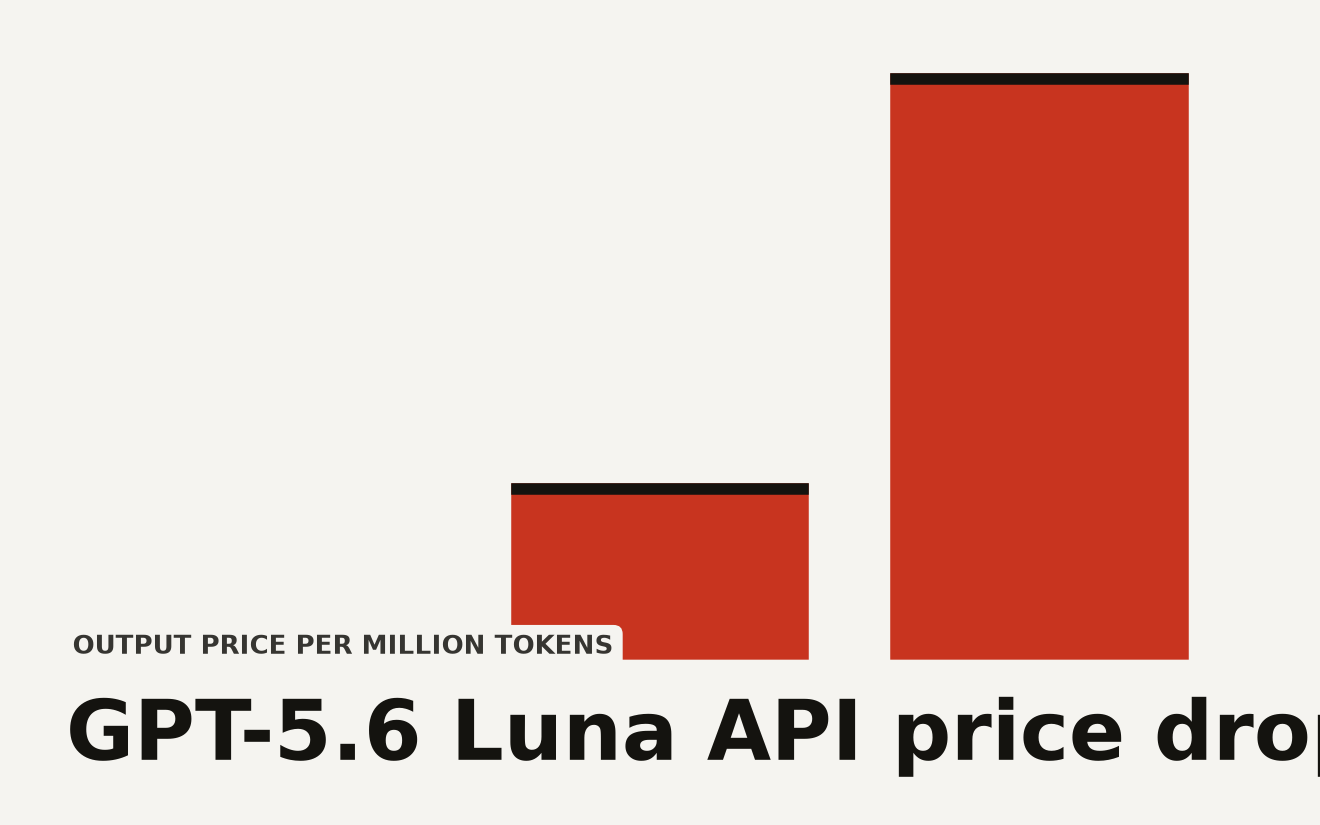
- Luna: $0.20 per million input tokens, $1.20 per million output tokens. Before the cut, Luna cost $1.00 per million input tokens and $6.00 per million output tokens. That is an 80 percent reduction.
- Terra: $2.00 per million input tokens, $12.00 per million output tokens. Before the cut, Terra cost $2.50 per million input tokens and $15.00 per million output tokens. That is a 20 percent reduction.
- Sol: $5.00 per million input tokens, $30.00 per million output tokens. Unchanged.
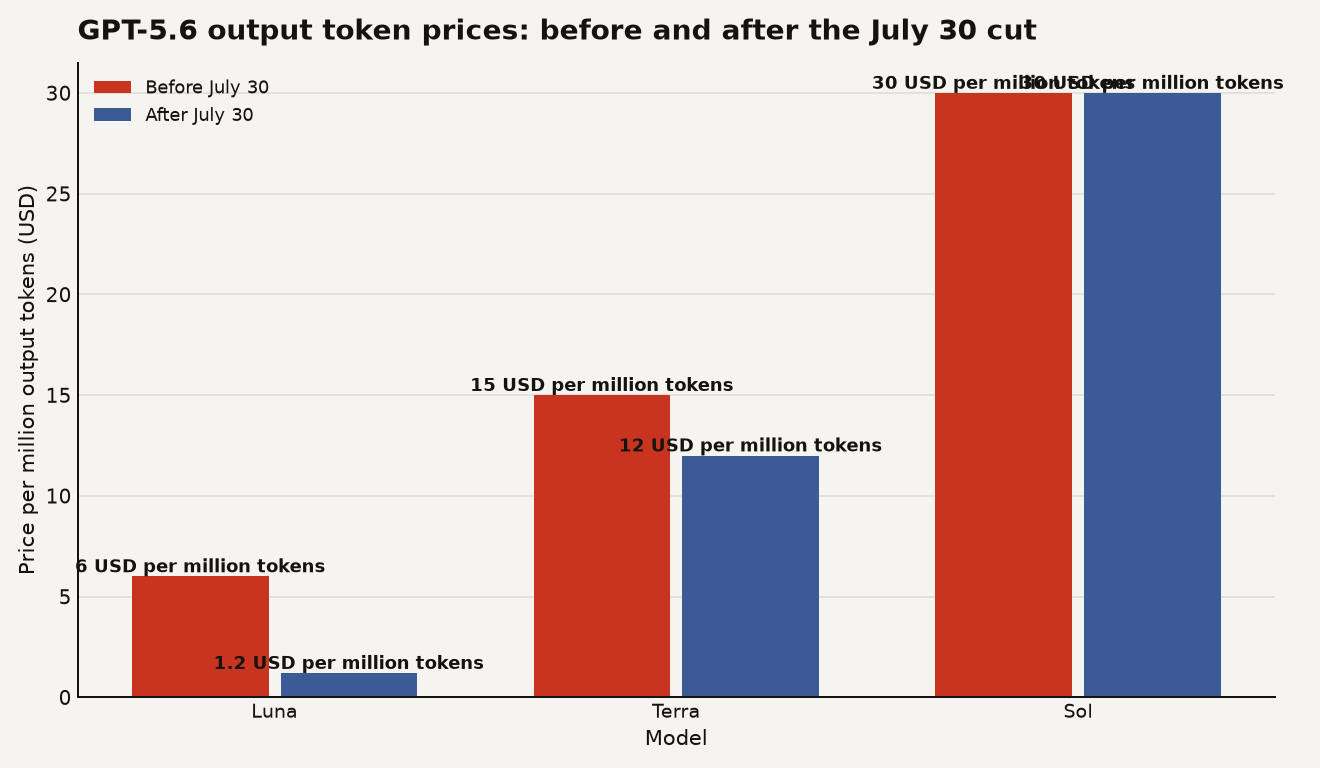
The chart below shows how output token prices changed across all three models.
OpenAI also introduced Fast mode for GPT-5.6 Sol in the API. Fast mode replaces the old Priority Processing tier and delivers up to 2.5 times faster responses at twice the price, with no change in intelligence. If you already have API requests tagged as "priority," they will automatically use Fast mode, so nothing breaks.
These price changes also affect ChatGPT Work and Codex, OpenAI's subscription products for businesses and developers. The subscription prices themselves did not change, but Luna and Terra now consume fewer credits when you use them, so your subscription goes further.
How did OpenAI make these cuts possible?
The short answer: OpenAI used its own smartest model to make its infrastructure cheaper to run.
GPT-5.6 Sol, the flagship model, was put to work inside OpenAI's own systems in what the company calls a human-led process. Sol autonomously rewrote and optimized production kernels, which are the low-level software programs that run directly on GPUs (the specialized chips that power AI). It also designed and ran hundreds of experiments to improve how efficiently the system generates tokens, and it monitored the training process for other models, stepping in when hardware failures or instability threatened to derail things.
The results were concrete. The kernel optimization work reduced the end-to-end cost of serving the model by 20 percent. The experiments on token generation increased efficiency by more than 15 percent. OpenAI also improved load balancing, which is how the system decides which hardware should handle which request, and speculative decoding, a technique where a small "draft" model proposes answers that the main model verifies in parallel.
If you want to understand what speculative decoding means in practice, think of it as a fast reader checking a rough draft. The small model writes a few words, the big model checks them all at once instead of writing each word one by one, and when the small model gets it right, the whole thing speeds up. The OpenAI engineering team described the technique in detail alongside the other optimizations.
OpenAI frames this as a compounding loop: better models help them build better infrastructure, which makes models cheaper to run, which lets them cut prices, which drives more usage, which funds more improvement. Whether that loop stays virtuous over time is an open question. The current iteration is real, and the cuts reflect actual reductions in the cost of running the system.
Why does this matter for you?
If you are a beginner building with AI, whether through a coding assistant, a chatbot prototype, or a side project that calls an API, the GPT-5.6 price cut changes your options in three concrete ways.
First, Luna is now cheap enough for bulk work. At $0.20 per million input tokens and $1.20 per million output tokens, Luna costs roughly 6 cents on the dollar compared to what a frontier-class model cost a year ago, according to OpenAI's own comparison. Tasks that would have been too expensive to automate at scale, like classifying thousands of customer messages, summarizing large document collections, or running a coding agent that writes and tests its own code in a loop, are now affordable for a solo builder or a small team.
Second, the performance gap between cheap and expensive is shrinking. OpenAI claims that on a benchmark called Agents' Last Exam, which tests long-running professional workflows across 55 fields, Luna outperforms a competing model called Fable 5 at an estimated cost per task nearly 99 percent lower. You should treat benchmark claims from any AI lab with healthy skepticism, since the lab designs the comparison. The direction is real, though: the cheapest models are now good enough for many tasks that used to require the most expensive ones.
Third, you can now mix models within a single workflow. OpenAI explicitly recommends this approach. Use Sol, the smartest model, for the parts of your task that require planning and judgment. Then hand off to Luna for the repetitive execution: writing well-specified code changes, running tests, evaluating results. This is a pattern that more experienced developers have used for a while, but the price gap between the two ends makes it newly practical for beginners. A solo founder building a coding tool could use Sol to design the architecture and Luna to do the heavy lifting, and the Luna portion would cost almost nothing.
The chart above shows the output token prices. Luna dropped from $6.00 to $1.20 per million. Terra dropped from $15.00 to $12.00. Sol held at $30.00. The gap between Luna and Sol is now 25 to 1 on output pricing. That gap is the whole story.
What should you actually do about this?
Here is the practical takeaway for a beginner.
If you are paying per-token through the API, switch your high-volume tasks to Luna. If you have been using Terra or even an older model like GPT-5.4 for routine work, Luna at $0.20 per million input tokens is likely good enough and dramatically cheaper. Test it on your actual workload rather than trusting benchmarks.
If you use ChatGPT Work or Codex subscriptions, you do not need to do anything. The price changes are automatic. Your credits will simply last longer when you use Luna or Terra.
If you need speed on complex tasks, look at Fast mode for Sol. At twice the price of standard Sol for 2.5 times faster responses, Fast mode makes sense when you are paying for time-sensitive work. For most beginners, standard processing is fine.
Start thinking in terms of model routing. This is the pattern that matters most as prices diverge. Instead of picking one model for everything, use the cheapest model that gets the job done for each step. Plan with Sol, execute with Luna, and only escalate to Terra or Sol when Luna's output is not good enough. You can read more about which AI to use for different tasks in our guide to choosing the right AI for the job.
One caveat: OpenAI's pricing page notes that regional processing endpoints, which keep data in a specific geographic area, carry a 10 percent surcharge for models released on or after March 5, 2026. If data residency matters to you, factor that in.
Another caveat: these are API prices. If you are using ChatGPT's free tier or a consumer subscription, the per-token pricing does not directly apply to you. What you will notice is that your subscription credits go further and that Luna is available as a model choice in more tiers.
The narrowing gap
The GPT-5.6 price cut tells you something bigger than "API calls are cheaper now." It tells you that the frontier model is helping build the infrastructure for the cheaper models, and the cheaper models are getting close enough to the frontier for most real work. The gap between the smartest AI and the cheapest AI is narrowing fast, and the price gap is narrowing even faster. If you are building something with AI, design for a world where the cheap model is your default and the expensive one is your escalation path.
Sources
- openai.com , Advancing the price-performance frontier with GPT-5.6
- openai.com , How GPT-5.6 fuses frontier intelligence with frontier efficiency
- openai.com , GPT-5.6: Frontier intelligence that scales with your ambition
- developers.openai.com , OpenAI API Pricing
- unite.ai , OpenAI Cuts API Prices on Its Two Cheaper GPT-5.6 Tiers