You have been hearing about GPT-5.6 since July, but the piece of news that actually changes your monthly bill just landed on August 24, 2026. OpenAI brought the full GPT-5.6 model family into Kiro, Amazon Web Services' spec-driven coding environment, and quietly cut what it costs to run two of the three tiers inside that tool. If you are a hobbyist or an indie builder who has been priced out of frontier model coding agents, this is the update to read carefully.
GPT-5.6 in Kiro now spans three tiers: Sol, Terra, and Luna, with Kiro credit multipliers of 2.4x, 1.0x, and 0.1x respectively after the August price drop. That Luna number is the one that matters for beginners. It fell from 0.6x to 0.1x, which means a task that costs 10 credits on Kiro's default Auto routing now costs half a credit on Luna. Terra dropped from 1.2x to 1.0x, making it the same per-task cost as Auto but with frontier model intelligence behind it.
If you already know the basics of the GPT-5.6 family from our GPT-5.6 Luna Terra Sol explainer for beginners, the news here is about where those models live and what they cost in a tool that wraps them in real engineering structure. Kiro is not a chat box. It converts your high-level intent into requirements documents, technical designs, and executable task lists, and then hands that structured context to the model before it writes a single line of code. That scaffolding is the reason the cost numbers moved so dramatically.
GPT-5.6 went live in Kiro on August 24
The Kiro launch announcement confirms that GPT-5.6 Sol, Terra, and Luna are live across Kiro IDE, Kiro CLI, and Kiro Web. This is the first time OpenAI models have appeared in Kiro at all, which previously offered Anthropic's Claude family plus several open-weight options. All three tiers ship with a 272,000-token context window, which is the amount of text and code the model can hold in working memory at once.
The model lineup breaks down as follows:
- GPT-5.6 Sol is the flagship. Kiro reports it scores 80 on the Coding Agent Index and 88.8 percent on Terminal-Bench 2.1, which Kiro describes as above Claude Fable 5 on both metrics. It uses less than half the output tokens and takes less than half the time of prior frontier runs on the hardest multi-step work. The credit multiplier sits at 2.4x, so it is the most expensive tier.
- GPT-5.6 Terra is the balanced option. It scores 77.4 on the Coding Agent Index, just above Claude Fable 5's 77.2, at a fraction of Sol's cost. After the price update, its Kiro multiplier is 1.0x, down from 1.2x at launch.
- GPT-5.6 Luna is the cost-efficient tier. It scores 74.6 on the Coding Agent Index, above Claude Opus 4.8's 72.5, at roughly one-quarter of Sol's cost. After the price update, its Kiro multiplier is 0.1x, down from 0.6x at launch.
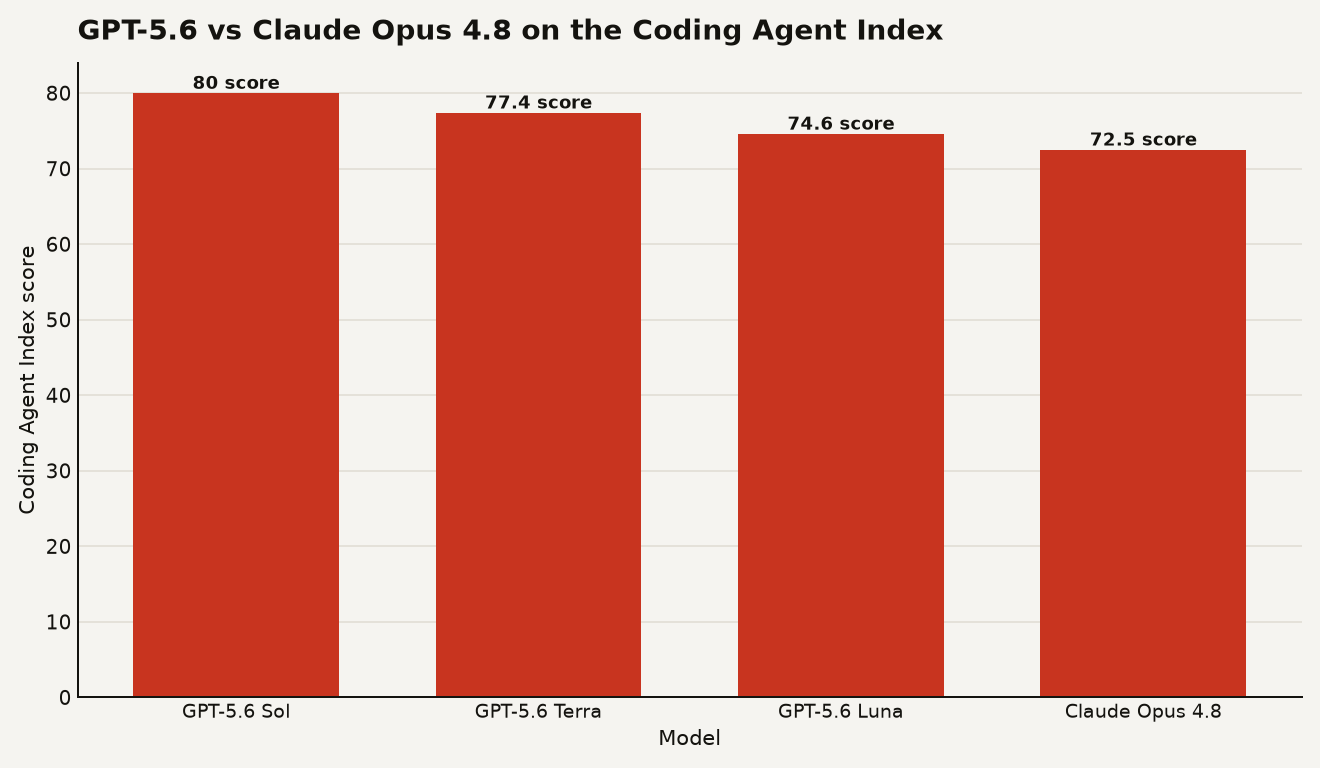
The chart above shows where each tier lands on the Coding Agent Index alongside Claude Opus 4.8. The gap between Luna and Sol is real but narrower than the price gap, which is the whole point of a tiered family.
One important detail for beginners: these models use a hidden chain-of-thought reasoning process. Kiro's documentation is explicit that you will not see the model's internal reasoning steps, only the final output. Chain-of-thought means the model works through a problem step by step internally before showing you an answer. In Kiro, that process is hidden from you. This is expected behavior and does not affect output quality, but it does mean you cannot inspect or debug the model's intermediate thinking the way you can with some other setups.
The Kiro models changelog records the price drop as a direct pass-through of OpenAI's own API pricing changes. OpenAI reduced prices for Terra and Luna, and Kiro passed those savings to customers immediately. Sol's multiplier stayed at 2.4x.
The 82 percent cost reduction claim
The headline number from the joint OpenAI and AWS announcement is that GPT-5.6 Terra completed successful tasks in Kiro at roughly 82 percent lower cost on Terminal-Bench 2.1. Terminal-Bench 2.1 is a command-line benchmark that tests how well an AI agent can navigate a terminal, run commands, and complete multi-step tasks. You should read that 82 percent figure with one important caveat.
The cost reduction measures cost, not accuracy. Unite AI's coverage of the announcement points out that the companies did not break out how much of the savings comes from Kiro's spec-driven harness versus the model's own token efficiency, and the announcement reports no accuracy delta for the Kiro configuration specifically. OpenAI's own GPT-5.6 launch evaluation puts Terra at 87.4 percent on Terminal-Bench 2.1, against 88.8 percent for Sol and 85.6 percent for the prior-generation GPT-5.5.
What this means for you as a beginner or hobbyist is that the savings are real but structural. Kiro's approach is to ground the model in requirements, design documents, and task context before it starts generating. The model arrives at working solutions in fewer iterations because it has a map. If you have ever burned through tokens in a chat box because the model kept misunderstanding what you wanted, that is the waste Kiro is designed to eliminate.
For your wallet, the practical takeaway is that a task that costs 10 credits on Kiro's Auto baseline would cost 1 credit on Luna after the price update. The Kiro models documentation lays out the full multiplier table, and the comparison is worth understanding:
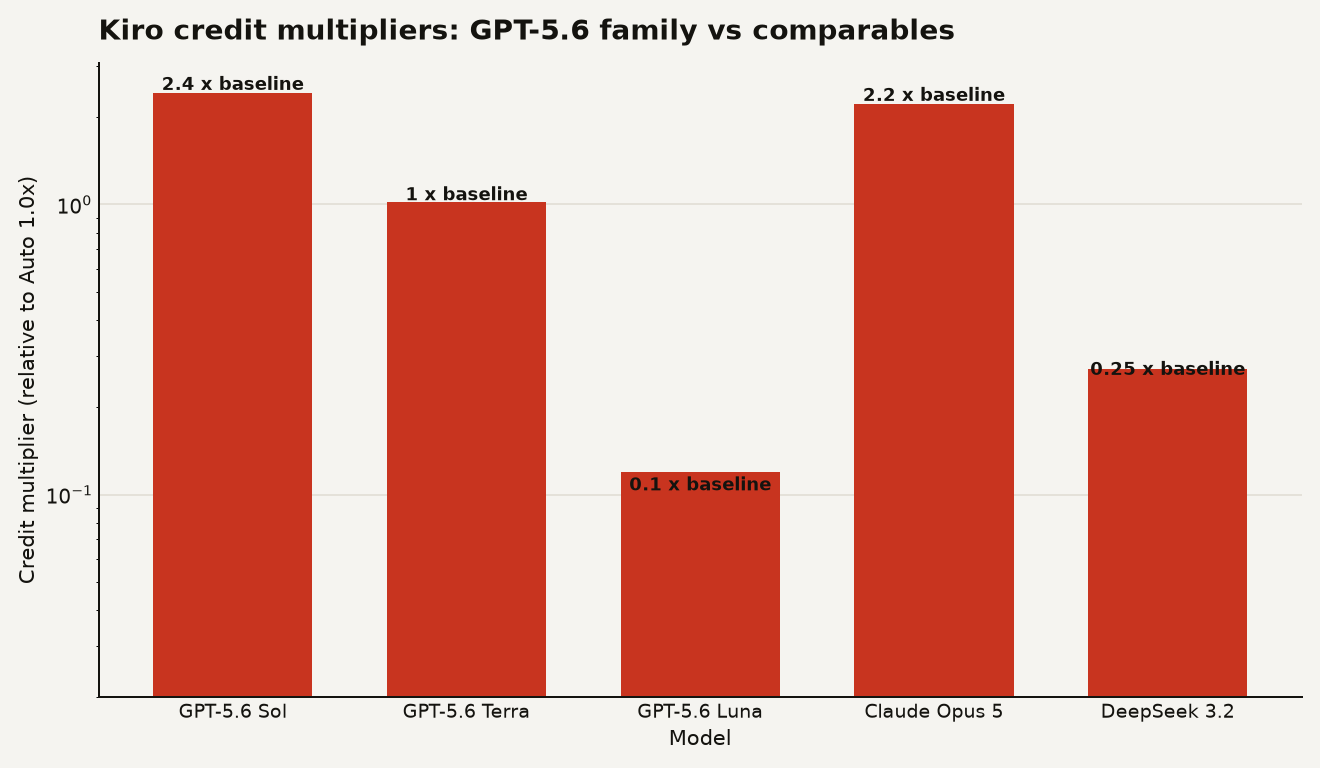
The chart above shows the post-update multipliers. Luna at 0.1x is now the cheapest frontier model option in Kiro, cheaper even than open-weight alternatives like DeepSeek 3.2 at 0.25x and Qwen3 Coder Next at 0.05x. Terra at 1.0x matches the Auto baseline, meaning you get a balanced frontier model for the same credit cost as letting Kiro pick the model for you. Sol at 2.4x is for the hardest multi-step work where accuracy matters more than throughput.
Picking between Sol, Terra and Luna
The question is not which model is best. It is which model fits the work you actually do.
Use Luna for high-frequency, lower-stakes tasks
If you are generating boilerplate, writing small utility functions, converting data formats, or running many similar small tasks in a loop, Luna's 0.1x multiplier means you can run roughly 24 Luna tasks for the credit cost of one Sol task. The Coding Agent Index score of 74.6 is still above Claude Opus 4.8, so you are not sacrificing much intelligence for the savings.
Use Terra for everyday multi-step development
At 1.0x, Terra costs the same as Kiro's Auto routing but gives you a known frontier model rather than a routing decision. If you are building a feature that spans a few files, needs some iteration, and requires reliable code generation, Terra is the sweet spot. Its 77.4 Coding Agent Index score is essentially tied with Claude Fable 5, so you are getting top-tier performance without flagship pricing.
Use Sol for the hardest work
Spec-driven implementation of a complex feature, long-horizon refactors across a large codebase, and complex terminal tasks where a mistake costs more than the tokens you saved. Sol's 2.4x multiplier is steep, but Kiro reports it uses less than half the output tokens and takes less than half the time of prior frontier runs, so the per-task cost may be lower than the multiplier suggests if it finishes in fewer steps.
There is also a fourth option: Auto, which routes each task to the optimal model automatically at a 1.0x baseline. If you do not want to think about model selection at all, Auto is a reasonable default. But with Terra now at 1.0x, you can get the same credit cost with a guaranteed frontier model rather than a routing guess.
Check your access first
First, check your access. GPT-5.6 in Kiro is rolling out with experimental support to Kiro Pro, Pro+, Pro Max, and Power customers in the AWS US-East-1 (Northern Virginia) and AWS Europe (Frankfurt) regions, with cross-region inference support. If you are on a free tier, you will not see these models yet. Free Kiro plans currently include Auto, Claude Sonnet 4.5 and 4.0, DeepSeek 3.2, MiniMax M2.5 and M2.1, GLM-5, and Qwen3 Coder Next, but not the GPT-5.6 family.
Second, restart your IDE or CLI to pull the latest model list. Web users can refresh their browser to see Sol, Terra, and Luna in the model selector.
Third, if you have been waiting for a reason to try Kiro's spec-driven approach, the Luna price drop is it. At 0.1x, you can experiment with spec-driven development at a cost that approaches free. Write a requirements document, let Kiro convert it into a technical design and task list, and let Luna execute. You will spend less learning what works than you would have a week ago.
One caveat to keep in mind: the 82 percent cost reduction figure is a vendor-run result on a specific benchmark. It is a useful directional signal, not a guarantee that your tasks will cost 82 percent less. Your actual savings depend on your codebase, your task complexity, and how well you write the requirements that ground the model.
The cheapest tier is now good enough
The story is not that OpenAI shipped three model tiers. The story is that the cheapest tier in a structured coding environment is now close enough to free that a beginner can treat spec-driven development as a learning tool rather than a budget decision. If you have been priced out of frontier coding agents, the door just opened wider than it has been all year.