You have been using ChatGPT for free to explain code, draft emails, and brainstorm ideas. Now sponsored ads are showing up below some of those answers, and you probably have questions about what changed.
If you use ChatGPT for free, sponsored ads now appear below some answers in nine countries, with no change to the answers themselves.
OpenAI started testing ads in ChatGPT on February 9, 2026, for logged-in adult users on the Free and Go subscription tiers in the United States. By August 11, 2026, the company had expanded the test to nine countries across three continents: the U.S., Canada, Australia, New Zealand, the United Kingdom, Mexico, Brazil, Japan, and South Korea. The company had previously outlined the principles guiding its approach before the test began.
A subscription tier is just a level of service you pay for or do not pay for. Free costs nothing. Go is a low-cost plan. Plus, Pro, Business, Enterprise, and Education are higher-priced tiers with more features. Ads help fund the Free and Go tiers so OpenAI can keep them available while covering the significant compute costs of running a large language model.
Sponsored placements below ChatGPT answers
ChatGPT ads are sponsored placements that appear below the end of a ChatGPT response. A sponsored placement means a company pays OpenAI to show its product or service to you. These ads are always clearly labeled as sponsored and visually separated from what OpenAI calls the organic answer, which is the answer ChatGPT generates naturally based on your question, not influenced by any advertiser.
Think of them like the sponsored results at the top of a Google search, except in this case they sit at the bottom of a conversation rather than at the top. During this test, you may see one or more ad units below a response when the system detects a relevant match to what you are discussing. A single ad unit might feature one product from one advertiser, or several items from multiple advertisers. For longer conversations, the system also considers the overall context of the chat and your experience to decide whether showing an ad makes sense.
The ads are currently limited to consumer categories. According to OpenAI's ad content policies, the initial test covers lifestyle and household goods, local services, travel and experiences, and digital products or education. The company says it may approve ads from financial services, healthcare and medicine, and legal services categories over time, but those are not part of the initial rollout. Ads also do not appear in the ChatGPT Atlas browser during this test.
Only Free and Go users see ads
Ads appear only for logged-in adult users on the Free and Go subscription tiers. If you pay for Plus, Pro, Business, Enterprise, or Education, you will never see ads in ChatGPT.
Only two of seven tiers see ads; five do not. OpenAI also says it will not show ads in accounts where the user tells the company they are under 18, or where the system predicts the user is under 18 based on available signals. The company uses both account-level age information and age prediction where available. If the system cannot confirm you are an adult, it will not show ads in your account.
Ads are also blocked from appearing near sensitive or regulated topics like health, mental health, and politics. OpenAI says it will expand responsibly as safeguards mature, but during the test period those guardrails are still relatively narrow.
The signals that pick your ad
The targeting system uses several signals to decide which ad is most relevant. According to the OpenAI Help Center, the system considers the context and intent of your current conversation, the ad's landing page and copy, advertiser-provided context hints and targeting selections, and, when personalization is enabled, select signals from your broader ChatGPT experience. Those broader signals can include past chats, memory, and how you have interacted with ads before.
If there are multiple eligible ads for a given conversation, OpenAI says it considers a combination of relevance and advertiser bids to decide which one shows first. If you turn off ad personalization, you will still see ads based on the context of your current chat thread, but the system will not use your other chat threads, ad history, or ad topics to inform what it shows you.
The privacy detail that matters most: advertisers do not get access to your chats, chat history, memories, name, email, precise location, IP address, or sensitive information. They only receive aggregate, non-identifying data about how their ads perform, such as total views or clicks. If you message an advertiser directly through an ad, that advertiser sees only the messages you send them in that direct conversation, nothing else.
OpenAI says ads cannot change answers
No. Ads run on separate systems from the chat model. Advertisers have no ability to shape, rank, or alter ChatGPT's responses. The answers ChatGPT gives you are optimized for what is most helpful, not for what benefits any advertiser.
This matters if you use ChatGPT for coding help or learning. When you ask ChatGPT to explain a Python function or debug a JavaScript error, the answer should be the same whether or not an ad appears below it. An ad is a paid placement, and seeing one does not mean OpenAI endorses or recommends the advertiser's product.
If you are weighing whether ChatGPT is still the right tool for your needs, our guide to which AI to use for tasks in 2026 compares the strengths of each major model for different jobs.
Controls for Free and Go users
OpenAI gives Free and Go users several ways to manage the ad experience:
- Dismiss any ad and tell the company why you did not want to see it
- Learn why you are seeing a particular ad
- Delete your ad data with one tap. That data is retained for up to 30 days before it is removed from OpenAI's servers
- Manage ad personalization at any time. Turning it off means ads rely only on your current chat thread, not your history
- Switch to Ads-Free mode on the Free tier, which removes ads but comes with lower usage limits and reduced feature access. You get fewer messages per day and lose access to some tools like image generation and deep research
- Upgrade to Plus or Pro for an ad-free experience without the reduced Free limits
The Ads-Free option and ad controls may only appear in regions where ads are being tested. If you are not in one of the nine active markets, you may not see these settings.
The tradeoff with Ads-Free mode is real. You lose access to tools that many free users rely on, including image generation and deep research. For someone who uses ChatGPT mainly for text answers, the reduced message limits may not matter much. For someone who uses the image tools regularly, the limits could change how they work each day.
A gradual rollout in three waves
The rollout has been gradual across three waves.
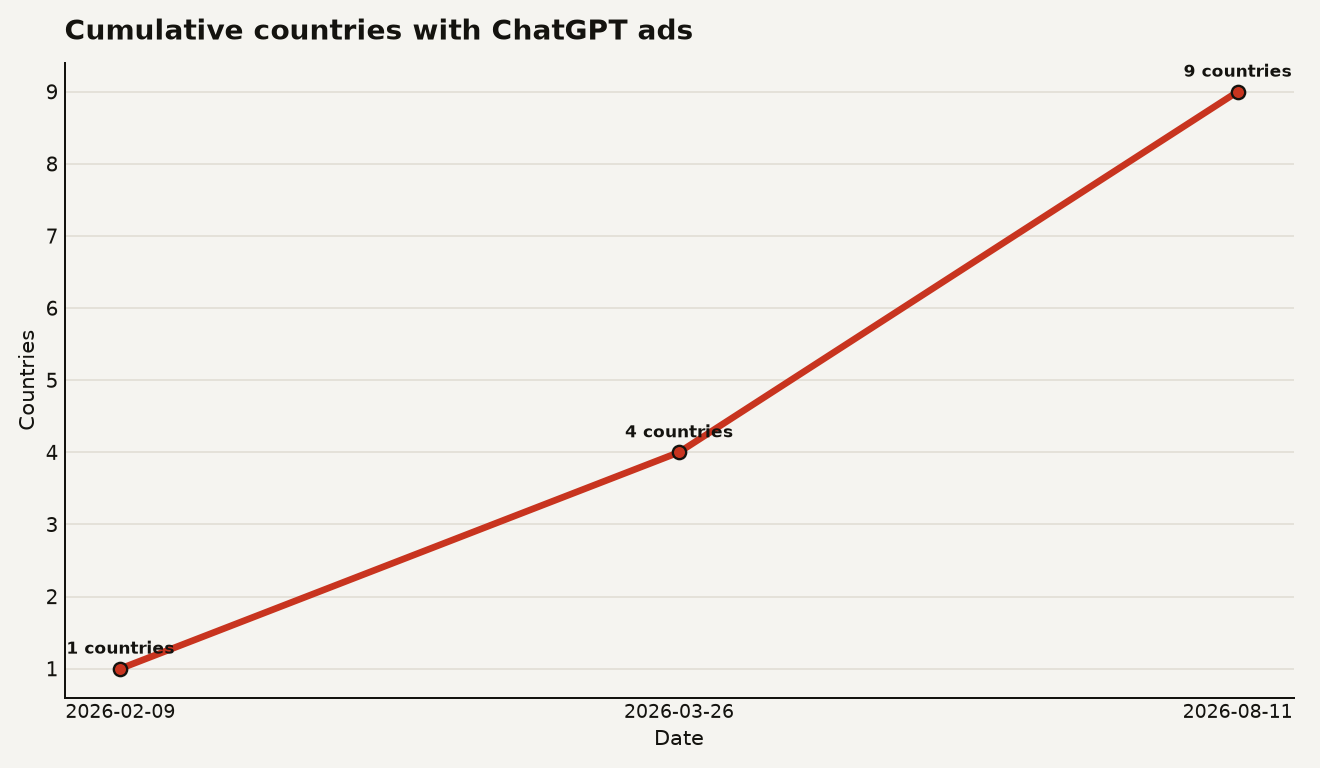
The chart above shows the cumulative country count: 1 country in February 2026, 4 by late March, and 9 by August. OpenAI says it is continuing to expand to more markets throughout 2026.
Reuters reported that the ad test is part of OpenAI's bid to boost revenue from its free and lower-priced tiers. The company frames it differently, saying ads help fund the infrastructure that keeps Free and Go tiers fast and reliable.
On March 26, 2026, OpenAI shared some early metrics. The company said it was seeing no impact on consumer trust metrics, low dismissal rates of ads, and ongoing improvements in the relevance of ads as it learned from feedback. These are self-reported figures from a company with a financial interest in the ad program, so treat them with appropriate caution. OpenAI has not published specific numbers for dismissal rates, click-through rates, or revenue.
For businesses, OpenAI is just beginning to explore how different organizations can participate in the ChatGPT experience. The company says it plans to evolve the ad program to support additional formats, objectives, and buying models over time. OpenAI also says it will continue to be deliberate about who it allows into the advertiser program, with guardrails to reduce the risk of scams and misleading ads. The company has said it will prevent narrow ad targeting, though it has not defined exactly what narrow means in practice. Interested businesses can sign up for updates at openai.com/advertisers.
What this means for you
If you are on the Free tier, ads are now part of the ChatGPT experience in nine countries and growing. Your three options are straightforward: accept the ads, switch to Ads-Free mode with tighter usage limits, or upgrade to a paid tier. The ads will not change your answers, and your chat content stays private from advertisers. The free lunch now comes with a side of sponsored content.
The open question is whether ad-supported AI becomes the default for consumer-facing tools. If OpenAI can make this work at scale, expect other AI companies to follow the same path. The chat interface, which once felt like a clean room for thinking, is becoming a media surface. Whether that erodes trust or simply normalizes AI products is the question nobody can answer from a pilot. What you can do now is decide which tradeoff works for you.