AutoJack is the kind of AI security bug that should make you check your localhost assumptions before lunch. Microsoft disclosed the AutoJack chain on June 18, 2026, after researchers found that a single malicious web page could steer a browsing agent into reaching AutoGen Studio's local MCP WebSocket and launching a host command through the developer's own account in affected development code.
The key number is three: AutoJack chained three ordinary looking weaknesses, localhost trust, missing authentication, and attacker supplied command parameters, into code execution on the machine running the agent.
AutoGen Studio matters because it sits where builders experiment. The AutoGen repository describes AutoGen as a framework for multi-agent AI applications, and its README shows AutoGen Studio as the no-code GUI for prototyping workflows. The same README also warns that AutoGen Studio is meant for rapid prototyping and is not a production-ready app, which is the polite version of: please do not put your daily driver laptop, browser agent, shell tools, and real credentials in the same blast radius.
This specific chain was narrower than the headline could imply. Microsoft said the affected AutoGen Studio code was remediated before any PyPI release, and the exposure was limited to developers who built from the GitHub main branch during the window between the MCP plugin landing and the hardening commit. That lowers the immediate patch fire. It does not lower the design warning.
If your team is prototyping browser-capable agents, AutoJack is a defensive playbook moment. Treat every local agent control plane like a remote API once an agent can read untrusted web content.
AutoJack runs through AutoGen Studio's MCP
Microsoft's research described AutoJack as a chain through AutoGen Studio's MCP WebSocket, where a browsing agent visiting attacker-controlled content could be manipulated into opening a WebSocket connection to a local endpoint and passing parameters that ended in process launch. In the proof of concept, Microsoft demonstrated the impact by launching Windows Calculator, a standard harmless stand-in for arbitrary command execution.
The interesting part is how small each individual mistake looks. The BleepingComputer report, which summarized Microsoft's disclosure on June 22, 2026, lists three separate weaknesses behind AutoJack: the MCP WebSocket trusted localhost, the /api/mcp/* route was excluded from normal authentication middleware, and a base64 encoded server_params value from the URL was passed into process launching code.
That is the whole pattern in one paragraph: browser-reachable agent, localhost control plane, no auth on a sensitive route, and URL supplied process parameters. No magic model behavior required. The agent only had to be useful enough to browse.
Here is the operational shape of the issue: one malicious page could trigger the chain, three weaknesses had to align, zero stable PyPI releases were affected according to Microsoft, and one hardening commit is the remediation marker operators should know.
Microsoft's fix landed in GitHub commit b047730, which is titled as a hardening change for the MCP WebSocket endpoint as part of a broader AutoGen Studio update. PyPI's release history shows autogenstudio stable version 0.4.2.2 was released on May 27, 2025, while the visible pre-release line includes 0.4.3.dev1 on July 14, 2025 and 0.4.3.dev2 on July 23, 2025.
Those dates matter because many teams treat development branches and pre-release packages as disposable in prototype environments. They are disposable until the environment has a real browser profile, cloud credentials, source checkouts, SSH keys, API tokens, and a Slack session open in the same user account. Then the prototype has production consequences wearing a hoodie.
Stable PyPI was spared, prototypes were not
The stable package detail is good news, but it is the least interesting lesson. The PyPI project page recommends installing AutoGen Studio from PyPI unless you plan to modify source, and Microsoft says the affected code never shipped in a published stable package. If all you did was install the stable package, this specific path should not be your emergency.
Your bigger exposure is architectural. Agent tooling often starts local because local is easy. A FastAPI server on port 8080, a browser automation service, a shell-capable MCP server, a few environment variables, a database token, maybe a mounted repo. The old assumption was that loopback services were safer because they listened on localhost. AutoJack shows how that assumption collapses once the browser is controlled by an agent reading hostile content.
This is the same class of mistake Data Today covered in the AI build room supply chain problem: the riskiest moment often happens before production, inside developer workflows where secrets, package managers, automation, and trust shortcuts sit close together. Agent labs make that proximity worse because tool calling turns text into action.
AutoGen's public footprint also explains why the story traveled fast. GitHub showed the Microsoft AutoGen repository with 59.2k stars and 8.9k forks when checked for this guide, which means security lessons from this project are not niche hobby-room lessons.
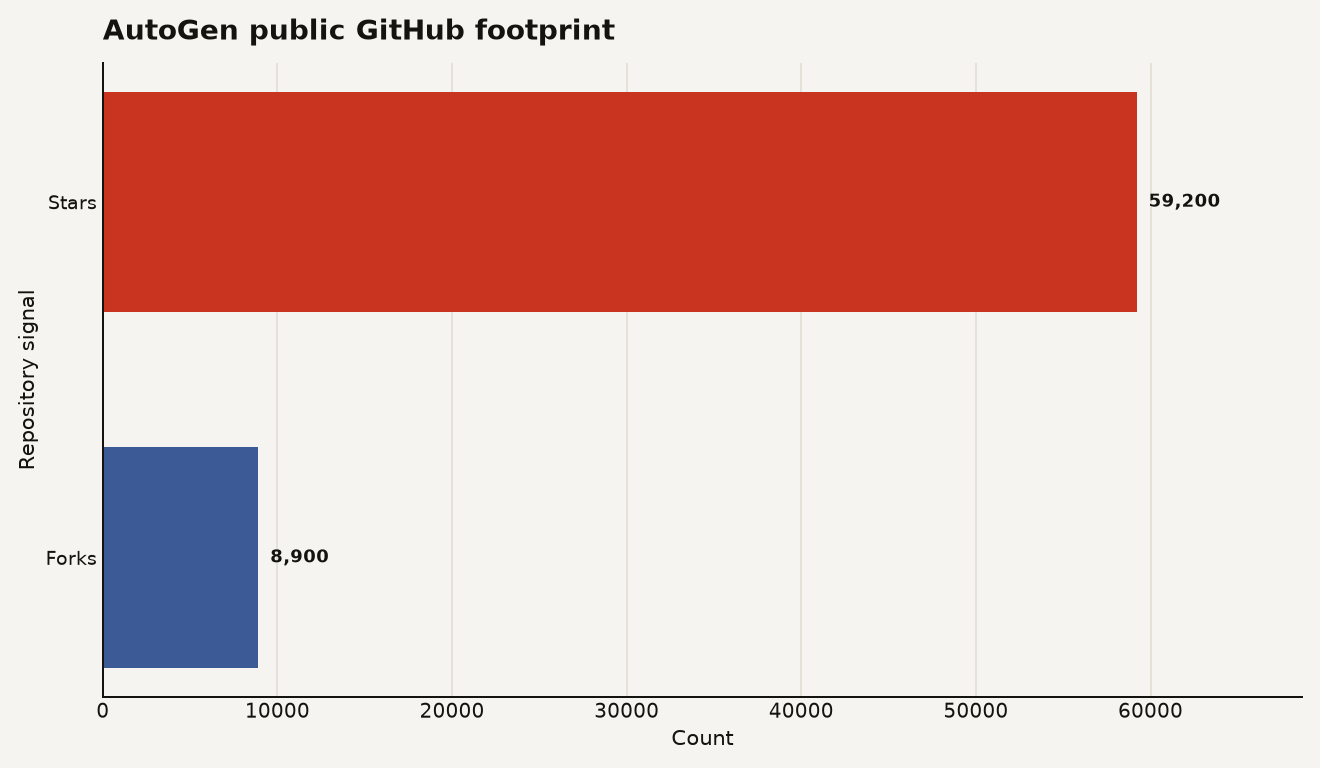
A large open-source footprint does not mean a flaw is being exploited. It means a design pattern will be copied, remixed, forked, embedded, and half remembered. That is how prototype assumptions spread.
The operator impact lands in four places:
- Developer workstations: If an agent can browse the web and trigger local tools, run it under a low-privilege account without access to your normal browser profile, SSH agent, cloud CLI cache, or password manager.
- MCP servers: Treat MCP endpoints as privileged APIs. Require authentication, bind tool parameters server side, and deny process launch from user controlled query strings.
- CI and preview environments: Block agent demos from running with repo write tokens, deployment tokens, or production data access. A demo bot with a deploy key is a future incident report.
- Detection: Log WebSocket connections to local agent control planes, tool invocations, process creation by agent runtimes, and browser automation reaching non-corporate domains.
OWASP's 2025 LLM Top 10 calls this family of risk LLM06: Excessive Agency, where an LLM extension or agent has permissions that exceed the application's intended operation. AutoJack is a clean example because the dangerous action came from the allowed tool surface, not from memory corruption or a browser exploit.
Start with an inventory of agent prototypes
Start with inventory, because most teams do not have a clean list of agent prototypes. Ask for running processes, open ports, and packages, not just architecture diagrams. If someone says, "it is only on localhost," keep asking.
First, find AutoGen Studio instances. Search developer machines, shared GPU boxes, Codespaces, lab VMs, and internal demo hosts for autogenstudio, autogenstudio ui, port 8080, and local MCP endpoints. The AutoGen README shows AutoGen Studio commonly run with autogenstudio ui --port 8080, so that is a practical starting point.
Second, confirm install paths. Stable PyPI users appear outside this specific affected path, but source builds from the GitHub main branch during the vulnerable window deserve review. If your team built AutoGen Studio from source, compare the checkout with commit b047730 and move to a hardened revision.
Third, isolate before you celebrate. Microsoft's guidance says to deploy AutoGen Studio strictly as a developer prototype in an isolated environment and to avoid running it with an agent capable of browsing or executing arbitrary code on a machine exposed to untrusted content. In practical terms, that means a container, VM, or throwaway user profile with no durable personal credentials and no production cloud role.
Fourth, harden MCP usage beyond AutoGen. For every MCP server or tool bridge in your agent stack, record these five facts:
- Does the endpoint require authentication on every route, including WebSocket routes?
- Does it enforce origin checks that survive browser automation and localhost quirks?
- Are executable names and arguments chosen server side from an allowlist?
- Does the agent run as a low-privilege identity with a separate home directory?
- Are tool calls logged with raw parameters, calling agent identity, and process IDs?
Fifth, add a regression test. A useful test does not need a weaponized payload. Build a local page that tries to make your browsing agent connect to 127.0.0.1 and request a harmless tool call. The expected result should be boring: authentication failure, blocked origin, denied tool, or no route. If your agent runtime launches anything, you found work.
This is where security teams should be stubborn. A prompt-injection filter will not save a local control plane that accepts unauthenticated command parameters. A model policy will not save a shell tool running under your normal user. The durable control is boring infrastructure security: auth, least privilege, allowlists, network boundaries, and logs.
A disposable agent environment
A safer setup starts by making the agent environment disposable. Use a separate Unix user, Windows account, dev container, or VM. Do not mount your real home directory. Do not share your browser profile. Do not pass through your normal SSH agent. Give the agent a working directory with test data, not a copy of your whole monorepo unless the task truly requires it.
Then split browsing from execution. A browser agent that visits arbitrary pages should not share a trust zone with a shell tool. If the workflow needs both, put a policy gate between them. Require explicit, inspectable approval for command execution, and show the actual command and arguments, not the agent's friendly summary. The human should approve the syscall-shaped thing, not the bedtime story.
For MCP servers, prefer server-side session identifiers over client supplied command descriptors. Microsoft's hardening commit is valuable because it points at the right direction: move sensitive binding server side and route MCP traffic through normal authentication paths. If a URL parameter can name powershell, bash, curl, or npx, your design has already lost the argument.
For business owners, the roadmap change is simple. Treat agent demos as security scoped products once they can browse, read files, call APIs, or execute code. That means ownership, update cadence, dependency tracking, and decommissioning. The cheapest agent risk reduction is deleting forgotten demos that still have tokens.
For platform teams, create a paved road:
- A standard agent sandbox image with no persistent secrets.
- A brokered MCP gateway with authentication, per-tool policy, and audit logs.
- A default egress policy that blocks local control plane access from browser automation unless explicitly allowed.
- A preflight checklist before any agent prototype gets access to internal systems.
None of that blocks experimentation. It keeps experimentation from inheriting the privileges of the most overpowered developer account in the room.
Keep the agent small enough to distrust
AutoJack was constrained in distribution, but sharp in lesson. The dangerous boundary was not the model. The dangerous boundary was the place where a helpful browsing loop met a trusted local service that could launch commands.
That boundary now exists in a lot of prototypes.
If an agent can read the internet and touch your tools, build as if the internet can touch your tools too. The teams that learn that while still in the lab will ship faster later, mostly because they will spend less time explaining why a demo box had production keys.
Sources
- Microsoft Security Blog: AutoJack: How a single page can RCE the host running your AI agent
- GitHub: microsoft/autogen repository
- GitHub: microsoft/autogen commit b047730
- PyPI: autogenstudio project release history
- BleepingComputer: Microsoft fixes AutoGen Studio flaw that enabled code execution
- OWASP: LLM06:2025 Excessive Agency