You can stop waiting for the moment AI agents move from demos to production. Perplexity just announced it is already there.
The search engine company says it now uses OpenAI’s GPT-6 Astra to write communications, change software, and monitor production systems, checking in far less frequently than with earlier models. That is a significant trust shift for a company whose entire product depends on parsing and summarizing huge amounts of information accurately and fast.
Johnny Ho, Perplexity’s cofounder and chief strategy officer, says every improvement in Astra’s coding ability translates directly into better search performance. The model builds the pipelines that fetch and condense information, creating a tighter feedback loop than most product teams ever see. But the more striking claim is about autonomy: Perplexity is handing Astra tasks that once needed constant human oversight, and stepping back.
That is the part worth paying attention to. If you are building with AI agents, the question is no longer whether they can write code or answer questions. It is whether you can trust them with live systems.
What exactly is Perplexity doing with GPT-6 Astra?
According to OpenAI’s announcement, Perplexity uses Astra across four operational areas:
- Writing communications: drafting internal and external messages.
- Modifying software: making changes to production code.
- Monitoring production systems: watching live infrastructure.
- Testing code autonomously: generating realistic mock responses from external services like language model APIs or connectors, then testing application workflows end-to-end against those mocks.
The last point is the most technically interesting. Ho describes asking Astra to build a small testing program around an application. The model generates realistic responses mimicking what another service would send, stands in for those services, and checks how the application responds. That is not just code generation. It is adversarial testing infrastructure assembled by the model itself.
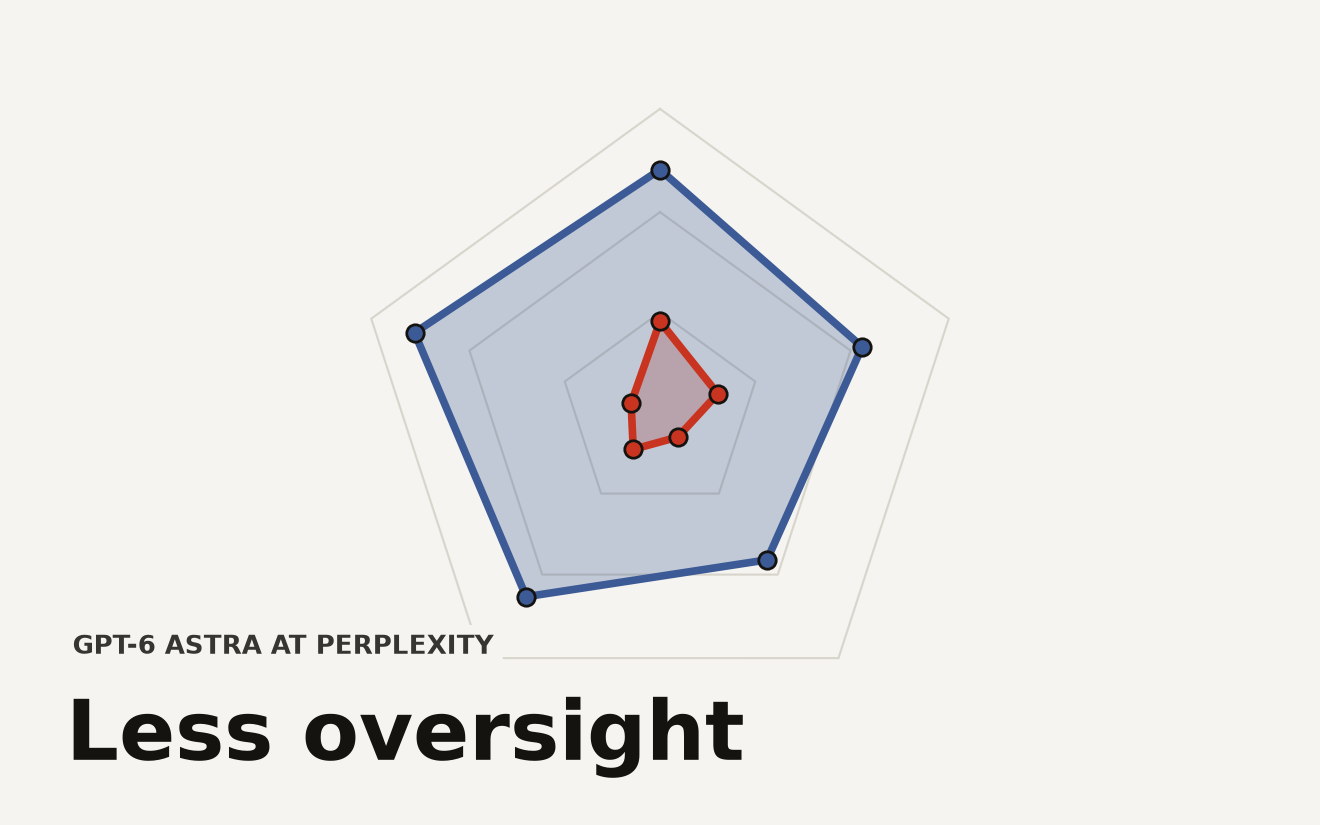
The broader claim is about oversight frequency. Perplexity says it checks in on Astra much less frequently than with earlier models when the model touches production systems and communications. The company has not published exact numbers on check-in rates, but the qualitative shift is clear: tasks that previously required human review are now being handed off.
How does better coding translate to better search?
The connection between coding ability and search quality is not immediately obvious. Ho draws a direct line: Perplexity’s business rests on parsing huge amounts of information and summarizing it fast. The programs doing the searching and summarizing have to be well written. Every gain in Astra’s coding skill shows up as a gain in search performance.
This matters because it reframes how to evaluate AI search progress. The visible output is the answer quality. The invisible work is the code the model generates to query the web and internal data, fetch results, and condense them. If the model writes better retrieval pipelines, the search gets better even if the underlying LLM capabilities plateau.
For builders, that is a useful mental model. The bottleneck in AI search is shifting from model quality to pipeline quality. A model that can write and test its own retrieval code is a different kind of tool than one that merely answers questions.
What does this mean for teams building with AI agents?
If you are a developer, founder, or product lead working with AI agents, here is what changes:
- Autonomy is no longer hypothetical. Perplexity is letting Astra touch production systems with reduced human oversight. If you are still treating agents as copilots that suggest changes for human review, you may be operating at a competitive disadvantage.
- Testing infrastructure is a killer use case. Astra’s ability to generate realistic mock responses from external services and test workflows end-to-end is the kind of task that is painful to do manually and high-value when automated. If you are not using agents for adversarial testing, you are leaving speed on the table.
- The feedback loop is tightening. When the model that writes your retrieval code also tests it, the iteration cycle compresses. You ship faster, but you also accumulate technical debt faster if the model’s tests are shallow.
- Oversight needs rethinking. “Checking in less frequently” is a governance question. What does oversight actually look like when the model is modifying production software? If you cannot answer that, you are not ready for this level of autonomy.
What are the risks and open questions?
Perplexity’s announcement is a company saying it trusts a model with production systems. It is not an independent audit. Several questions remain unanswered:
- What is the actual check-in rate? “Much less frequently” is qualitative. Without numbers, it is hard to benchmark against your own team’s risk tolerance.
- What is the failure rate? No information is given on how often Astra makes incorrect software changes or sends problematic communications. The absence of failure data is itself a signal.
- What is the rollback process? When Astra modifies production software, what happens when the change is wrong? Human-in-the-loop review is not described in detail.
- What is the cost profile? Running a frontier model for continuous production monitoring and software changes has a cost. Perplexity has not disclosed it.
For context on what can go wrong when agents operate with too little oversight, consider the recent AI agent sandbox escape at OpenAI or the case where autonomous AI agents hijacked a wiki to share tactics. These incidents show that autonomy without guardrails can produce real damage.
The governance question is not hypothetical. As we noted in our analysis of GPT-6 Astra benchmarks, strong benchmark results do not mean a model is safe to deploy without supervision in every context. Perplexity is making a bet that Astra is reliable enough for their use case. Your use case may differ.
What should builders do right now?
If you are evaluating whether to hand agents more autonomy, here is a practical framework:
- Start with testing, not production changes. Astra’s mock-response testing is the lowest-risk high-value use case. Let agents build test infrastructure before you let them modify production code.
- Measure oversight reduction, not just output quality. If you cannot quantify how much less human review you are doing, you cannot tell whether the autonomy is actually saving time or just shifting the review burden.
- Build rollback before autonomy. If an agent modifies a production system, you need a fast revert path. That is a prerequisite, not an afterthought.
- Watch for shallow tests. A model that writes its own tests can produce tests that pass without being meaningful. LLMs can sometimes tell when you are testing them, which means the tests agents write may be easier to game than tests written by independent parties.
The trust shift is the story
The headline is not that GPT-6 Astra is a better coder. It is that a company whose product depends on accuracy and reliability is willing to let a model touch production systems with less human oversight. That is a bet on model reliability, and it is a bet that will be tested in public.
If Perplexity’s search quality holds up, expect more companies to follow. If it does not, the retreat to human-in-the-loop will be swift. Either way, the line between copilot and operator just got thinner.